
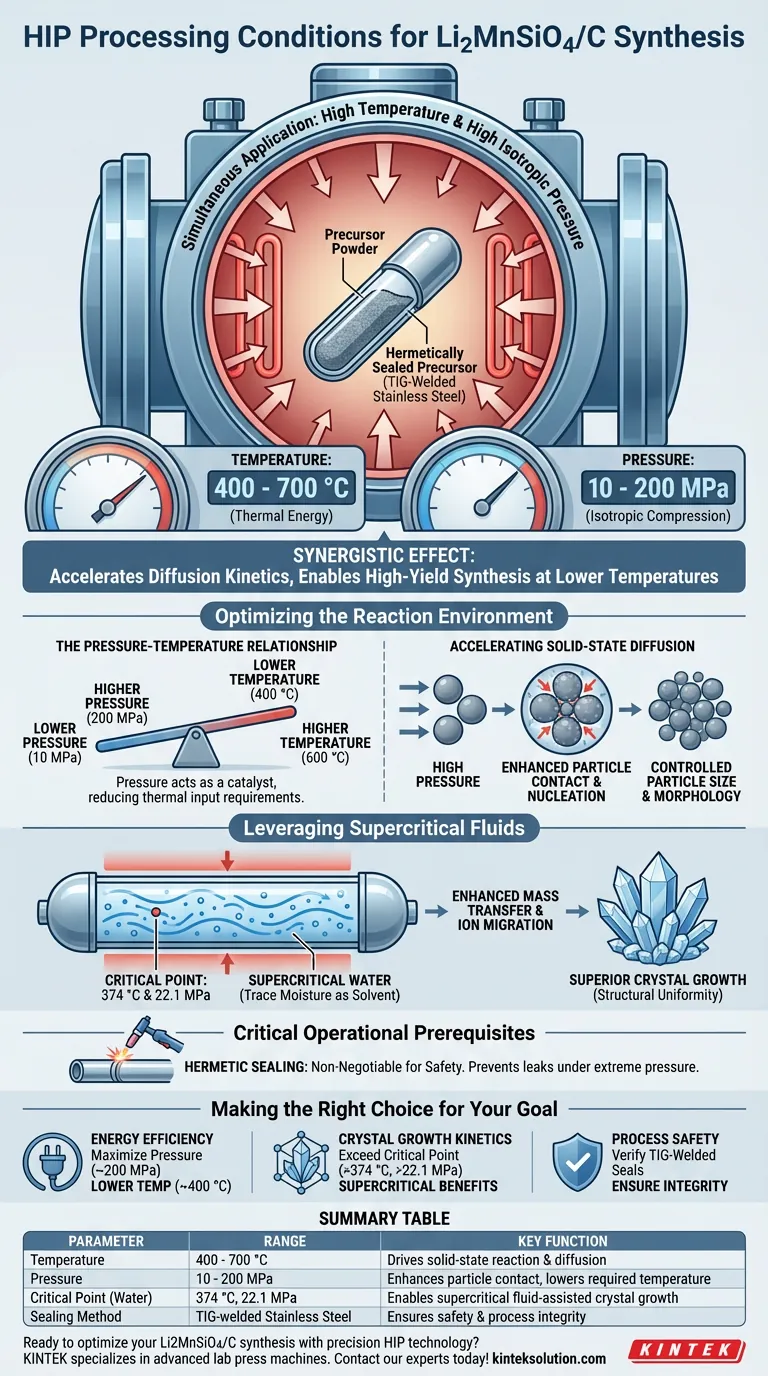
Hot Isostatic Pressing (HIP) systems primarily facilitate synthesis through the simultaneous application of high temperatures ranging from 400 to 700 °C and high isotropic pressures between 10 and 200 MPa. This dual-action environment drives the solid-state reaction required to form Li2MnSiO4/C composites.
The defining advantage of HIP is the synergistic effect of heat and pressure, which accelerates diffusion kinetics to enable high-yield material synthesis at significantly lower temperatures than conventional methods.
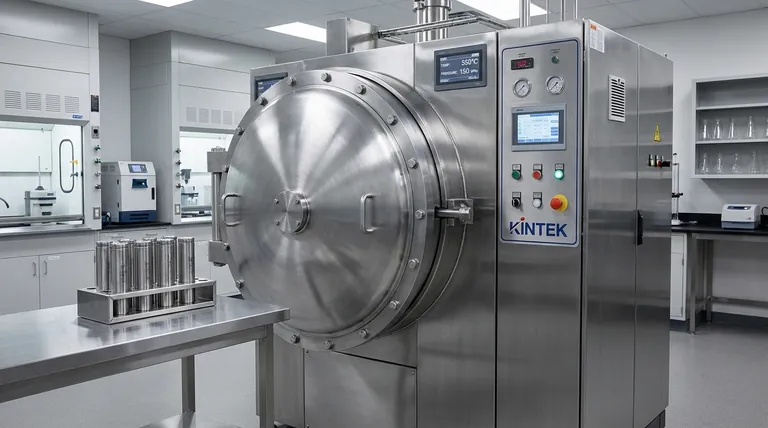
Optimizing the Reaction Environment
To synthesize high-quality Li2MnSiO4/C, you must manage two critical variables: thermal energy and physical compression. Understanding the relationship between these two allows you to tailor the process for efficiency and crystal quality.
The Pressure-Temperature Relationship
Pressure acts as a catalyst for reaction efficiency, allowing you to reduce thermal input.
Data indicates that increasing system pressure significantly lowers the required synthesis temperature.
For example, successful synthesis can be achieved at 400 °C when applied under 200 MPa of pressure.
However, if the pressure is reduced to 10 MPa, the required temperature must rise to 600 °C to achieve similar results.
Accelerating Solid-State Diffusion
The core mechanism behind HIP is the acceleration of diffusion kinetics.
High isotropic pressure enhances the physical contact between reactant particles.
This pressure induces stress concentration at particle contact points, which promotes the nucleation of the new phase.
The result is effective control over the final product's particle size and morphology.
Leveraging Supercritical Fluids
Beyond standard solid-state reactions, HIP systems can unlock advanced growth mechanisms if trace moisture is present in the precursor.
Reaching the Critical Point
HIP processing conditions naturally exceed the critical point of water (374 °C and 22.1 MPa).
When the sealed precursor contains trace water, the system transforms this moisture into a supercritical fluid.
Supercritical Water-Assisted Growth
In this state, water acts as a highly effective solvent and mass transfer medium.
It accelerates the migration of reactant ions within the sealed environment.
This mechanism significantly promotes the growth of Li2MnSiO4 crystals, resulting in superior structural uniformity.
Critical Operational Prerequisites
While HIP offers distinct advantages, it requires strict adherence to sample preparation protocols to ensure safety and success.
The Necessity of Hermetic Sealing
The precursor powder cannot be exposed directly to the HIP environment; it must be encapsulated.
Stainless steel tubes are typically used to contain the powder.
These tubes must be hermetically sealed, often using Tungsten Inert Gas (TIG) welding.
A secure seal is non-negotiable to prevent leaks or ruptures under the extreme external pressures of the chamber.
Making the Right Choice for Your Goal
The specific settings you choose within the HIP range should depend on your primary material objective.
- If your primary focus is Energy Efficiency: Maximize pressure toward 200 MPa to lower the required synthesis temperature to roughly 400 °C.
- If your primary focus is Crystal Growth Kinetics: Ensure processing conditions exceed 374 °C and 22.1 MPa to utilize the mass transfer benefits of supercritical water.
- If your primary focus is Process Safety: Verify the integrity of TIG-welded seals before subjecting samples to the high-pressure environment.
By balancing pressure and temperature, HIP transforms the synthesis of Li2MnSiO4 from a high-heat challenge into a controlled, high-yield process.
Summary Table:
| Parameter | Range | Key Function |
|---|---|---|
| Temperature | 400 - 700 °C | Drives solid-state reaction and diffusion |
| Pressure | 10 - 200 MPa | Enhances particle contact, lowers required temperature |
| Critical Point (Water) | 374 °C, 22.1 MPa | Enables supercritical fluid-assisted crystal growth |
| Sealing Method | TIG-welded stainless steel | Ensures safety and process integrity |
Ready to optimize your Li2MnSiO4/C synthesis with precision HIP technology? KINTEK specializes in advanced lab press machines, including isostatic presses and heated lab press systems, designed to deliver the exact pressure and temperature control your laboratory needs for high-yield material synthesis. Contact our experts today to discuss how our HIP solutions can enhance your research efficiency and material quality!
Visual Guide
Related Products
- Warm Isostatic Press for Solid State Battery Research Warm Isostatic Press
- Electric Lab Cold Isostatic Press CIP Machine
- Lab Isostatic Pressing Molds for Isostatic Molding
- Automatic Lab Cold Isostatic Pressing CIP Machine
- Automatic High Temperature Heated Hydraulic Press Machine with Heated Plates for Lab
People Also Ask
- Why must composite cathodes be sealed in vacuum lamination bags for WIP? Ensure Battery Stability and Density
- What is the function of elastic molds in warm isostatic pressing? Achieve Uniform Density in Composite Particles
- How do sacrificial volume materials (SVM) maintain microchannels in isostatic pressing? Ensure Structural Integrity
- What are the advantages of using a Warm Isostatic Press (WIP) for batteries? Achieve Superior Interface Contact
- What is the significance of temperature control in Warm Isostatic Pressing? Unlock Uniform Densification and Process Stability



















