Knowledge What are the main advantages of using a hot press system, specifically Spark Plasma Sintering (SPS), for material synthesis compared to conventional furnace-based solid-state reaction methods? Achieve Superior Material Performance in Minutes
Author avatar

Tech Team · Kintek Press

Updated 3 days ago

What are the main advantages of using a hot press system, specifically Spark Plasma Sintering (SPS), for material synthesis compared to conventional furnace-based solid-state reaction methods? Achieve Superior Material Performance in Minutes


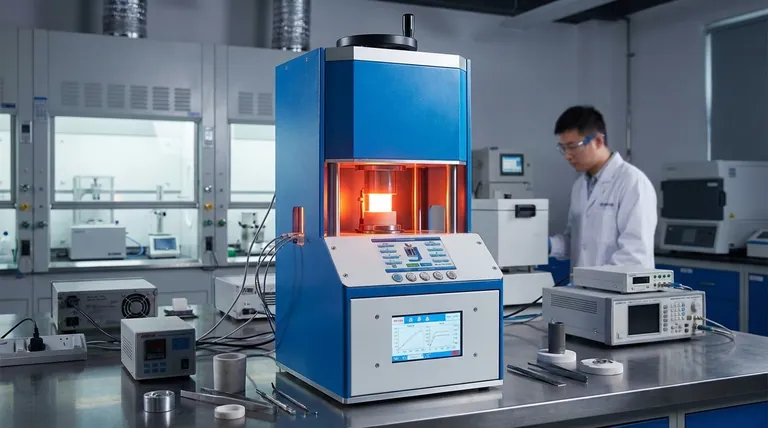
Spark Plasma Sintering (SPS) offers a transformative advantage over conventional furnace-based methods by integrating direct Joule heating with simultaneous mechanical pressure. This approach enables material synthesis to be completed in minutes rather than hours, fundamentally altering the microstructure to achieve superior density and performance.

The core value of SPS lies in its ability to decouple densification from grain growth. By utilizing rapid thermal cycles and pressure, it produces materials with high relative density and uniform, fine-grained microstructures that are unattainable through standard solid-state reactions.
What are the main advantages of using a hot press system, specifically Spark Plasma Sintering (SPS), for material synthesis compared to conventional furnace-based solid-state reaction methods? Achieve Superior Material Performance in Minutes

The Mechanics of Rapid Synthesis

Direct Joule Heating

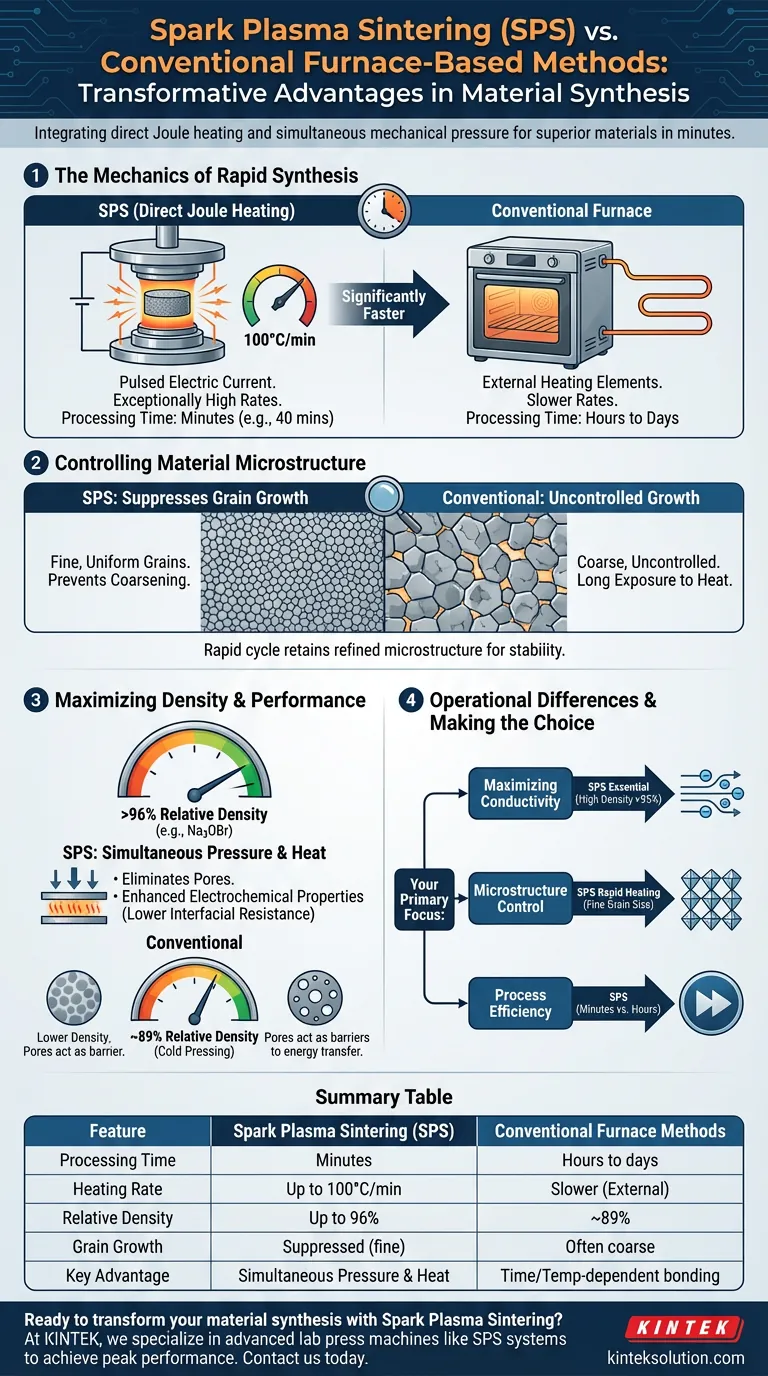
Unlike conventional furnaces that rely on external heating elements, SPS utilizes direct Joule heating via pulsed electric current.

This allows for exceptionally high heating rates, often reaching 100°C/min.

Drastic Reduction in Processing Time

The combination of rapid heating and direct energy transfer significantly shortens the synthesis cycle.

While traditional methods may require many hours to complete a reaction, SPS can finish the entire process in a matter of minutes, such as 40 minutes.

Controlling Material Microstructure

Suppressing Grain Growth

In conventional sintering, long exposure to high heat often causes grains to merge and grow effectively uncontrolled.

The rapid sintering cycle of SPS effectively suppresses grain growth, preventing the material's microstructure from becoming coarse.

Achieving Uniformity

Because the process is so fast, the final product retains a refined microstructure.

This results in significantly smaller and more uniformly distributed grains, which is often the critical factor in improving a material's physical and mechanical stability.

Maximizing Density and Performance

Simultaneous Pressure and Heat

SPS applies mechanical pressure at the exact same time as thermal energy.

This dual action effectively eliminates pores between particles that would otherwise remain in a standard solid-state reaction.

Superior Relative Density

The impact on density is measurable and significant.

For example, in electrolytes like Na3OBr, SPS can achieve a relative density as high as 96%, compared to just 89% achieved through conventional cold pressing and sintering.

Enhanced Electrochemical Properties

High density is not just a structural metric; it dictates performance.

Superior densification leads to a substantial reduction in interfacial resistance, which directly improves the total ionic conductivity of the material.

Understanding the Operational Differences

The Limitation of Conventional Methods

Standard furnace heating relies on time and temperature to bond particles.

Without the simultaneous application of pressure and rapid heating, these methods frequently struggle to remove internal porosity, resulting in lower density products.

The Density-Conductivity Link

When using conventional methods, the presence of voids or pores acts as a barrier to energy transfer.

SPS overcomes this by physically forcing particle contact, ensuring that the theoretical limits of the material's conductivity are more closely realized.

Making the Right Choice for Your Goal

To determine if SPS is the required solution for your specific application, consider your primary performance metrics:

  • If your primary focus is maximizing conductivity: SPS is essential for achieving the high relative density (e.g., >95%) required to minimize interfacial resistance.
  • If your primary focus is microstructure control: The rapid heating rate of SPS allows you to consolidate materials without sacrificing fine grain size to thermal growth.
  • If your primary focus is process efficiency: SPS reduces synthesis timelines from hours to minutes, offering a significantly faster production cycle.

By selecting Spark Plasma Sintering, you are prioritizing the integrity of the material's internal structure to achieve peak physical and electrochemical performance.

Summary Table:

Feature Spark Plasma Sintering (SPS) Conventional Furnace Methods
Processing Time Minutes (e.g., 40 minutes) Hours to days
Heating Rate Up to 100°C/min (direct Joule heating) Slower (external heating)
Relative Density Up to 96% (e.g., Na3OBr) ~89% (cold pressing/sintering)
Grain Growth Suppressed (fine, uniform grains) Often coarse and uncontrolled
Key Advantage Simultaneous pressure & heat for peak performance Time/temperature-dependent bonding

Ready to transform your material synthesis with Spark Plasma Sintering?

At KINTEK, we specialize in advanced lab press machines, including automatic lab presses, isostatic presses, and heated lab presses like SPS systems. Our solutions are designed to help you achieve superior material density, precise microstructure control, and faster production cycles—ensuring peak performance for your laboratory needs.

Contact us today to discuss how our SPS technology can elevate your research and development. Let’s build the future of materials, together.

Get in touch with our experts now!

Visual Guide
What are the main advantages of using a hot press system, specifically Spark Plasma Sintering (SPS), for material synthesis compared to conventional furnace-based solid-state reaction methods? Achieve Superior Material Performance in Minutes Visual Guide

Related Products

People Also Ask

Related Products

Automatic High Temperature Heated Hydraulic Press Machine with Heated Plates for Lab

Automatic High Temperature Heated Hydraulic Press Machine with Heated Plates for Lab

KINTEK High Temperature Hot Press: Precision sintering & material processing for labs. Achieve extreme temperatures & consistent results. Custom solutions available.

Laboratory Split Manual Heated Hydraulic Press Machine with Hot Plates

Laboratory Split Manual Heated Hydraulic Press Machine with Hot Plates

Boost lab efficiency with KINTEK's heated lab presses—precise temperature control, durable design, and rapid cooling for consistent results. Explore now!

Heated Hydraulic Press Machine with Heated Plates for Vacuum Box Laboratory Hot Press

Heated Hydraulic Press Machine with Heated Plates for Vacuum Box Laboratory Hot Press

KINTEK Heated Hydraulic Lab Press with Vacuum Box ensures precise sample preparation. Compact, durable, and featuring digital pressure control for superior results.

Laboratory Manual Heated Hydraulic Press Machine with Hot Plates

Laboratory Manual Heated Hydraulic Press Machine with Hot Plates

KINTEK's Manual Hot Press delivers precise material processing with controlled heat and pressure. Ideal for labs needing reliable bonds and high-quality samples. Contact us today!

Manual Laboratory Hydraulic Pellet Press Lab Hydraulic Press

Manual Laboratory Hydraulic Pellet Press Lab Hydraulic Press

Boost lab efficiency with KINTEK's precision hydraulic presses—compact, leak-proof, and ideal for spectroscopy. Custom solutions available.

Laboratory Hydraulic Press Lab Pellet Press Button Battery Press

Laboratory Hydraulic Press Lab Pellet Press Button Battery Press

KINTEK Lab Press Machines: Precision hydraulic presses for material research, pharmacy, and electronics. Compact, durable, and low maintenance. Get expert advice today!

Cylindrical Lab Electric Heating Press Mold for Laboratory Use

Cylindrical Lab Electric Heating Press Mold for Laboratory Use

KINTEK's Cylindrical Electric Heating Press Mold offers rapid heating (up to 500°C), precise control, and customizable sizes for lab sample preparation. Ideal for battery, ceramic, and material research.

Laboratory Hydraulic Press Lab Pellet Press Machine for Glove Box

Laboratory Hydraulic Press Lab Pellet Press Machine for Glove Box

Precision lab press for glove boxes: Compact, leak-proof design with digital pressure control. Ideal for inert atmosphere material processing. Explore now!

Automatic Laboratory Hydraulic Press for XRF and KBR Pellet Pressing

Automatic Laboratory Hydraulic Press for XRF and KBR Pellet Pressing

KinTek XRF Pellet Press: Automated sample prep for precise XRF/IR analysis. High-quality pellets, programmable pressure, durable design. Boost lab efficiency today!

Lab Isostatic Pressing Molds for Isostatic Molding

Lab Isostatic Pressing Molds for Isostatic Molding

High-quality isostatic pressing molds for lab presses - achieve uniform density, precision components, and advanced material research. Explore KINTEK's solutions now!

Lab Anti-Cracking Press Mold

Lab Anti-Cracking Press Mold

Precision Anti-Cracking Press Mold for lab use. Durable Cr12MoV steel, high-pressure resistant, customizable sizes. Ideal for material testing. Get yours now!

Lab Infrared Press Mold for Laboratory Applications

Lab Infrared Press Mold for Laboratory Applications

KINTEK's lab press molds ensure precise sample preparation with durable tungsten carbide construction. Ideal for FTIR, XRF, and battery research. Custom sizes available.

Lab Ring Press Mold for Sample Preparation

Lab Ring Press Mold for Sample Preparation

High-precision Ring Press Dies for uniform pellets in labs & industry. Durable Cr12MoV alloy, sizes Φ3-80mm. Boost efficiency & accuracy today!

Special Shape Lab Press Mold for Laboratory Applications

Special Shape Lab Press Mold for Laboratory Applications

Special Shape Press Molds for precise lab applications. Customizable, high-pressure performance, and versatile shapes. Ideal for ceramics, pharmaceuticals, and more. Contact KINTEK today!

Assemble Lab Cylindrical Press Mold for Laboratory Use

Assemble Lab Cylindrical Press Mold for Laboratory Use

Premium lab cylindrical press mold for flawless sample prep. Prevents delamination, ultra-durable Japanese steel. Custom sizes available. Get yours now!

Lab Cylindrical Press Mold with Scale

Lab Cylindrical Press Mold with Scale

KINTEK's Cylindrical Press Mold ensures precision material processing with uniform pressure, versatile shapes, and optional heating. Ideal for labs and industries. Get expert advice now!

Assemble Square Lab Press Mold for Laboratory Use

Assemble Square Lab Press Mold for Laboratory Use

KINTEK's Assemble Lab Press Mold ensures precise sample prep for delicate materials, preventing damage with quick-disassembly design. Ideal for thin strips & reliable demolding.

Square Lab Press Mold for Laboratory Use

Square Lab Press Mold for Laboratory Use

KINTEK's Square Lab Press Molds create uniform strip samples with precision. Durable Cr12MoV steel, versatile sizes, ideal for lab applications. Enhance your sample prep today!

Lab Double Plate Heating Mold for Laboratory Use

Lab Double Plate Heating Mold for Laboratory Use

Precision Double Plate Heating Mold for labs, featuring dual-zone temperature control, rapid cooling, and uniform heating. Ideal for material testing and sample preparation.

Square Bidirectional Pressure Mold for Lab

Square Bidirectional Pressure Mold for Lab

Achieve high-precision powder molding with KINTEK's Square Bidirectional Pressure Mold for superior lab results. Explore now!


Leave Your Message

