
The primary advantages of using pressed pellets for XRF analysis stem from their ability to create a dense, flat, and uniform sample surface. This method significantly improves analytical accuracy by eliminating the physical inconsistencies found in loose powders, such as void spaces and irregular particle distribution.
Core Insight: Pressed pellets transform a variable material into a standardized analytical surface. By compressing samples to eliminate air gaps and ensure "infinite thickness," you achieve the signal intensity and stability required for high-precision quantitative analysis, particularly for trace elements.
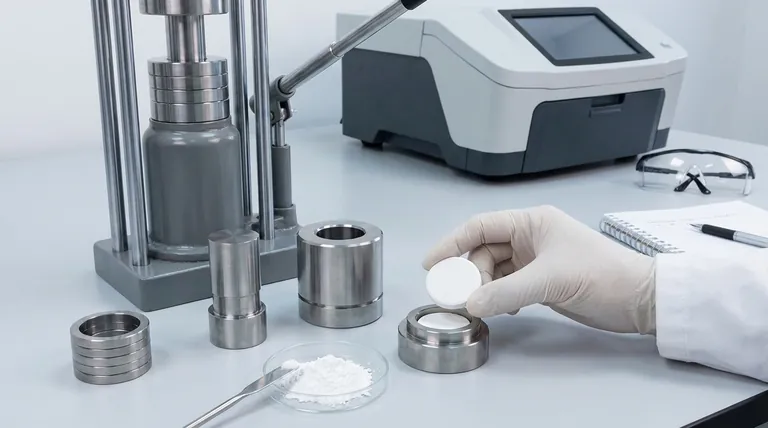
Enhancing Data Quality and Precision
The transition from loose powder to pressed pellets is fundamentally about controlling variables. By standardizing the physical state of the sample, you remove noise from your data.
Improved Sample Homogeneity
Loose powders are prone to segregation, where particles separate by size or density. Pressing the sample creates a solid form with uniform density, locking the particles in place. This minimizes segregation and ensures the analyzed volume is truly representative of the whole sample.
Higher Signal Intensity
Loose powders contain significant void spaces (air gaps) between particles, which dilute the sample signal. Compressing the material eliminates these voids, increasing the density of the material in the X-ray path. This results in higher peak intensities, which directly improves the sensitivity of the analysis.
Reduction of Particle Size Effects
Variations in particle size can scatter X-rays unpredictably, altering the results. Because pressed pellets require grinding samples to a very fine powder before pressing, and then compacting them under high load (10-40 tonnes), these particle size effects are drastically reduced.
Achieving "Infinite Thickness"
For XRF results to be reliable, the X-rays must not penetrate through the entire sample to the holder behind it. Pressed pellets are engineered to be "infinitely thick" relative to the X-ray beam depth. This ensures the detector measures only the sample's composition, free from background interference.
Operational Advantages
Beyond the physics of detection, pressed pellets offer practical benefits for laboratory workflow and sample management.
Superior Trace Element Detection
Due to the increased density and reduced background noise, pressed pellets are the superior choice for analyzing elements in the parts-per-million (ppm) range. The improved signal-to-noise ratio makes it possible to detect trace elements that might be lost in the noise of a loose powder analysis.
Physical Stability and Durability
Unlike loose powders, which can spill or shift during handling, a pressed pellet is a durable solid disc. This allows for safer handling, easier storage, and the ability to re-analyze the sample later without worrying about material shifting.
High-Throughput Capability
Modern laboratories can utilize hydraulic presses with integrated dies and rapid cycles. This allows for the quick extraction of pellets (typically 32mm or 40mm in diameter), enabling labs to maintain high sample throughput without sacrificing sample preparation quality.
Understanding the Trade-offs
While pressed pellets offer superior data, the preparation process introduces specific variables that must be managed to maintain integrity.
The Risk of Contamination
The most significant risk occurs during the grinding phase required before pressing. Contamination can arise from the grinding equipment itself or cross-contamination from previous samples. Strict cleaning protocols are essential to prevent introducing foreign elements into the pellet.
Material Compatibility and Binders
Not all materials bind naturally under pressure. Hard, brittle geological samples often require the addition of a binding agent, such as cellulose or boric acid, to prevent the pellet from crumbling. While necessary for structural integrity, binders slightly dilute the sample and must be accounted for in the analysis.
Making the Right Choice for Your Goal
To maximize the benefits of XRF analysis, align your preparation method with your specific analytical requirements.
- If your primary focus is Trace Analysis (ppm): You must use pressed pellets to achieve the necessary density and signal intensity for detecting low-concentration elements.
- If your primary focus is Geological Samples: Ensure you use a binding agent and sufficient pressure (up to 40 tonnes) to overcome the brittleness of hard materials.
- If your primary focus is Reproducibility: Implement a standardized grinding and pressing protocol to eliminate particle size effects and ensure every sample is "infinitely thick."
Ultimately, pressed pellets are the standard for quantitative XRF because they turn a physical variable—the sample's texture—into a constant.
Summary Table:
| Advantage | Key Benefit |
|---|---|
| Improved Homogeneity | Eliminates particle segregation for a representative sample |
| Higher Signal Intensity | Increases density by removing air gaps for better sensitivity |
| Reduced Particle Effects | Minimizes X-ray scattering from variable particle sizes |
| Infinite Thickness | Ensures reliable results by preventing beam penetration |
| Trace Element Detection | Enables accurate analysis in the parts-per-million (ppm) range |
| Physical Stability | Creates a durable, spill-proof disc for safe handling and storage |
| High-Throughput Capability | Supports rapid sample preparation for efficient laboratory workflow |
Ready to achieve superior accuracy in your XRF analysis?
KINTEK specializes in high-performance lab press machines, including automatic lab presses and heated lab presses, designed to create the perfect pressed pellets for your laboratory needs. Our equipment ensures the consistent pressure and durability required for reliable, high-throughput sample preparation.
Contact us today to learn how our solutions can enhance your analytical precision and efficiency!
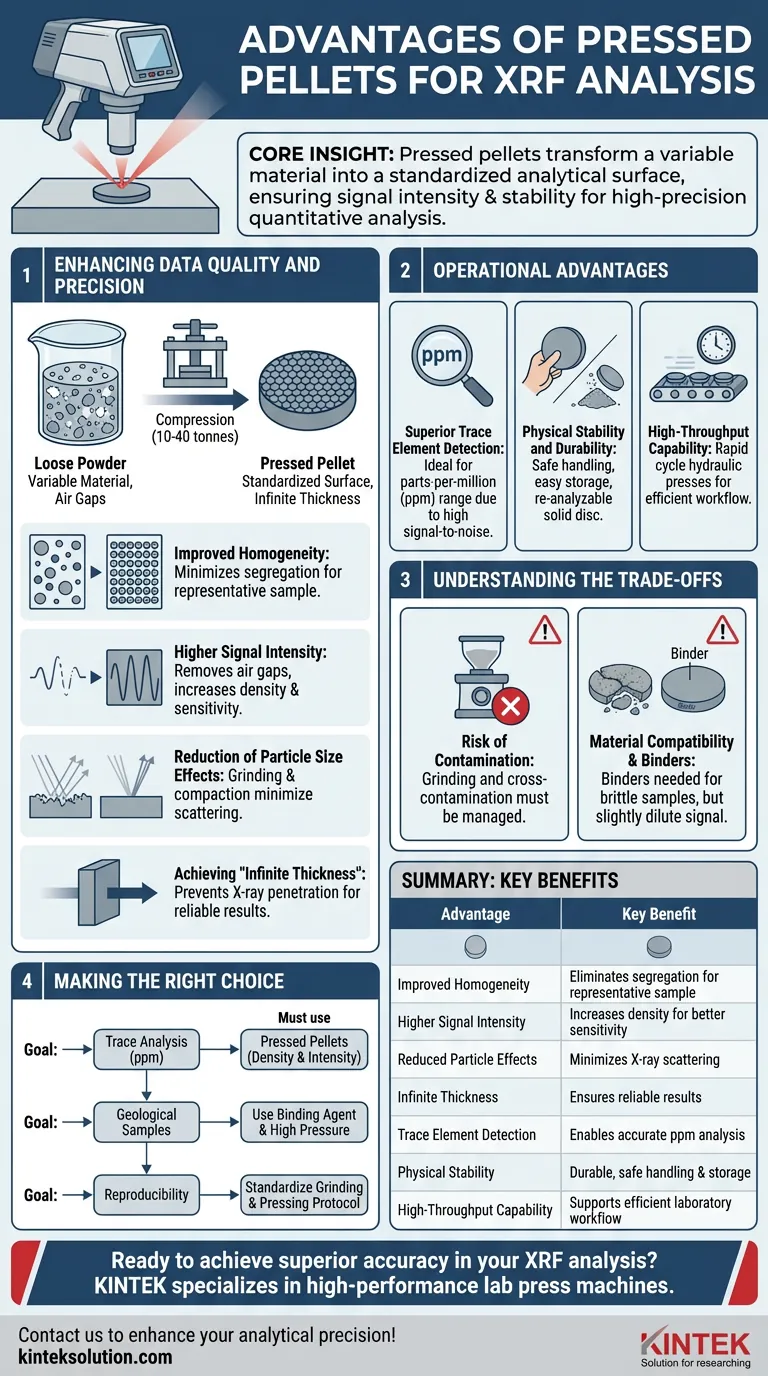
Visual Guide
Related Products
- Laboratory Hydraulic Split Electric Lab Pellet Press
- Manual Laboratory Hydraulic Pellet Press Lab Hydraulic Press
- Laboratory Hydraulic Pellet Press for XRF KBR FTIR Lab Press
- Automatic Laboratory Hydraulic Press Lab Pellet Press Machine
- XRF KBR Plastic Ring Lab Powder Pellet Pressing Mold for FTIR
People Also Ask
- What are the emerging trends in the design and materials of lab pellet presses? Modernize Your Lab Efficiency
- How do lab pellet presses support customization and flexibility? Optimize Your Sample Prep for Any Material
- What are common lab pellet press issues? Expert Troubleshooting Guide for Reliable Material Research
- What are the common operational types of lab pellet presses? Choosing the Right Manual, Automatic, or Hydraulic System
- Why use a laboratory pellet press for solid-state battery evaluation? Ensure Accuracy in Interface Stability Testing



















