
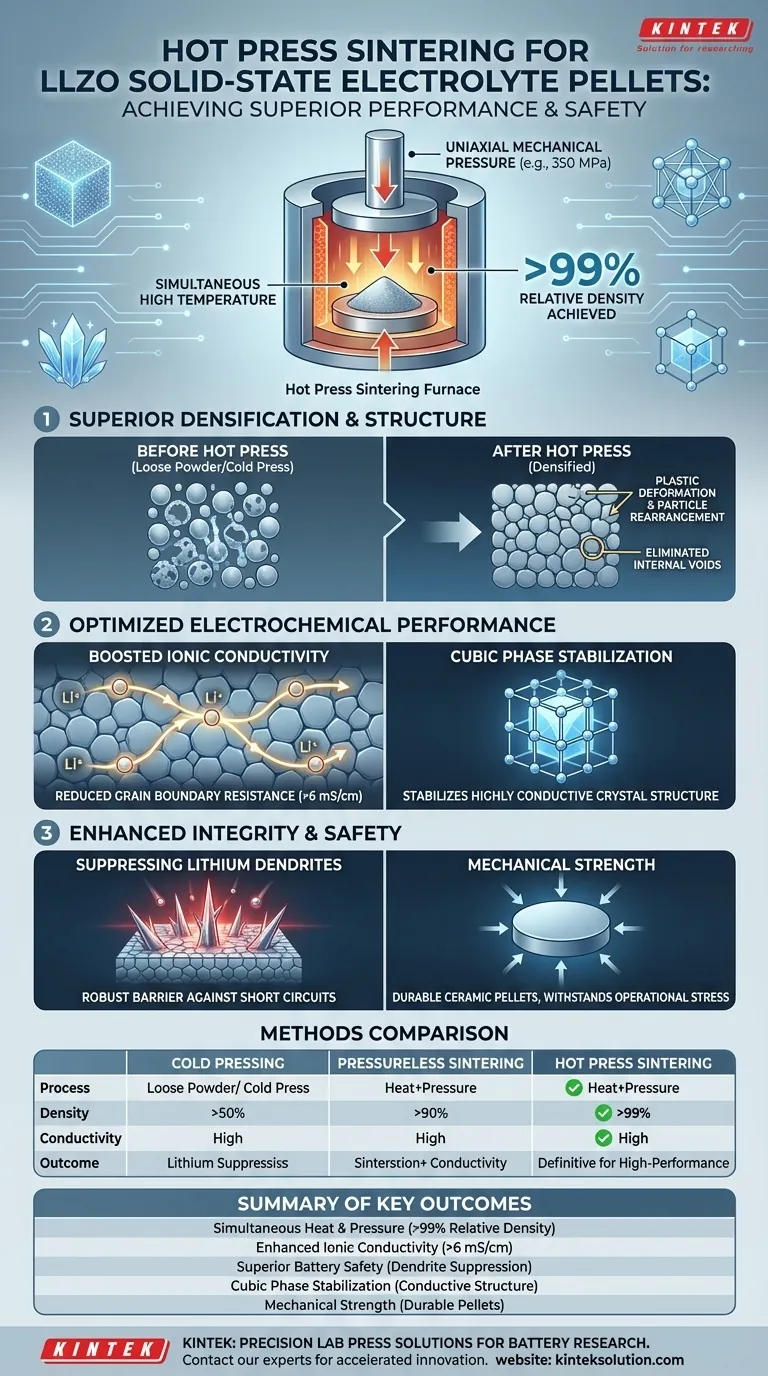
The primary advantage of using a hot press sintering furnace is the simultaneous application of high temperature and uniaxial mechanical pressure. This dual action forces the densification of LLZO powder far beyond what traditional pressureless methods can achieve, enabling the fabrication of electrolyte pellets with relative densities exceeding 99%.
Core Insight: By leveraging simultaneous heat and pressure, hot press sintering facilitates plastic deformation and particle rearrangement that simple thermal sintering cannot match. This process eliminates internal voids and stabilizes the conductive cubic phase, which is essential for maximizing ionic conductivity and preventing lithium dendrite penetration in solid-state batteries.
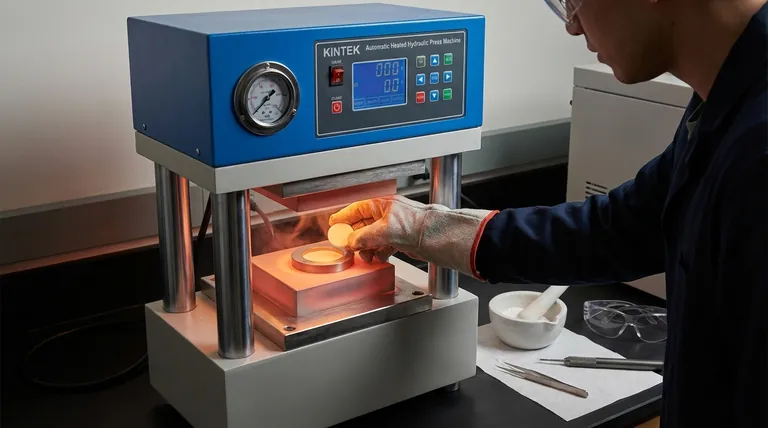
Achieving Superior Densification
The central challenge in preparing LLZO (Lithium Lanthanum Zirconium Oxide) electrolytes is removing porosity. Hot press sintering addresses this through distinct mechanical advantages.
The Mechanics of Combined Force
Unlike standard sintering, which relies solely on thermal energy to bond particles, a hot press applies mechanical force (e.g., 350 MPa) while the material is heated. This promotes plastic deformation and particle softening, forcing solid material into interstitial spaces that would otherwise remain empty.
Eliminating Microscopic Voids
The immediate result of this process is the effective elimination of inter-particle voids. While cold pressing creates a "green pellet" with basic shape, hot pressing creates an intimate solid-solid interface, pushing the relative density to over 99%.
Optimizing Electrochemical Performance
The physical density achieved through hot pressing directly translates to superior electrical properties within the battery cell.
Boosting Ionic Conductivity
High density is critical for reducing grain boundary resistance. When particles are pressed tightly together during the sintering phase, lithium ions can move more freely between grains. References indicate that this method can significantly boost ionic conductivity (e.g., from ~3 mS/cm in cold-pressed samples to over 6 mS/cm in hot-pressed samples).
Stabilizing the Cubic Phase
To function effectively, LLZO must maintain a specific crystal structure known as the cubic phase. The environment within a hot press sintering furnace helps stabilize this highly conductive phase, ensuring the final ceramic possesses the intrinsic properties required for high-performance batteries.
Enhancing Structural Integrity and Safety
Beyond conductivity, the mechanical properties of the pellet are vital for the longevity and safety of the battery.
Suppressing Lithium Dendrites
Internal pores in an electrolyte can act as pathways for lithium dendrites—metallic filaments that grow and cause short circuits. By achieving near-theoretical density and eliminating these pores, hot-pressed pellets act as a robust physical barrier against dendrite growth.
Mechanical Strength
The process yields exceptionally dense ceramic pellets with superior mechanical strength. This durability is fundamental for constructing solid-state batteries that can withstand the physical stresses of operation without cracking or delaminating.
Understanding the Alternatives
To fully appreciate the value of hot press sintering, it is helpful to understand the limitations of other common preparation methods mentioned in the field.
Limitations of Cold Pressing
A laboratory hydraulic press (cold pressing) is essential for forming the initial "green pellet." However, it relies only on mechanical compaction without heat. While it creates initial contact, it leaves significant voids and results in lower conductivity (approx. 3.08 mS/cm). It is generally a preparatory step, not a final sintering solution.
Limitations of Pressureless Sintering
Traditional sintering applies heat without pressure. While simpler, this method often struggles to achieve the extreme densification required for LLZO. Without the mechanical force to close pores, the resulting ceramic often retains higher grain boundary resistance and lower overall structural integrity.
Making the Right Choice for Your Goal
Using a hot press sintering furnace is an investment in quality and performance. Here is how to align this technology with your specific objectives:
- If your primary focus is Maximum Conductivity: Use hot pressing to minimize grain boundary resistance and maximize the continuous pathways for lithium-ion transport.
- If your primary focus is Battery Safety: Rely on hot pressing to achieve >99% density, ensuring there are no pore networks that allow lithium dendrites to cause short circuits.
- If your primary focus is Manufacturing Speed: Consider rapid induction hot pressing, which utilizes the same principles but significantly reduces processing time while maintaining high density (>95%).
Ultimately, for high-performance solid-state batteries, hot press sintering is not just an option; it is the definitive method for converting loose powder into a dense, conductive, and safe electrolyte.
Summary Table:
| Advantage | Key Outcome |
|---|---|
| Simultaneous Heat & Pressure | Forces particle deformation, achieving >99% relative density |
| Enhanced Ionic Conductivity | Reduces grain boundary resistance, boosting conductivity (e.g., >6 mS/cm) |
| Superior Battery Safety | Eliminates internal pores, creating a robust barrier against lithium dendrites |
| Cubic Phase Stabilization | Promotes and stabilizes the highly conductive crystal structure of LLZO |
| Mechanical Strength | Produces durable ceramic pellets capable of withstanding operational stresses |
Ready to fabricate high-performance LLZO pellets with >99% density?
KINTEK specializes in precision lab press machines, including advanced heated lab presses and isostatic presses designed for the demanding requirements of solid-state battery research. Our equipment delivers the simultaneous heat and pressure control essential for achieving superior densification, conductivity, and safety in your electrolyte development.
Contact our experts today to discuss how our hot press sintering solutions can accelerate your battery innovation.
Visual Guide
Related Products
- Warm Isostatic Press for Solid State Battery Research Warm Isostatic Press
- Automatic High Temperature Heated Hydraulic Press Machine with Heated Plates for Lab
- Automatic Heated Hydraulic Press Machine with Hot Plates for Laboratory
- Laboratory Manual Heated Hydraulic Press Machine with Hot Plates
- Lab Heat Press Special Mold
People Also Ask
- Why must composite cathodes be sealed in vacuum lamination bags for WIP? Ensure Battery Stability and Density
- What is the function of elastic molds in warm isostatic pressing? Achieve Uniform Density in Composite Particles
- How do sacrificial volume materials (SVM) maintain microchannels in isostatic pressing? Ensure Structural Integrity
- How does Warm Isostatic Pressing differ from traditional pressing methods? Unlock Uniform Density for Complex Parts
- What are the advantages of using a Warm Isostatic Press (WIP) for batteries? Achieve Superior Interface Contact








