
Manual hydraulic presses are mechanical, hand-operated devices designed to generate significant compressive force—often up to 25 tons—without the use of electronic components. Regarding cost and operation, they represent the most economical entry point for laboratory sample preparation, exchanging the convenience of automation for a lower price tag and a simpler, more compact design.
Core Takeaway While manual hydraulic presses offer a cost-effective and space-saving solution for occasional use or limited budgets, they place the burden of consistency on the user. They are excellent for basic tasks like FTIR/XRF pellet creation, provided the operator can manage the physical effort and variability inherent in manual pumping.
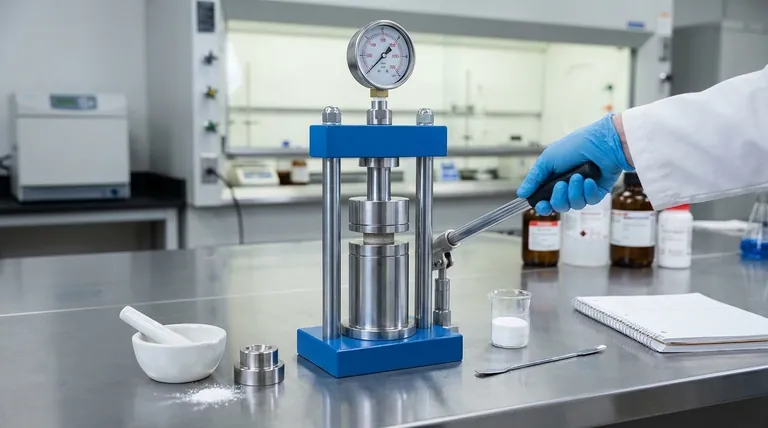
The Mechanics of Operation
Purely Mechanical Force Generation
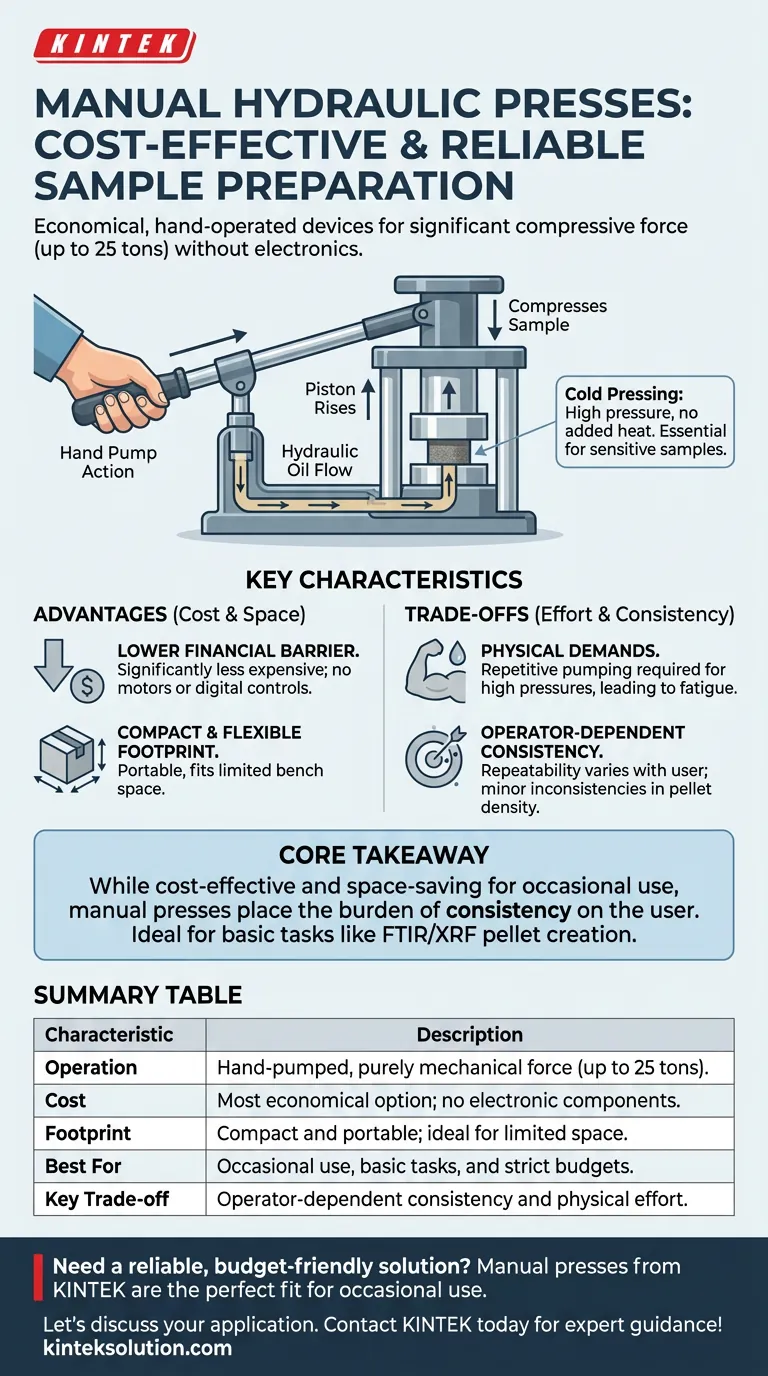
These presses operate on a simple hydraulic principle: a mechanical lever controls a piston within a cylinder filled with hydraulic oil.
By pumping a handle, the operator manually increases the pressure exerted on the material, slowly raising the piston.
The Operational Workflow
The process begins by centering the workpiece, such as a pellet die, on the piston and adjusting the top leadscrew to contact the sample.
The user then pumps the handle to apply the specific load required for the application.
Finally, a release valve is turned to depressurize the system and retrieve the compressed sample.
Cold Pressing Capabilities
Manual presses are designed to exert high pressure without introducing additional heat to the sample.
This "cold pressing" characteristic makes them essential for preparing sensitive samples where thermal stability is a concern.
Cost and Spatial Efficiency
Lower Financial Barrier
Because manual presses lack electric motors, digital controllers, and complex electronic switches, they are significantly less expensive than their automatic counterparts.
This makes them the preferred choice for laboratories facing strict budget constraints.
Compact and Flexible Footprint
These units are available in various sizes, ranging from full-size benchtop models to handheld versions.
Their lack of electronic infrastructure makes them highly portable and suitable for facilities with limited counter space.
Understanding the Trade-offs
Physical Demands on the Operator
The most distinct characteristic of a manual press is the requirement for physical labor.
Achieving high pressures (e.g., nearing the 25-ton limit) requires repetitive pumping, which can lead to operator fatigue during high-volume workflows.
Operator-Dependent Consistency
While these presses are capable of delivering accurate results, the repeatability of those results is entirely dependent on the user.
Unlike automatic presses that use motors to hit exact setpoints, a manual operator may apply slightly different pressure loads from one sample to the next.
This variance can lead to minor inconsistencies in pellet density or thickness, which may affect sensitive analytical results.
Making the Right Choice for Your Goal
To determine if a manual hydraulic press fits your laboratory's needs, evaluate your volume and precision requirements.
- If your primary focus is Budget or Occasional Use: The manual press is the ideal choice, offering high-quality compression capabilities at the lowest possible price point.
- If your primary focus is High Throughput or Absolute Consistency: You may find the manual operation too physically demanding and variable, making an automatic press a better long-term investment.
Ultimately, the manual hydraulic press remains a reliable workhorse for labs that value simplicity and cost-efficiency over automation.
Summary Table:
| Characteristic | Description |
|---|---|
| Operation | Hand-pumped, purely mechanical force generation (up to 25 tons). |
| Cost | Most economical option; no electronic components. |
| Footprint | Compact and portable; ideal for limited space. |
| Best For | Occasional use, basic tasks, and strict budgets. |
| Key Trade-off | Operator-dependent consistency and physical effort required. |
Need a reliable and cost-effective solution for your lab's sample preparation?
Manual hydraulic presses from KINTEK offer a simple, economical entry point for creating high-quality pellets for FTIR, XRF, and other analytical techniques. If your lab values budget-friendly equipment for occasional use but requires the robust performance of a lab press, our manual models are the perfect fit.
Let's discuss your specific application and find the right press for your needs. Contact KINTEK today for expert guidance!
Visual Guide
Related Products
- Manual Heated Hydraulic Lab Press with Integrated Hot Plates Hydraulic Press Machine
- Manual Laboratory Hydraulic Press Lab Pellet Press
- Laboratory Manual Heated Hydraulic Press Machine with Hot Plates
- Manual Laboratory Hydraulic Pellet Press Lab Hydraulic Press
- Laboratory Split Manual Heated Hydraulic Press Machine with Hot Plates
People Also Ask
- Why is a laboratory hydraulic press with heating plates required for PLA/TEC films? Achieve Precise Sample Integrity
- Why is a manual hydraulic heated lab press essential for compleximer materials? Unlock Advanced Material Synthesis
- Function of a Laboratory Hydraulic Press with Heated Platens in SSE? Enhance Battery Density & Conductivity
- What role does a lab manual hydraulic press play in Li9B19S33 ionic conductivity? Optimize Pellet Characterization
- What are the main benefits of performing proper maintenance on a heated lab press? Ensure Accuracy & Safety



















