
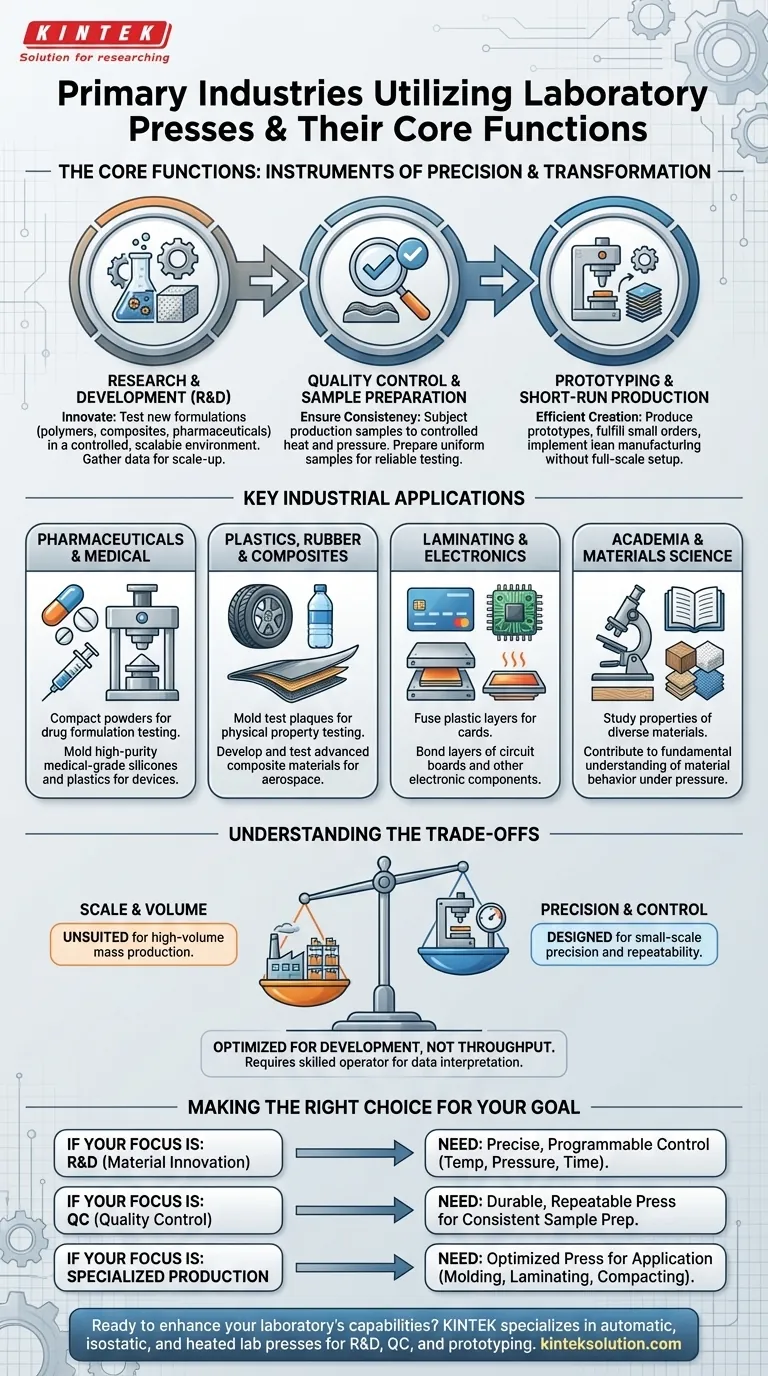
At their core, laboratory presses are instruments of precision and transformation. They are most widely used in industries like pharmaceuticals, plastics and rubber molding, composites, and laminating. These sectors rely on them for a wide range of critical tasks, from groundbreaking research and development to rigorous quality control and specialized, short-run production.
The true value of a laboratory press isn't just the industries it serves, but the function it performs: providing a controlled, scalable environment to test, validate, and perfect materials and processes before committing to full-scale production.
The Core Functions: Why Industries Need Laboratory Presses
Before listing every industry, it's more important to understand what these presses do. Their utility comes from three primary functions that are valuable across many sectors.
Research & Development (R&D)
Laboratory presses are fundamental tools for innovation. They allow researchers to test new material formulations, such as novel polymers, composites, or pharmaceutical compounds, in a small-scale, controlled environment.
Because they can accurately mimic the functions of much larger production presses, they provide valuable data and performance guidelines that can be used to develop and scale up new manufacturing methods efficiently.
Quality Control & Sample Preparation
In a factory or lab setting, consistency is paramount. Laboratory presses are used to take samples from production batches and subject them to controlled pressure and heat.
This process ensures that the material meets quality standards. It is also a critical step in preparing samples with uniform density and shape for further analytical testing, which guarantees that subsequent test results are reliable.
Prototyping & Short-Run Production
Not every task requires a full-scale production line. Industries use laboratory presses for creating prototypes, fulfilling small orders, or implementing lean and cell manufacturing principles.
This approach is highly efficient for limited production runs, as it avoids the cost and time of setting up and running a massive production-grade machine for a small job.
A Closer Look at Key Industrial Applications
With an understanding of their core functions, we can see how specific industries leverage laboratory presses for their unique needs.
Pharmaceuticals & Medical
Precision is non-negotiable in the pharmaceutical and medical fields. Presses are used to compact powders to test drug formulations and dissolution rates.
They are also essential for molding high-purity materials like medical-grade silicones and plastics used in devices and equipment, where material integrity is a matter of patient safety.
Plastics, Rubber & Composites
This is perhaps the largest and most diverse user group. These industries use lab presses to mold test plaques from new polymer and rubber blends, which are then used for physical property testing.
In high-tech sectors like aerospace, presses are used to develop and test advanced composite materials, applying specific heat and pressure profiles to create lightweight, high-strength parts.
Laminating & Electronics
The credit cards and ID cards in your wallet were likely developed using a laminating press. This process uses heat and pressure to fuse layers of plastic together.
This same principle applies to certain electronics manufacturing processes, where presses can be used to bond layers of a circuit board or other components.
Academia & Materials Science
Beyond specific commercial applications, laboratory presses are standard equipment in university and corporate research labs.
They are used to study the properties of a vast range of materials, including wood, plywood, ceramics, textiles, and thermoplastic resins, contributing to the fundamental understanding of how materials behave under pressure.
Understanding the Trade-offs
While incredibly versatile, a laboratory press is a specialized tool with inherent limitations that are important to understand.
Scale vs. Precision
The primary trade-off is volume. A laboratory press is designed for precision, control, and repeatability on a small scale. It is fundamentally unsuited for high-volume, mass production.
Optimized for Development, Not Throughput
These presses are often described as a "jack of all trades" for material development. However, for a single, repetitive production task, a machine designed specifically for that purpose will almost always be more efficient.
Data Requires Interpretation
While a press can be equipped with sensors to provide data on pressure, temperature, and time, this information is not automatically useful. It requires a skilled operator to interpret the data and successfully translate the process parameters to a full-scale production environment.
Making the Right Choice for Your Goal
Selecting or utilizing a laboratory press depends entirely on your end goal.
- If your primary focus is material innovation (R&D): You need a press with precise, programmable control over temperature, pressure, and time to explore and perfect new formulations.
- If your primary focus is quality control (QC): Prioritize a durable, repeatable press that can quickly and consistently prepare samples for further testing.
- If your primary focus is specialized production: Look for a press optimized for your specific application, whether it's short-run molding, laminating, or compacting.
Ultimately, a laboratory press is a strategic investment in certainty, ensuring your materials and processes are perfected before they reach the production floor.
Summary Table:
| Industry | Key Applications |
|---|---|
| Pharmaceuticals & Medical | Drug formulation testing, medical device molding |
| Plastics, Rubber & Composites | Material testing, prototype development |
| Laminating & Electronics | Card lamination, circuit board bonding |
| Academia & Materials Science | Research on various materials like ceramics and textiles |
Ready to enhance your laboratory's capabilities with a reliable lab press? KINTEK specializes in automatic lab presses, isostatic presses, heated lab presses, and more, designed to meet the needs of industries like pharmaceuticals, plastics, and composites. Whether you're focused on R&D, quality control, or prototyping, our machines deliver precise control, durability, and scalability to perfect your materials and processes. Contact us today to discuss how we can support your specific goals and drive innovation in your lab!
Visual Guide
Related Products
- Laboratory Hydraulic Press 2T Lab Pellet Press for KBR FTIR
- Laboratory Hydraulic Press Lab Pellet Press Button Battery Press
- Laboratory Hydraulic Press Lab Pellet Press Machine for Glove Box
- Laboratory Split Manual Heated Hydraulic Press Machine with Hot Plates
- Laboratory Hydraulic Pellet Press for XRF KBR FTIR Lab Press
People Also Ask
- What is the role of a laboratory pressure machine and KBr in FTIR? Master Sample Preparation for Flame Retardants
- What is the role of a laboratory hydraulic press in high-loading NCM811 cathode prep for solid-state batteries?
- What role does a laboratory hydraulic press play in reaction pellets? Optimizing Lunar Soil and Metal Fuel Density
- Why is a laboratory hydraulic press necessary for sample preparation? Precise Pelleting for Spiro Heterocyclic Analysis
- How does a laboratory hydraulic press ensure repair performance? Master Self-Healing CFRP Molding with Precision



















