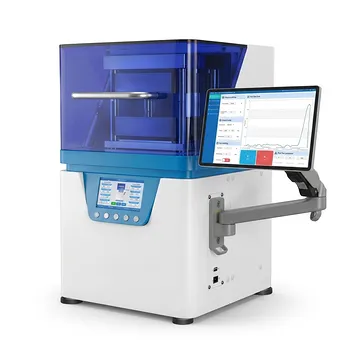
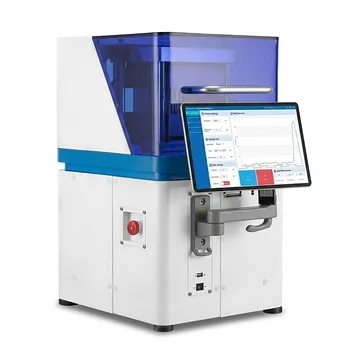
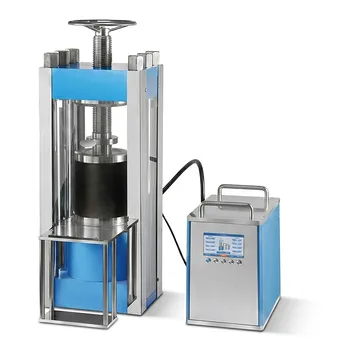
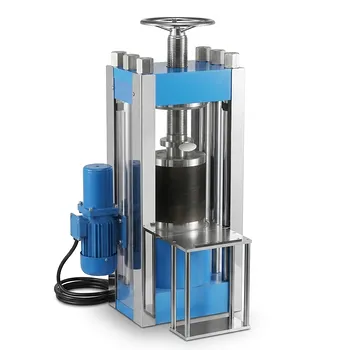
The primary purpose of a laboratory hot press is to facilitate the rigorous research and development of new materials. It serves as a foundational tool for exploring complex process parameters and preparing precise, small-scale samples for subsequent testing and analysis. By creating a controlled environment, it allows researchers to isolate variables and validate material properties before scaling up to production.
By integrating thermal energy with mechanical force, the laboratory hot press transforms raw formulations into consolidated specimens. Its value lies in reproducibility: it ensures that every sample created for testing reflects the exact parameters intended by the researcher, eliminating the variables that lead to bad data.
Core Functions in Research and Development
Driving Material Innovation
The central role of the hot press is to enable the synthesis and consolidation of novel materials. Whether working with polymers, composites, or ceramics, the equipment applies heat and pressure to bond disparate elements. This capability is essential for R&D teams attempting to engineer materials with specific mechanical or electrical properties.
Exploration of Process Parameters
Before a material can be mass-produced, its processing "recipe" must be perfected. A hot press allows scientists to systematically vary critical inputs—specifically temperature, pressure, and time—to observe their effects. This experimentation helps identify the optimal processing window that yields the highest quality results.
Preparation of Test Specimens
Accurate analysis requires uniform samples. The hot press is used to mold materials into standardized shapes (such as flat sheets or pellets) required for tensile, impact, or thermal analysis. High-quality construction and digital controls ensure that each sample is chemically and physically consistent with the last.
The Mechanism of Action
Simultaneous Heat and Pressure
The efficiency of a hot press stems from its ability to combine two stressors in a single step. The system heats platens to a target temperature while simultaneously applying hydraulic or mechanical pressure. This dual action promotes material flow, curing, or sintering much faster than separate heating and compressing steps.
Precision and Control
Modern laboratory presses utilize advanced control systems to regulate the rate of heating and the specific pressure applied. This allows for complex "holding" or dwell stages, where conditions are maintained to allow chemical changes (like cross-linking) or physical changes (like solder flow) to occur. This precision is vital for high-stakes bonding applications, such as forming permanent electrical connections between solder-coated parts.
Understanding the Trade-offs
Throughput vs. Precision
While a laboratory hot press excels at precision and versatility, it is generally limited in throughput. It is designed for batch production of small quantities rather than continuous, high-volume manufacturing. Users must accept slower cycle times—requiring heating, holding, and cooling phases—in exchange for the high data fidelity required in a lab setting.
Operational Complexity
Achieving the "perfect" sample often requires significant trial and error regarding parameter settings. If the cooling phase is rushed or the pressure release is timed incorrectly, samples can warp or degrade. The operator must strictly follow protocols—from pre-operation checks to safe temperature removal (typically below 60°C)—to avoid damaging both the sample and the precise platens.
Making the Right Choice for Your Goal
When integrating a hot press into your workflow, align the machine's capabilities with your specific research objectives.
- If your primary focus is New Material Discovery: Prioritize a machine with a wide temperature and pressure range to accommodate diverse and unknown material behaviors.
- If your primary focus is Data Validation: Focus on control systems that offer high reproducibility and digital logging to ensure every test specimen is statistically identical.
- If your primary focus is Process Scaling: Select a unit that mimics the mechanics of production-scale machinery to ensure your lab results transfer accurately to the factory floor.
The laboratory hot press is not just a molding tool; it is the gatekeeper between a theoretical concept and a viable physical product.
Summary Table:
| Core Purpose | Key Benefits | Research Application |
|---|---|---|
| Material Innovation | Synthesis of novel polymers & composites | Engineering specific mechanical properties |
| Process Optimization | Fine-tuning temperature, pressure & time | Establishing mass-production recipes |
| Specimen Preparation | Creates uniform, standardized samples | Consistent tensile, impact & thermal testing |
| Bonding & Sintering | Simultaneous heat/pressure application | High-stakes electrical and chemical bonding |
Accelerate your material innovation with KINTEK’s precision engineering. As specialists in comprehensive laboratory pressing solutions, we offer a diverse range of manual, automatic, heated, and multifunctional models—including glovebox-compatible designs and isostatic presses for advanced battery research. Contact us today to discover how our tailored solutions can ensure the reproducibility and high data fidelity your research demands.
Related Products
- Laboratory Split Manual Heated Hydraulic Press Machine with Hot Plates
- 24T 30T 60T Heated Hydraulic Lab Press Machine with Hot Plates for Laboratory
- Heated Hydraulic Press Machine with Heated Plates for Vacuum Box Laboratory Hot Press
- Automatic Hydraulic Hot Press with Large Plate and Precision Temperature Control for Advanced Material Sample Preparation and Industrial Research
- Laboratory Manual Heated Hydraulic Press Machine with Hot Plates
People Also Ask
- Why is a laboratory hydraulic press with heating plates required for PLA/TEC films? Achieve Precise Sample Integrity
- Why reduce load when applying composite strengthening tabs? Protect Specimen Integrity and Data Accuracy
- What role does a laboratory heated hydraulic press play in LTCC? Essential for High-Density Ceramic Lamination
- Why is a laboratory heated hydraulic press required? Ensure Precise Vulcanization for NBR/EPDM Nanocomposites
- What is the critical role of a laboratory heated hydraulic press? Mastering PVC Sample Prep for Testing