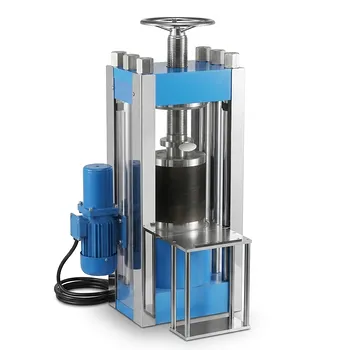
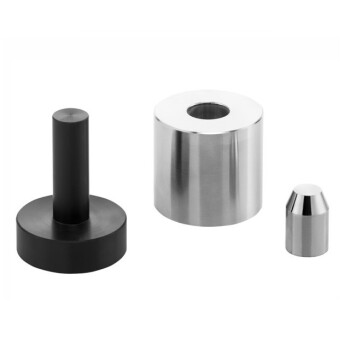
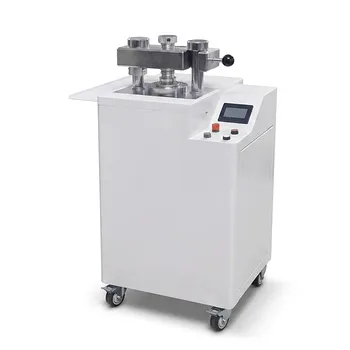
The primary safety considerations for using a KBr press revolve around shielding the operator from chemical exposure and managing high mechanical forces. You must always wear appropriate Personal Protective Equipment (PPE), specifically gloves and safety glasses, when handling potassium bromide powder. Furthermore, because the hydraulic press operates under extreme pressure, strict adherence to the manufacturer's operational guidelines is required to prevent catastrophic mechanical failure.
Core Takeaway Safety in KBr pellet preparation is a dual discipline: protecting the body from chemical irritants and maintaining the structural integrity of the high-pressure machinery. Neglecting routine maintenance on hydraulic components is the single leading cause of preventable laboratory accidents with this equipment.
Personal Protection and Workspace Setup
Essential PPE
Handling potassium bromide (KBr) powder carries risks of irritation or contamination. To mitigate this, safety glasses and gloves are mandatory during the entire preparation process. This protects against both chemical contact and potential debris from the press.
Equipment Stability
Before applying any force, ensure the press is stable and securely placed on the workbench. Accidental movement during high-pressure operation can lead to equipment tipping or die set misalignment. A level, uncluttered surface is a prerequisite for safe operation.
Operational Safety and Pressure Management
Respecting Force Limits
Hydraulic presses are designed to exert massive force, often requiring approximately 8 tons to form a proper pellet. You must never exceed the maximum pressure rating specified by the manufacturer. Over-pressurizing can shatter the die set or rupture hydraulic components.
Vacuum Application
To ensure a stable pellet, a vacuum should be applied to the die set to eliminate air and moisture before pressing. While primarily for spectral quality, removing trapped air pockets reduces the risk of structural flaws in the pellet that could cause it to crack or shatter under load.
Common Pitfalls and Maintenance Trade-offs
The Danger of Neglect
There is a temptation to prioritize rapid sample throughput over equipment care, but this trade-off compromises safety. Regular maintenance is not optional; you must routinely inspect the press for leaking hoses, compromised seals, cracks, or excessive vibration. Ignoring these signs increases the risk of a high-pressure hydraulic blow-out.
Fluid and Component Care
Hydraulic fluids degrade over time and must be replaced with the correct type of hydraulic oil to ensure safe pressure regulation. Additionally, failure to keep the working parts clean and lubricated can lead to seizing or jerking motions during operation. Keeping the die set and plungers clean prevents contamination and mechanical binding.
Ensuring Long-Term Safety and Quality
To maintain a safe laboratory environment while producing high-quality KBr pellets, prioritize your workflow based on these guidelines:
- If your primary focus is Operator Safety: Strictly enforce the use of PPE and ensure the press is bolted or weighted down to prevent bench movement.
- If your primary focus is Equipment Longevity: Implement a strict schedule for lubricating components and inspecting hydraulic hoses for leaks before every use.
- If your primary focus is Sample Consistency: Store the die set in a dry environment to prevent corrosion, which ensures the tooling can safely withstand repeated high-pressure cycles.
By combining respectful handling of high-pressure mechanics with rigorous maintenance, you ensure both the safety of your personnel and the accuracy of your analytical results.
Summary Table:
| Safety Category | Key Requirement | Purpose |
|---|---|---|
| Personal Protection | Safety glasses & gloves | Protect against chemical irritants and debris |
| Stability | Level, secure workbench | Prevents equipment tipping or misalignment |
| Force Management | Max 8 tons (or per manual) | Prevents mechanical failure and die shattering |
| Vacuum Step | Air/moisture removal | Eliminates air pockets that cause structural flaws |
| Maintenance | Regular seal/hose inspection | Prevents catastrophic hydraulic blow-outs |
Maximize Your Lab Safety with KBr Pressing Experts
Don't compromise your laboratory's safety or research accuracy. KINTEK specializes in comprehensive laboratory pressing solutions, offering manual, automatic, heated, multifunctional, and glovebox-compatible models, as well as cold and warm isostatic presses widely applied in battery research.
Whether you are upgrading your equipment or need guidance on high-pressure safety, our team provides the precision tools and expertise necessary to protect your personnel and your data.
Ready to enhance your lab's efficiency? Contact KINTEK today to find the perfect, safe pressing solution for your application.
Related Products
- Laboratory Hydraulic Press 2T Lab Pellet Press for KBR FTIR
- Laboratory Hydraulic Pellet Press for XRF KBR FTIR Lab Press
- Automatic Laboratory Hydraulic Press for XRF and KBR Pellet Pressing
- Lab Infrared Press Mold for No Demolding
- Button Battery Sealing Press Machine for Lab
People Also Ask
- What is the role of a laboratory pressure machine and KBr in FTIR? Master Sample Preparation for Flame Retardants
- What is the role of a laboratory hydraulic press in high-loading NCM811 cathode prep for solid-state batteries?
- What role does a laboratory hydraulic press play in reaction pellets? Optimizing Lunar Soil and Metal Fuel Density
- Why is a laboratory hydraulic press necessary for sample preparation? Precise Pelleting for Spiro Heterocyclic Analysis
- What is the role of a laboratory hydraulic press in denture preparation? Achieve High-Density Dental Prosthetics