
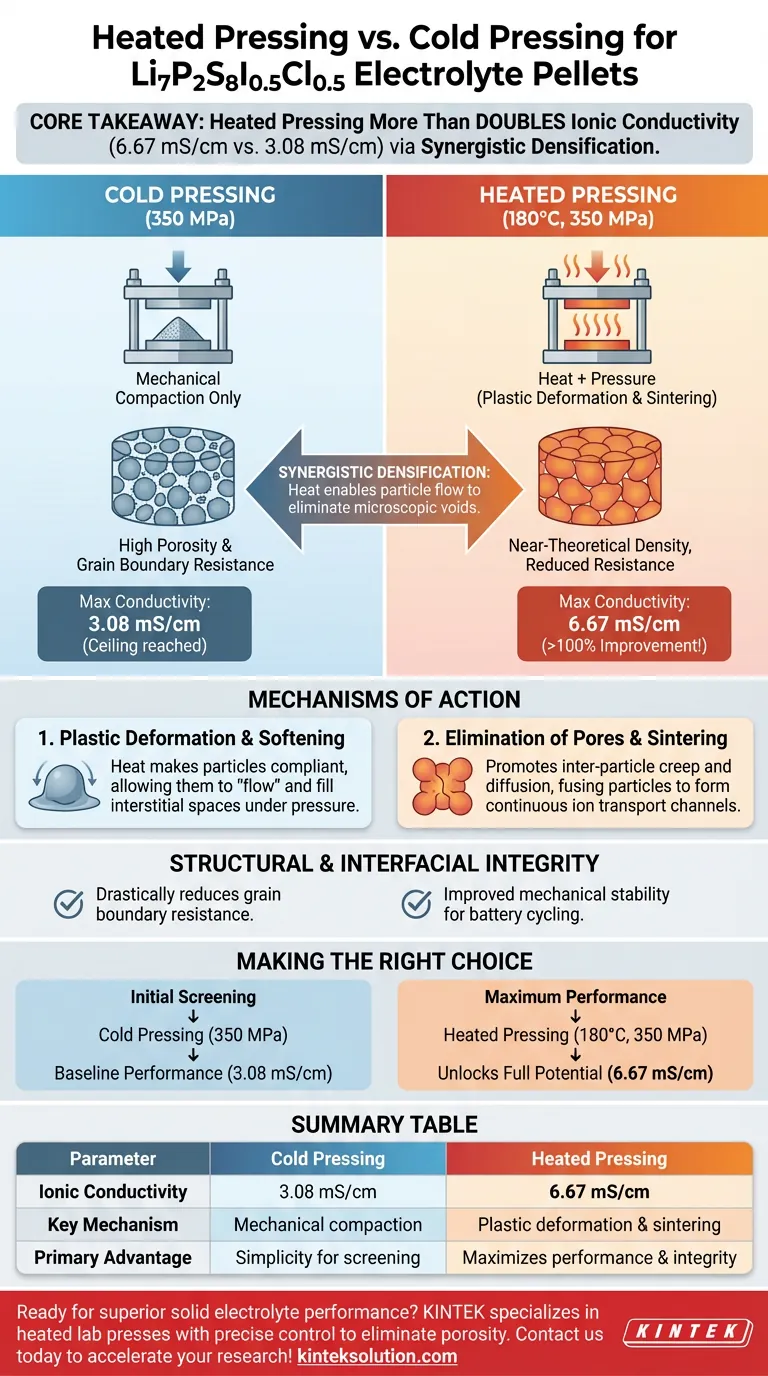
Heated pressing significantly outperforms cold pressing for $Li_7P_2S_8I_{0.5}Cl_{0.5}$ electrolytes by more than doubling the resulting ionic conductivity. While cold pressing at 350 MPa can achieve a conductivity of 3.08 mS/cm, simultaneously applying heat (180°C) and pressure boosts this figure to 6.67 mS/cm by fundamentally altering the material's microstructure.
Core Takeaway: The superior performance of heated pressing stems from synergistic densification. Heat induces plastic deformation in the electrolyte particles, allowing them to flow into and eliminate microscopic voids that mechanical pressure alone cannot close. This creates a near-theoretical density with minimal grain boundary resistance.
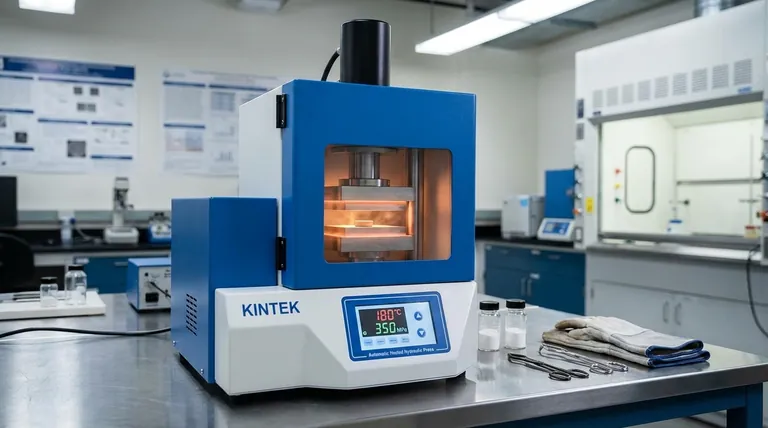
The Conductivity Gap: Cold vs. Heated
The most distinct advantage of using a heated press is the quantifiable leap in ionic conductivity. This metric is the primary indicator of how well the electrolyte will perform in a battery.
The Ceiling of Cold Pressing
Cold pressing relies solely on mechanical force to compact powder. For $Li_7P_2S_8I_{0.5}Cl_{0.5}$, increasing pressure from 10 MPa to 350 MPa significantly improves performance, but it hits a "ceiling."
At 350 MPa without heat, the maximum achievable ionic conductivity plateaus at 3.08 mS/cm.
The Heated Press Advantage
By introducing a temperature of 180°C alongside the 350 MPa pressure, you unlock performance that cold pressing cannot reach.
The heated process creates a more intimate solid-solid interface, raising the ionic conductivity to 6.67 mS/cm. This is a greater than 100% improvement over the optimized cold-pressed sample.
Mechanisms of Densification
To understand why heated pressing yields better results, you must look at how the material behaves at the microscopic level during compaction.
Plastic Deformation and Softening
Cold pressing compacts particles, but they remain relatively rigid. Heated pressing promotes the softening and plastic deformation of the electrolyte particles.
Because the particles become compliant, they can deform and "flow" under pressure. This allows the material to fill interstitial spaces that would otherwise remain as empty voids in a cold-pressed pellet.
Elimination of Pores
The combination of heat and pressure promotes inter-particle creep and diffusion.
This action effectively eliminates residual porosity. In contrast, cold-pressed compacts typically retain internal cracks and pores, which act as barriers to ion transport.
Structural and Interfacial Integrity
High density is not just about mass per volume; it is about the continuity of the ion transport pathways.
Reducing Grain Boundary Resistance
The primary barrier to conductivity in solid electrolytes is often the resistance found at the boundaries between particles (grain boundaries).
Heated pressing facilitates sintering, fusing particles together to form continuous lithium-ion transport channels. This drastically reduces the grain boundary resistance, which is a key factor in the conductivity jump from 3.08 to 6.67 mS/cm.
Mechanical Stability
Beyond conductivity, heated pressing produces physically stronger pellets.
The fusion of particles results in improved mechanical integrity and stability. This is critical for the electrolyte's ability to withstand the physical stresses of battery cycling without cracking or delaminating.
Understanding the Trade-offs
While heated pressing is superior for performance, it introduces process complexities that must be managed.
Equipment and Control Requirements
Heated pressing requires specialized equipment capable of maintaining precise temperature control (e.g., 180°C) alongside high hydraulic pressure.
Parameter Sensitivity
The process is sensitive to specific parameters. You must target the correct window (e.g., 180°C and 350 MPa) to achieve the specific benefits for $Li_7P_2S_8I_{0.5}Cl_{0.5}$. Deviating significantly could fail to achieve the necessary plastic deformation or potentially degrade the material if temperatures are excessive.
Making the Right Choice for Your Goal
The choice between cold and heated pressing depends on the specific requirements of your development stage.
- If your primary focus is maximum performance: You must use heated pressing (180°C, 350 MPa) to achieve the 6.67 mS/cm conductivity required for high-performance cells.
- If your primary focus is initial screening: Cold pressing (350 MPa) is sufficient to verify the material phase, yielding a baseline conductivity of 3.08 mS/cm, but it will not reflect the material's full potential.
Ultimately, heated pressing is not just an optional enhancement; it is a critical processing step required to unlock the intrinsic properties of sulfide-based solid electrolytes.
Summary Table:
| Parameter | Cold Pressing (350 MPa) | Heated Pressing (180°C, 350 MPa) |
|---|---|---|
| Ionic Conductivity | 3.08 mS/cm | 6.67 mS/cm |
| Key Mechanism | Mechanical compaction | Plastic deformation & sintering |
| Primary Advantage | Simplicity for initial screening | Maximizes performance & structural integrity |
Ready to achieve superior solid electrolyte performance? KINTEK specializes in lab press machines, including automatic and heated lab presses, designed to deliver the precise temperature and pressure control required for high-density Li7P2S8I0.5Cl0.5 pellets. Our equipment helps you eliminate porosity and double ionic conductivity for next-generation battery development. Contact us today to discuss how our heated press solutions can accelerate your research!
Visual Guide
Related Products
- Heated Hydraulic Press Machine with Heated Plates for Vacuum Box Laboratory Hot Press
- Automatic High Temperature Heated Hydraulic Press Machine with Heated Plates for Lab
- Heated Hydraulic Press Machine With Heated Plates For Vacuum Box Laboratory Hot Press
- Automatic Heated Hydraulic Press Machine with Hot Plates for Laboratory
- Automatic Heated Hydraulic Press Machine with Heated Plates for Laboratory
People Also Ask
- How does a laboratory heated hydraulic press facilitate PBN sample prep for WAXS? Achieve Precise X-Ray Scattering
- What are the requirements for electrode pressing with high-viscosity ionic liquids like EMIM TFSI? Optimize Performance
- What are the industrial applications of heated hydraulic presses? Master Heat & Force for Precision Manufacturing
- Function of a Laboratory Hydraulic Press with Heated Platens in SSE? Enhance Battery Density & Conductivity
- How are heated hydraulic presses utilized in the preparation of thin films? Key Mechanisms and Applications



















