
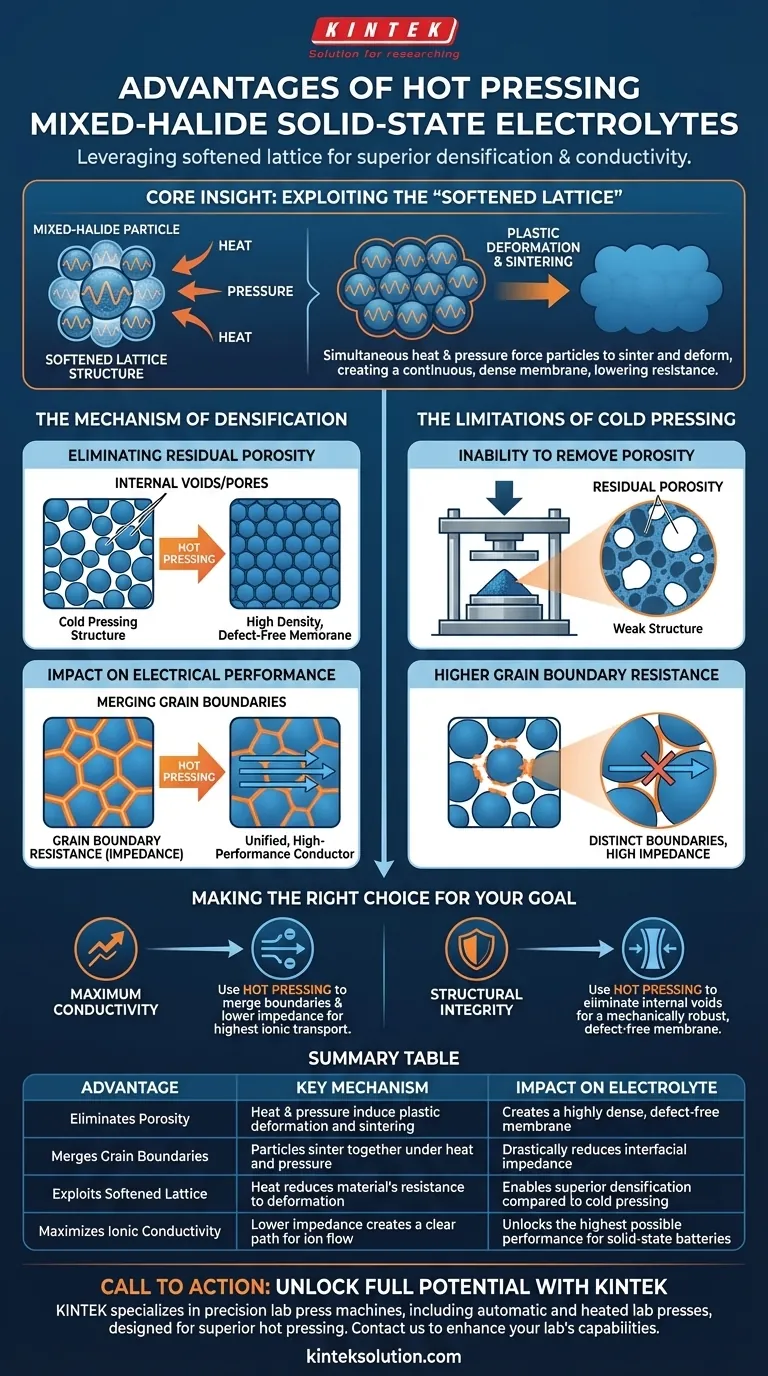
Hot pressing creates a superior mixed-halide electrolyte by leveraging the material's naturally softened lattice to achieve densification levels that cold pressing cannot match. By applying heat and mechanical pressure simultaneously, this process induces plastic deformation and sintering. This directly eliminates residual porosity and merges grain boundaries, solving the critical issue of high interfacial impedance.
Core Insight: The effectiveness of hot pressing for mixed-halide materials stems from their specific "softened lattice" structure. The simultaneous application of heat and pressure forces these particles to sinter and deform plastically, creating a continuous, dense membrane that lowers resistance and maximizes ionic conductivity.
The Mechanism of Densification
Exploiting the Softened Lattice
Mixed-halide electrolytes possess a unique "softened lattice" structure. Hot pressing takes advantage of this characteristic by applying heat to reduce the material's resistance to deformation.
Unlike harder ceramic materials, the combination of heat and pressure promotes plastic deformation in the halide particles. This allows the material to flow and pack tightly, fundamentally changing the physical structure of the electrolyte.
Eliminating Residual Porosity
A major challenge in solid-state electrolyte fabrication is the presence of internal voids or pores. Hot pressing is particularly effective at removing these defects.
The applied pressure compacts the powder, while the heat ensures that particles merge completely. This results in a highly dense membrane where internal bubbles and voids are effectively eliminated, leading to a density that significantly exceeds what is possible with cold pressing alone.
Impact on Electrical Performance
Merging Grain Boundaries
The primary barrier to ion movement in solid-state batteries is often the resistance found at the boundaries between particles (grain boundaries).
Hot pressing causes these particles to sinter together, effectively merging the grain boundaries into a cohesive unit. This physical merging removes the bottlenecks that typically impede ion flow.
Reducing Interfacial Impedance
By creating a dense, defect-free structure with merged boundaries, hot pressing drastically lowers interfacial impedance.
This reduction in resistance is the key pathway to obtaining the highest possible ionic conductivity performance for halide electrolytes. It transforms a collection of particles into a unified, high-performance conductor.
The Limitations of Cold Pressing
While hot pressing is superior for mixed-halides, it is important to understand why simpler methods fall short.
Inability to Remove Residual Porosity
References indicate that while cold pressing can compact powder, it often leaves residual porosity within the material. In halide electrolytes, these microscopic voids act as barriers to ion conduction and weaken the material structure.
Higher Grain Boundary Resistance
Without the thermal energy provided by hot pressing to induce sintering, particles pressed at room temperature maintain distinct boundaries. This results in significantly higher grain boundary resistance, which throttles the overall ionic conductivity of the electrolyte.
Making the Right Choice for Your Goal
To maximize the potential of mixed-halide electrolytes, the fabrication method must align with the material's physical properties.
- If your primary focus is Maximum Conductivity: You must use hot pressing to merge grain boundaries and lower interfacial impedance, as this unlocks the highest possible ionic transport speeds.
- If your primary focus is Structural Integrity: Hot pressing is essential to eliminate internal voids and achieve a relative density that creates a mechanically robust, defect-free membrane.
Summary: For mixed-halide electrolytes, hot pressing is not just a forming technique but a critical activation step that merges the soft lattice structure into a high-density, high-conductivity monolith.
Summary Table:
| Advantage | Key Mechanism | Impact on Electrolyte |
|---|---|---|
| Eliminates Porosity | Heat & pressure induce plastic deformation and sintering | Creates a highly dense, defect-free membrane |
| Merges Grain Boundaries | Particles sinter together under heat and pressure | Drastically reduces interfacial impedance |
| Exploits Softened Lattice | Heat reduces material's resistance to deformation | Enables superior densification compared to cold pressing |
| Maximizes Ionic Conductivity | Lower impedance creates a clear path for ion flow | Unlocks the highest possible performance for solid-state batteries |
Ready to unlock the full potential of your mixed-halide solid-state electrolytes?
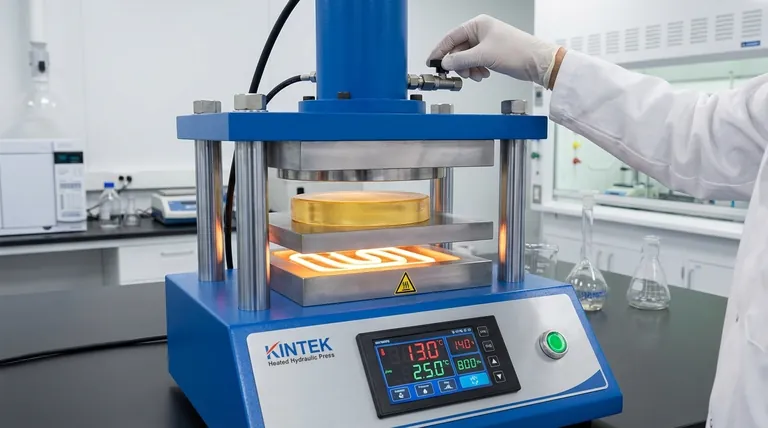
KINTEK specializes in precision lab press machines, including automatic lab presses and heated lab presses, designed to deliver the exact conditions required for superior hot pressing. Our equipment helps researchers and battery developers achieve the high-density, low-impedance membranes essential for next-generation batteries.
Contact us today to discuss how our solutions can enhance your lab's capabilities and accelerate your research and development.
Visual Guide
Related Products
- Automatic High Temperature Heated Hydraulic Press Machine with Heated Plates for Lab
- Heated Hydraulic Press Machine with Heated Plates for Vacuum Box Laboratory Hot Press
- Automatic Heated Hydraulic Press Machine with Hot Plates for Laboratory
- Heated Hydraulic Press Machine With Heated Plates For Vacuum Box Laboratory Hot Press
- Laboratory Manual Heated Hydraulic Press Machine with Hot Plates
People Also Ask
- Function of a Laboratory Hydraulic Press with Heated Platens in SSE? Enhance Battery Density & Conductivity
- What are the requirements for electrode pressing with high-viscosity ionic liquids like EMIM TFSI? Optimize Performance
- How does a laboratory heated hydraulic press facilitate PBN sample prep for WAXS? Achieve Precise X-Ray Scattering
- What are the industrial applications of heated hydraulic presses? Master Heat & Force for Precision Manufacturing
- Why is a laboratory hydraulic press with heating plates required for PLA/TEC films? Achieve Precise Sample Integrity



















