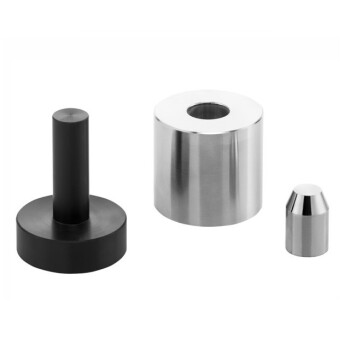
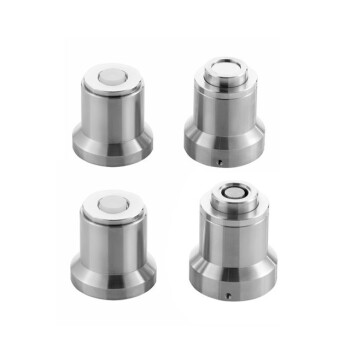
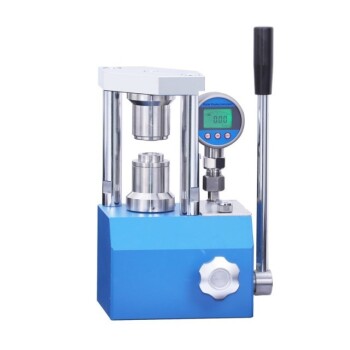
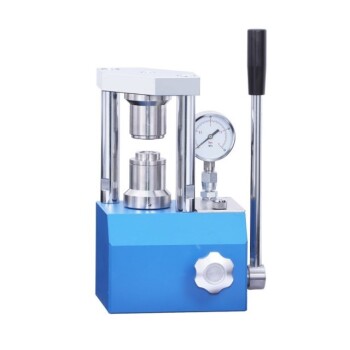
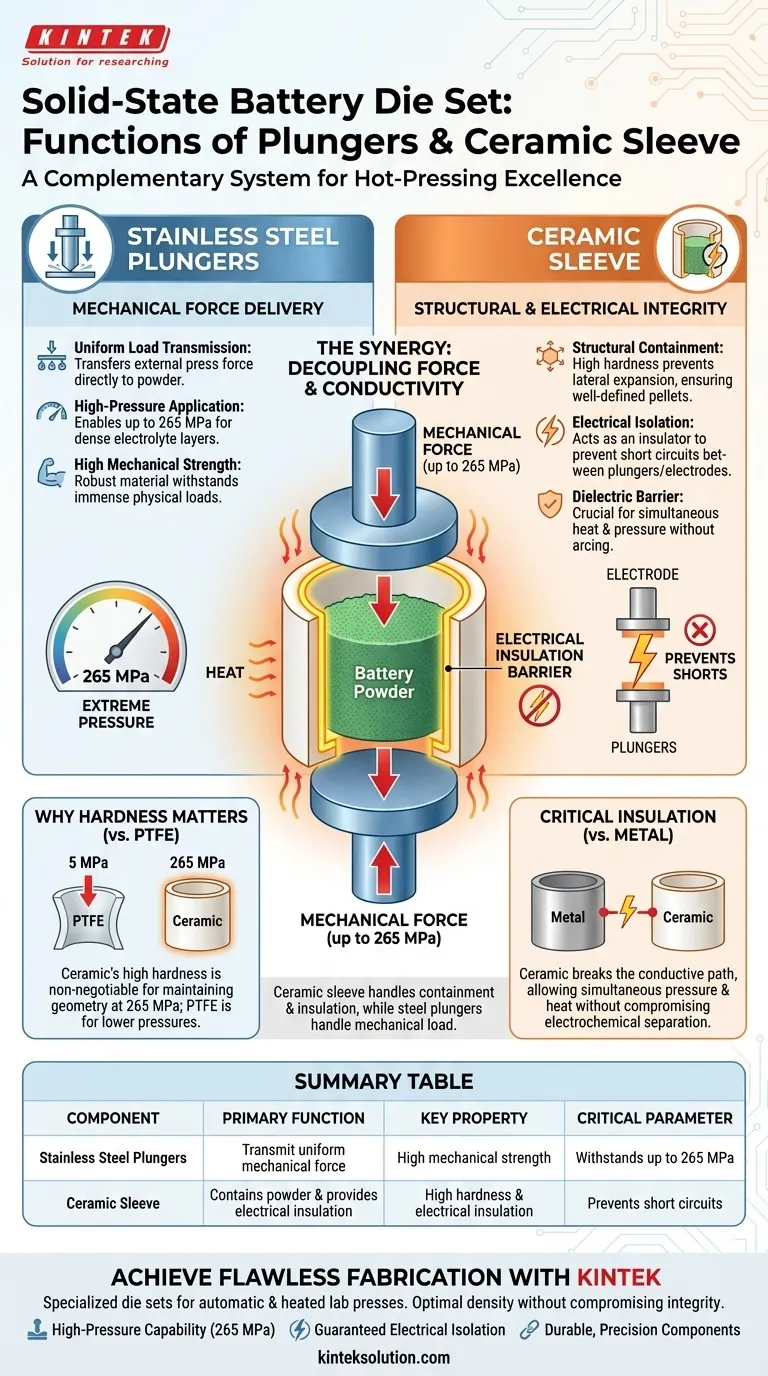
The stainless steel plungers and ceramic sleeve function as a complementary system where the plungers deliver mechanical force and the sleeve ensures structural and electrical integrity. Specifically, the plungers act as the mechanism to uniformly transmit high-pressure loads to the battery powder, while the ceramic sleeve serves as the electrically insulating die body that contains the powder during compaction.
Core Takeaway Ideally, this setup decouples mechanical force from electrical conductivity. The stainless steel handles the immense physical load required to densify the solid electrolyte, while the ceramic sleeve ensures that this pressure does not result in an electrical short circuit between the electrodes.
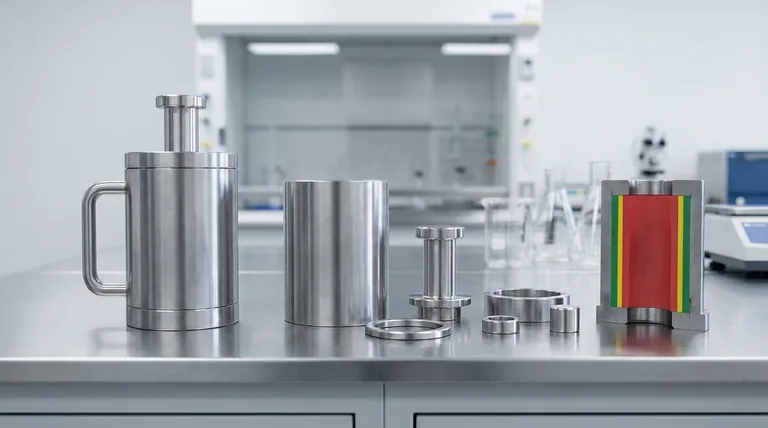
The Mechanics of the Die Set
The Role of Stainless Steel Plungers
### Uniform Load Transmission The primary function of the stainless steel plungers is to transfer the force applied by the external press directly onto the stacked battery powders.
Because stainless steel is mechanically robust, it can withstand the significant forces required for densification.
### Application of High Pressure Solid-state battery fabrication often requires extreme pressure to ensure proper contact between particles.
The steel plungers enable the application of pressures as high as 265 MPa. This capability is essential for creating a dense, viable electrolyte layer.
The Role of the Ceramic Sleeve
### Structural Containment (Hardness) The ceramic sleeve acts as the main body of the die.
Its high hardness is critical during the compaction process. It physically contains the powder, preventing lateral expansion and ensuring the formation of a well-defined, structurally sound pellet.
### Electrical Isolation Perhaps the most critical function of the ceramic sleeve is its property as an electrical insulator.
During assembly and hot-pressing, the top and bottom plungers often act as current collectors or electrodes. The ceramic sleeve prevents these two components from touching or arcing, effectively preventing short circuits.
Understanding the Interactions
Why Material Hardness Matters
You cannot simply use any insulating material for the sleeve.
While materials like PTFE (Teflon) offer insulation and low friction, they are typically used for lower pressure applications (e.g., 5 MPa).
For hot-pressing at 265 MPa, the high hardness of ceramic is non-negotiable to maintain the die's geometry and contain the internal stress without deforming.
The Criticality of Insulation
If the sleeve were made of metal (like the plungers), the die set would become a single conductive unit.
The ceramic breaks this conductive path. This allows you to apply pressure and heat simultaneously without compromising the electrochemical separation of the anode and cathode sides of the assembly.
Making the Right Choice for Your Goal
To ensure successful solid-state battery fabrication, you must verify that your die set materials align with your specific processing parameters.
- If your primary focus is High-Density Compaction: Ensure your ceramic sleeve has sufficient wall thickness and hardness to withstand the radial stresses generated by 265 MPa of vertical pressure.
- If your primary focus is Electrochemical Integrity: Verify that the ceramic sleeve provides a complete dielectric barrier between the plungers to prevent micro-shorts during the pressing phase.
By selecting this specific combination of steel and ceramic, you ensure that mechanical rigors never compromise electrical performance.
Summary Table:
| Component | Primary Function | Key Property | Critical Parameter |
|---|---|---|---|
| Stainless Steel Plungers | Transmit uniform mechanical force | High mechanical strength | Withstands pressures up to 265 MPa |
| Ceramic Sleeve | Contains powder & provides electrical insulation | High hardness & electrical insulation | Prevents short circuits during pressing |
Achieve flawless solid-state battery fabrication with KINTEK's specialized die sets.
Our automatic lab presses and heated lab presses are engineered for precision and reliability. The complementary system of robust stainless steel plungers and high-hardness ceramic sleeves in our die sets ensures your materials achieve optimal density without compromising electrochemical integrity.
KINTEK specializes in providing laboratory professionals with:
- High-Pressure Capability: Dense solid electrolyte layers with pressures up to 265 MPa.
- Guaranteed Electrical Isolation: Prevent short circuits during simultaneous pressing and heating.
- Durable, Precision Components: Withstand the rigors of repeated high-temperature, high-pressure cycles.
Ready to enhance your lab's capabilities? Contact our experts today to discuss your specific hot-pressing requirements and find the perfect solution for your research and development goals.
Visual Guide
Related Products
- Warm Isostatic Press for Solid State Battery Research Warm Isostatic Press
- Lab Button Battery Tablet Press Sealing Mold
- Lab Heat Press Special Mold
- Laboratory Hydraulic Press Lab Pellet Press Button Battery Press
- Lab Button Battery Disassembly and Sealing Mold
People Also Ask
- Why must composite cathodes be sealed in vacuum lamination bags for WIP? Ensure Battery Stability and Density
- How do sacrificial volume materials (SVM) maintain microchannels in isostatic pressing? Ensure Structural Integrity
- What is the function of elastic molds in warm isostatic pressing? Achieve Uniform Density in Composite Particles
- What is the role of the flexible material in warm isostatic pressing? Key to Uniform Density & Precision
- What is the function of hydraulic pressure in warm isostatic pressing? Achieve Uniform Material Density