
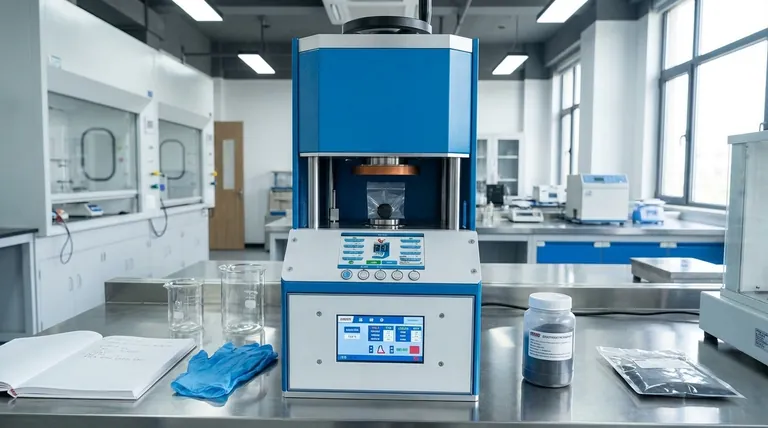
Warm Isostatic Pressing (WIP) offers a unique processing advantage by leveraging mild heating to activate the plasticity of soft electrolyte materials. By applying uniform isostatic pressure at moderate temperatures (typically up to 150°C), WIP allows softer compounds like sulfides and halides to deform and flow. This capability enables exceptional densification and the elimination of voids at pressures significantly lower than those required by cold processing methods.
The core value of WIP lies in its ability to densify materials that are too soft for high-heat sintering but too resistant for room-temperature compaction. It achieves near-perfect particle contact—essential for ionic conductivity—without exposing thermally sensitive electrolytes to the destructive temperatures of Hot Isostatic Pressing.
The Mechanism: Why Heat Matters for Soft Electrolytes
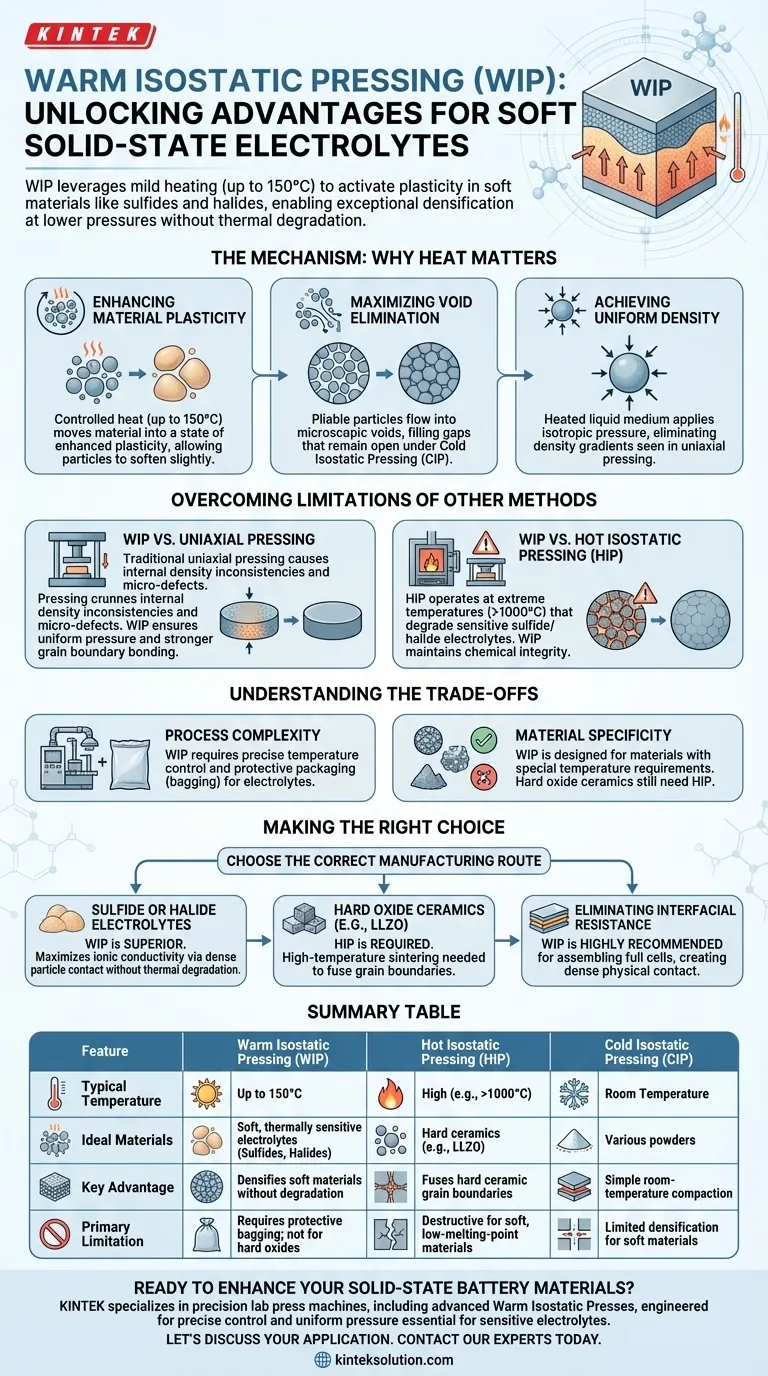
Enhancing Material Plasticity
The defining feature of WIP is the introduction of controlled heat (up to 150°C) alongside pressure. For soft materials like sulfides and halides, this temperature is critical.
It moves the material into a state of enhanced plasticity, allowing particles to soften slightly without melting or degrading.
Maximizing Void Elimination
Because the particles are more pliable, they do not just pack together; they flow into irregularities.
This allows the material to fill microscopic voids and gaps that would remain open under standard Cold Isostatic Pressing (CIP).
Achieving Uniform Density
WIP utilizes a heated liquid medium to apply pressure from all directions simultaneously.
This ensures isotropic densification, eliminating the density gradients often seen in materials processed via uniaxial pressing.
Overcoming Limitations of Other Methods
WIP vs. Uniaxial Pressing
Traditional uniaxial pressing applies force from only one or two directions, leading to internal density inconsistencies and micro-defects.
WIP resolves this by transmitting pressure uniformly, fundamentally reducing pores and strengthening grain boundary bonding throughout the entire pellet.
WIP vs. Hot Isostatic Pressing (HIP)
It is crucial to distinguish WIP from Hot Isostatic Pressing (HIP). HIP operates at extreme temperatures (e.g., 1158°C) suitable for hard ceramics like Al-LLZ.
Such high temperatures would degrade or destroy sulfide and halide electrolytes. WIP provides the necessary densification within a temperature range that maintains the chemical integrity of these sensitive materials.
Understanding the Trade-offs
Process Complexity
WIP is more complex than simple die pressing. It requires the management of a liquid medium and precise temperature controls.
This often necessitates protective packaging (bagging) for the electrolyte material to prevent contamination or reaction with the pressurizing fluid.
Material Specificity
WIP is a specialized tool. It is specifically designed for materials with special temperature requirements or those that cannot be successfully molded at room temperature.
It is not a universal replacement for HIP; hard oxide ceramics will still require the extreme heat of HIP to achieve full density.
Making the Right Choice for Your Project
To determine if WIP is the correct manufacturing route for your solid-state battery application, consider your material properties and performance goals.
- If your primary focus is processing sulfide or halide electrolytes: WIP is the superior choice, as it maximizes ionic conductivity through dense particle contact without thermal degradation.
- If your primary focus is processing hard oxide ceramics (like LLZO): WIP will likely be insufficient; you will require the high-temperature sintering capabilities of HIP to fuse grain boundaries.
- If your primary focus is eliminating interfacial resistance: WIP is highly recommended for assembling full cells, as it creates dense physical contact between the electrolyte, electrode, and protective layers.
By matching the plasticity of your material to the moderate thermal profile of Warm Isostatic Pressing, you can achieve a dense, high-performance electrolyte structure that standard pressing methods cannot replicate.
Summary Table:
| Feature | Warm Isostatic Pressing (WIP) | Hot Isostatic Pressing (HIP) | Cold Isostatic Pressing (CIP) |
|---|---|---|---|
| Typical Temperature | Up to 150°C | High (e.g., >1000°C) | Room Temperature |
| Ideal Materials | Soft, thermally sensitive electrolytes (Sulfides, Halides) | Hard ceramics (e.g., LLZO) | Various powders |
| Key Advantage | Densifies soft materials without degradation | Fuses hard ceramic grain boundaries | Simple room-temperature compaction |
| Primary Limitation | Requires protective bagging; not for hard oxides | Destructive for soft, low-melting-point materials | Limited densification for soft materials |
Ready to enhance the performance of your solid-state battery materials?
KINTEK specializes in precision lab press machines, including advanced isostatic press solutions. Our Warm Isostatic Presses are engineered to provide the precise control and uniform pressure essential for processing sensitive sulfide and halide electrolytes, helping you achieve the high density and ionic conductivity required for next-generation batteries.
Let's discuss how our technology can benefit your specific application. Contact our experts today for a personalized consultation.
Visual Guide
Related Products
- Warm Isostatic Press for Solid State Battery Research Warm Isostatic Press
- Lab Isostatic Pressing Molds for Isostatic Molding
- Electric Lab Cold Isostatic Press CIP Machine
- Automatic Lab Cold Isostatic Pressing CIP Machine
- Electric Split Lab Cold Isostatic Pressing CIP Machine
People Also Ask
- Why must composite cathodes be sealed in vacuum lamination bags for WIP? Ensure Battery Stability and Density
- What is the function of elastic molds in warm isostatic pressing? Achieve Uniform Density in Composite Particles
- How do sacrificial volume materials (SVM) maintain microchannels in isostatic pressing? Ensure Structural Integrity
- What is the significance of temperature control in Warm Isostatic Pressing? Unlock Uniform Densification and Process Stability
- How does Warm Isostatic Pressing differ from traditional pressing methods? Unlock Uniform Density for Complex Parts



















