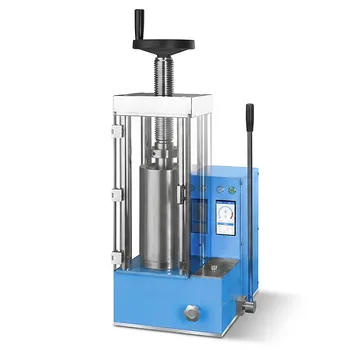
Advanced features in laboratory presses fundamentally transform experimental control. While basic models may suffice for rough applications, the integration of digital pressure displays and programmable settings provides critical benefits in accuracy and reproducibility. These tools shift the operation from subjective manual estimation to precise, data-driven control, ensuring that experimental conditions can be replicated exactly.
The primary value of digital integration in laboratory presses is the elimination of operator variables. By digitizing pressure monitoring and programming settings, you ensure consistent, highly reproducible results essential for scientific reliability.
The Impact on Experimental Integrity
The core purpose of any laboratory press is to prepare samples that yield reliable data. Advanced features directly address the variables that threaten this reliability.
Ensuring Reproducibility
In scientific experimentation, the ability to repeat a test and get the same result is paramount. Manual gauges can be misread or interpreted differently by different operators.
Digital displays eliminate this ambiguity. They provide an exact numerical readout, ensuring that "10 tons" of force is applied exactly the same way, regardless of who is operating the machine.
Maximizing Accuracy
Beyond consistency, advanced presses ensure the force applied matches the protocol requirements precisely.
Programmable settings allow users to input exact parameters. This removes the guesswork often associated with manual levers or valves, ensuring the pellet is pressed to strict specifications every time.
Streamlining Workflow and Usability
Advanced features do not just improve the data; they also improve the operator's experience. This is vital for laboratories with high throughput requirements.
Enhancing User Convenience
Reading a fluctuating needle on an analog gauge requires focus and interpretation.
Digital readouts offer immediate clarity. This reduces the cognitive load on the technician, allowing them to focus on sample preparation rather than monitoring mechanical dials.
Automating Repetitive Tasks
Programmable settings allow for the standardization of routines.
If a lab requires pressing 50 samples a day at a specific pressure, programmable features automate the target points. This significantly speeds up the workflow while maintaining the consistency required for comparative analysis.
Understanding the Trade-offs
While advanced digital features offer significant advantages, it is important to consider the operational context.
Complexity and Maintenance
Advanced features introduce electronic components into a mechanical workflow.
While a manual press is purely mechanical and often easier to repair, digital systems may require power sources and occasional calibration to maintain their accuracy. Users must ensure that the electronic displays are functioning correctly to trust the "precision" they provide.
Making the Right Choice for Your Goal
Deciding between a standard manual press and one with advanced digital features depends on your specific data requirements.
- If your primary focus is High-Precision Analytical Testing: Prioritize digital pressure displays to ensure every sample is processed under identical conditions for valid data comparison.
- If your primary focus is High-Throughput Efficiency: Leverage programmable settings to standardize the workflow, reduce operator error, and speed up sample processing.
By choosing the right level of technology, you ensure your laboratory equipment serves your data, not the other way around.
Summary Table:
| Feature | Key Benefit | Impact on Laboratory Results |
|---|---|---|
| Digital Displays | Eliminates operator ambiguity | Precise, repeatable pressure application |
| Programmable Settings | Standardized routines | High throughput with consistent sample density |
| Electronic Monitoring | Real-time data tracking | Enhanced accuracy for sensitive analytical testing |
| Automated Controls | Reduced manual labor | Minimizes cognitive load and human error |
Elevate Your Research with KINTEK’s Precision Pressing Solutions
Don’t let manual inconsistencies compromise your data. KINTEK specializes in comprehensive laboratory pressing solutions, offering a versatile range of manual, automatic, heated, and multifunctional models. Whether you need glovebox-compatible setups for sensitive materials or advanced cold and warm isostatic presses for battery research, we provide the tools to ensure maximum reproducibility.
Ready to upgrade your workflow? Contact us today to find the perfect press for your specific application and experience the KINTEK advantage in scientific reliability.
Related Products
- Laboratory Hydraulic Press Lab Pellet Press Machine for Glove Box
- Automatic Heated Hydraulic Lab Press with Programmable Touch Screen Controls and Precision Temperature Regulation
- Automatic Laboratory Hydraulic Press Lab Pellet Press Machine
- Lab Infrared Press Mold for Laboratory Applications
- Automatic Heated Hydraulic Press Machine with Hot Plates for Laboratory
People Also Ask
- How does a laboratory hydraulic press contribute to the preparation of Li3-3xScxSb samples? Optimize Ionic Conductivity
- What is the function of a laboratory hydraulic press in FT-IR of curcumin-coated MWCNTs? Achieve Optical Clarity.
- Why is a laboratory hydraulic press required for compression molding boron-siloxane? Solve High-Loading Density Challenges
- What role does a laboratory hydraulic press play in the preparation of piezoelectric ceramic discs for DC-PG? | KINTEK
- What role does a laboratory hydraulic press play in reaction pellets? Optimizing Lunar Soil and Metal Fuel Density