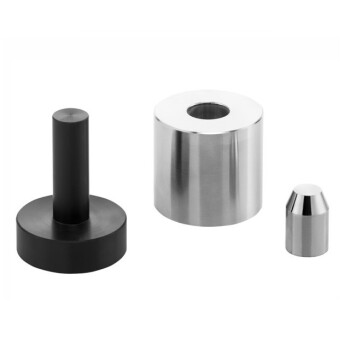
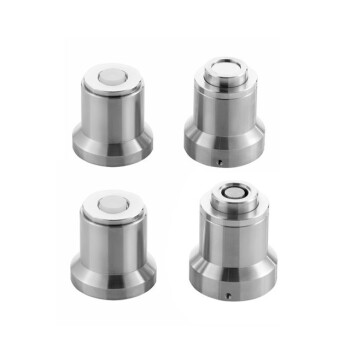
Coin cell molds function as precision mechanical constraints that are essential for evaluating pre-lithiated silicon electrodes. They provide a stable, sealed environment that applies consistent pressure to internal components, ensuring the physical integrity required to measure electrochemical performance during the intense volume changes associated with silicon cycling.
The coin cell is not merely a container; it is an active mechanical stabilizer. By physically constraining the silicon electrode against expansion, the mold allows you to isolate and verify the chemical improvements of pre-lithiation strategies—specifically Coulombic efficiency and cycle life—without mechanical disintegration skewing the data.
The Mechanics of Reliable Data Collection
Establishing Tight Interfacial Contact
To obtain valid cycling data, the internal components of the battery must remain in constant physical connection. The stainless steel shell and internal spring components of the coin cell mold work together to apply stable mechanical pressure. This forces the electrode, separator, and electrolyte into tight contact, significantly reducing interfacial contact resistance.
Constraining Volume Expansion
Silicon electrodes experience drastic physical expansion and contraction during charging and discharging. The rigid coin cell mold provides a physical constraint environment that counters this expansion. This mechanical restriction is critical for preventing the electrode material from pulverizing or delaminating during the test.
Verifying Pre-lithiation Efficacy
Pre-lithiation is designed to offset lithium loss and improve efficiency, but these chemical benefits can only be measured if the electrode remains mechanically intact. Because the mold stabilizes the physical structure, it serves as a standardized platform for verification. It ensures that changes in cycle life are attributed to the pre-lithiation strategy rather than mechanical failure of the cell assembly.
The Role of Hermetic Sealing
Preventing Environmental Contamination
The reliability of long-term testing depends on a pristine internal environment. A laboratory coin cell sealer applies precisely regulated mechanical pressure to crimp the housing. This creates a hermetic seal that completely blocks external contaminants from entering the system.
Ensuring Electrolyte Stability
Long-term cycling tests for silicon anodes can take weeks or months. The seal prevents the evaporation or leakage of the electrolyte. If the electrolyte volume changes during testing, it introduces variables that make it impossible to accurately assess the performance of the pre-lithiated electrode.
Understanding the Trade-offs
The "Idealized" Pressure Problem
While the high pressure of a coin cell is beneficial for stabilizing silicon, it can create an "idealized" environment. The strong spring pressure may mask adhesion problems or electrode swelling issues that would lead to failure in commercial formats, such as pouch cells, where pressure is less uniform.
Sealing Pressure Sensitivity
The performance of the cell is highly sensitive to the initial sealing pressure applied by the crimper. Inconsistent sealing pressure can lead to variations in contact resistance between different coin cells in the same batch, potentially creating noise in your data that misrepresents the actual consistency of your pre-lithiation process.
Making the Right Choice for Your Goal
To ensure your pre-lithiated silicon data is robust, tailor your approach to the specific testing phase:
- If your primary focus is validating electrochemical efficiency: Rely on the coin cell's rigid constraint to mechanically stabilize the silicon, allowing you to isolate the true impact of pre-lithiation on Coulombic efficiency.
- If your primary focus is long-term cycle life consistency: Standardize your sealing pressure to ensure uniform internal contact and prevent electrolyte loss, which acts as a confounding variable in extended tests.
By treating the coin cell mold as a critical mechanical component rather than just a holder, you ensure your data reflects the chemistry of your electrode, not the artifacts of your assembly.
Summary Table:
| Feature | Function in Silicon Electrode Evaluation | Benefit to Pre-lithiation Testing |
|---|---|---|
| Mechanical Constraint | Counters volume expansion and prevents pulverization | Isolates chemical performance from mechanical failure |
| Internal Spring Pressure | Reduces interfacial contact resistance | Ensures consistent electrochemical data collection |
| Hermetic Sealing | Prevents electrolyte leakage and contamination | Maintains stability during long-term cycling tests |
| Standardized Platform | Provides a uniform physical environment | Enables accurate verification of Coulombic efficiency |
Elevate Your Battery Research with KINTEK Precision
Reliable data on pre-lithiated silicon electrodes starts with the right mechanical environment. KINTEK specializes in comprehensive laboratory pressing and battery assembly solutions, offering manual and automatic models, as well as specialized isostatic presses designed for the rigors of advanced battery research.
Whether you need precision coin cell molds, glovebox-compatible equipment, or high-pressure isostatic solutions, our experts are ready to help you achieve consistent, high-fidelity results.
Ready to optimize your lab's performance? Contact us today to find the perfect pressing solution for your research goals.
References
- Aleksei Kolesnikov, Johannes Kasnatscheew. Toward Higher Prelithiation Degree of High‐Capacity Si‐Based Anodes via Physical Vapor Deposition: Impact on Homogeneity and Performance. DOI: 10.1002/aesr.202500150
This article is also based on technical information from Kintek Solution Knowledge Base .
Related Products
- Lab Button Battery Tablet Press Sealing Mold
- Lab Button Battery Disassembly and Sealing Mold
- Assemble Lab Cylindrical Press Mold for Laboratory Use
- Lab Cylindrical Press Mold for Laboratory Use
- Lab Cylindrical Press Mold with Scale
People Also Ask
- How does a sealed battery mold facilitate the assembly and testing of asymmetric supercapacitors using VO2?
- Why use standardized CR2032 components & high-precision presses? Ensure reliability in lithium metal battery research.
- Why is a laboratory battery sealing press essential for desolvation energy testing? Ensure Reliable Kinetic Data
- What is the function of specialized battery molds and sealing consumables? Optimize Your In-situ XRD Testing Today
- What role does a laboratory sealing press play in thermal analysis of solid dispersion films? Ensure Data Integrity