
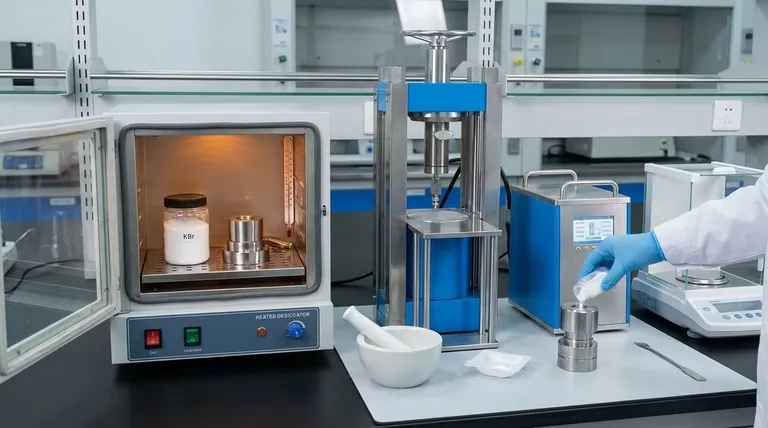
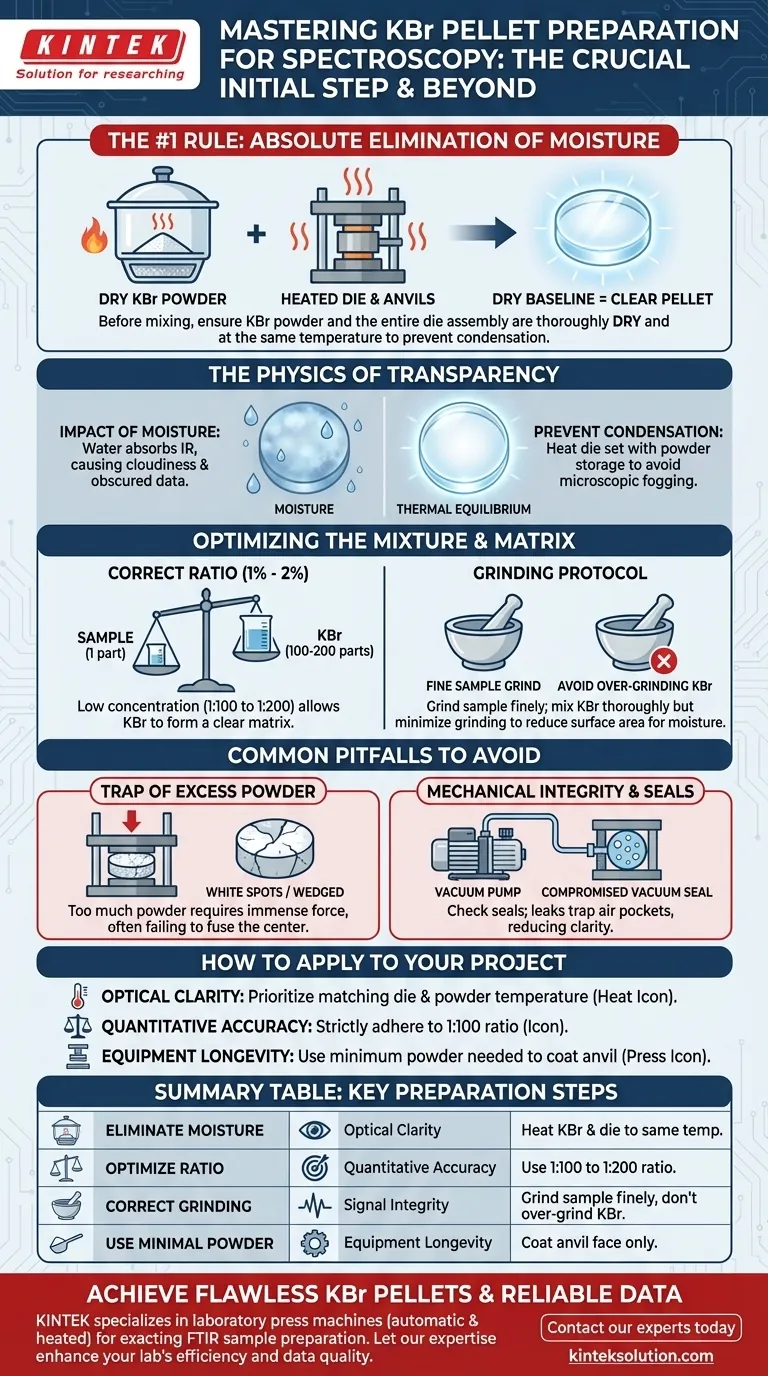
The single most crucial initial step in preparing KBr pellets is the absolute elimination of moisture from both the potassium bromide powder and the mechanical die assembly. Before you begin mixing or grinding, you must ensure the KBr powder is thoroughly dry—typically stored in a heated desiccator—and that the anvils and die body have been heated to remove any residual humidity. Failing to establish this dry baseline will inevitably result in cloudy pellets that compromise spectral quality.
Moisture is the primary cause of failed pellets and obscured data in FTIR analysis; the optical transparency of your pellet depends entirely on maintaining a completely dry thermal equilibrium between your powder and your tools.
The Physics of Pellet Transparency
The Impact of Moisture on Signal
Water is an intense absorber of infrared radiation. If your KBr powder or die assembly contains even trace amounts of moisture, the resulting pellet will appear cloudy or opaque.
This opacity scatters light and introduces broad interference bands in the spectral data, specifically in the O-H stretching region. This obscures the peaks of your actual sample, rendering the analysis unreliable.
Establishing Thermal Equilibrium
It is not enough to simply use dry powder; you must ensure the anvils, the die body, and the powder are at the same temperature.
If you introduce warm, dry powder to cold metal anvils, condensation can form immediately on the contact surfaces. By heating the die set alongside the powder storage, you prevent this microscopic "fogging" that degrades transparency.
Optimizing the Mixture and Matrix
Achieving the Correct Ratio
The principle of the KBr method relies on the salt becoming plastic under pressure to form a clear matrix. To achieve this, the sample concentration must be low, typically between 1% and 2% by weight (a 1:100 to 1:200 ratio).
Using too much sample material disrupts the crystal lattice of the KBr. This prevents the mixture from fusing into a solid, transparent disc, resulting in a fragile or opaque pellet.
The Grinding Protocol
The sample itself must be ground into a fine powder before it is combined with the KBr. Large sample particles scatter light, causing a sloping baseline in your spectrum (the Christiansen effect).
However, once you add the KBr, you should mix thoroughly but avoid excessive grinding of the salt itself. Grinding KBr crystals exposes new facets, which significantly increases their surface area and rate of moisture absorption.
Common Pitfalls to Avoid
The Trap of Excess Powder
One of the most frequent errors in spectroscopy labs is filling the die with too much KBr powder. A thicker pellet requires exponentially more force to become transparent.
If you use too much powder, even a hydraulic press applying 10 tonnes of load may fail to fuse the center of the disc. This results in "white spots" or a pellet that wedges tightly inside the die, risking damage to the equipment during extraction.
Mechanical Integrity and Vacuum Seals
If your pressing method involves a vacuum line to evacuate air from the die, you must verify the condition of the seals.
A compromised seal prevents the removal of trapped air pockets. These microscopic bubbles remain in the pellet after pressing, reducing clarity and weakening the physical structure of the disc.
How to Apply This to Your Project
To ensure your spectral data is both accurate and reproducible, align your preparation method with your specific analytical goals:
- If your primary focus is optical clarity: Prioritize heating the die set and anvils to match the temperature of the stored KBr to prevent condensation.
- If your primary focus is quantitative accuracy: Strictly adhere to the 1:100 weight ratio to ensure the sample is suspended evenly without saturating the matrix.
- If your primary focus is equipment longevity: Use the minimum amount of powder necessary to coat the anvil face, reducing the force required to form a stable disc.
Mastering the variable of moisture control is the difference between a cloudy, useless disc and a professional-grade spectral window.
Summary Table:
| Key Preparation Step | Primary Goal | Critical Action |
|---|---|---|
| Eliminate Moisture | Optical Clarity | Heat KBr powder and die assembly to the same temperature. |
| Optimize Ratio | Quantitative Accuracy | Use a 1:100 to 1:200 sample-to-KBr weight ratio. |
| Correct Grinding | Signal Integrity | Grind sample finely, but avoid over-grinding KBr salt. |
| Use Minimal Powder | Equipment Longevity | Use just enough powder to coat the anvil face. |
Achieve flawless KBr pellets and reliable spectroscopy data every time. The right lab press is essential for applying the precise, consistent pressure needed for transparent pellets. KINTEK specializes in laboratory press machines, including automatic and heated lab presses, designed to meet the exacting demands of sample preparation for FTIR analysis. Let our expertise help you enhance your lab's efficiency and data quality. Contact our experts today to find the perfect press for your spectroscopy needs!
Visual Guide
Related Products
- Laboratory Hydraulic Press 2T Lab Pellet Press for KBR FTIR
- XRF KBR Plastic Ring Lab Powder Pellet Pressing Mold for FTIR
- XRF KBR Steel Ring Lab Powder Pellet Pressing Mold for FTIR
- Laboratory Hydraulic Pellet Press for XRF KBR FTIR Lab Press
- Automatic Laboratory Hydraulic Press for XRF and KBR Pellet Pressing
People Also Ask
- What is the role of a laboratory pressure machine and KBr in FTIR? Master Sample Preparation for Flame Retardants
- What is the role of a laboratory hydraulic press in high-loading NCM811 cathode prep for solid-state batteries?
- Why is a laboratory hydraulic press necessary for sample preparation? Precise Pelleting for Spiro Heterocyclic Analysis
- What role does a laboratory hydraulic press play in reaction pellets? Optimizing Lunar Soil and Metal Fuel Density
- What is a laboratory hydraulic press? Essential Guide to Precision Sample Preparation and Testing



















