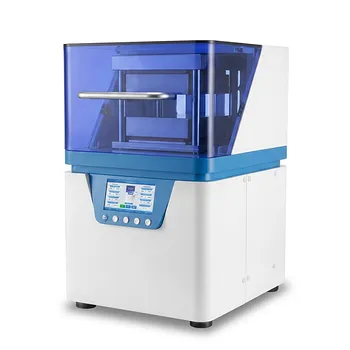
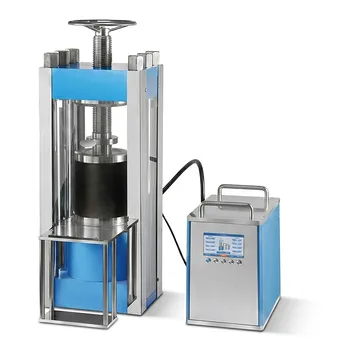
A hot press machine, also referred to as a hot hydraulic press, is an industrial device that utilizes a precise combination of heat and pressure to bond, shape, or level materials.
Fundamentally, its operation relies on the First Law of Thermodynamics, where heat transfer changes the internal energy of the material while mechanical force sets the structure. The machine is typically driven by oil pressure and compressed air, housed within a rigid frame constructed from a single processed steel plate to withstand immense physical stress.
The core value of a hot press machine is not just in applying force, but in the synchronized delivery of thermal energy and hydraulic pressure. This dual action creates bonds and shapes that are significantly stronger and more uniform than those achieved by pressure or heat alone.
How the Technology Works
The Thermodynamic Principle
The machine functions by transferring heat to the components being processed, altering their internal energy states to facilitate bonding or shaping.
This process is powered by a combination of oil pressure and compressed air. Because of this, ensuring your facility has sufficient air pressure and volume is a critical prerequisite for operation.
Structural Integrity
To maintain accuracy, the machine's frame is generally built from a single processed steel plate.
This solid construction is necessary to ensure the structural integrity and durability required to prevent deformation during high-pressure cycles.
Anatomy of the Machine systems
The Heating Architecture
The heating system relies on heating platens, typically crafted from high-thermal-conductivity metals like tool steel or aluminum alloy.
These platens are often chrome-plated or nitrided to resist corrosion and wear. Inside, heating elements—such as resistance wires or induction coils—convert electrical energy into heat, while thermocouples provide precise temperature data to the controller.
The Hydraulic Core
The pressing system utilizes heavy-duty cylinders and valves to apply force.
Technically, this system must provide high, balanced pressure with a controllable fluctuation range. Advanced units include an automatic pressure replenishment function to maintain consistent force throughout the holding cycle.
Control and Precision
Modern hot press machines utilize PID (Proportional-Integral-Derivative) controllers to manage heating rates and target temperatures with extreme accuracy.
For high-precision tasks, machines may feature pulse heating technology with a sampling frequency as fast as 0.1 seconds. Operators interface with the machine via a touchscreen HMI (Human-Machine Interface) to set parameters like holding time and pressure curves.
Common Industrial Applications
Woodworking and Board Production
Hot presses are standard in the manufacturing of man-made boards, including plywood, particle board, and joinery board.
They are also utilized for veneer drying, leveling, and the surface pasting of decorative fabrics or materials onto wood substrates.
Electronics and Manufacturing
In the electronics sector, these machines are used for soldering and laminating, often melting solder-coated parts to form strong electrical connections.
Beyond electronics, they are versatile enough to produce consumer goods such as yoga mats, mouse pads, and insulation foam.
Understanding the Technical Trade-offs
Precision vs. Complexity
Achieving high precision requires complex features like four-column structures and CCD vision systems for alignment.
While these features ensure accuracy for delicate tasks like electronics bonding, they increase the maintenance overhead and operational complexity compared to simpler, rugged machines used for basic woodworking.
Thermal Uniformity vs. Energy Consumption
Ideally, a hot press uses a solid, longitudinally drilled steel plate for the heat plate to ensure uniform heat transfer.
However, heating a massive steel mass consumes significant energy. The trade-off is between the operational cost of electricity and the quality assurance provided by perfectly uniform temperature distribution across the workpiece.
Making the Right Choice for Your Goal
Selecting the correct hot press configuration depends entirely on the specific demands of your material and production volume.
- If your primary focus is high-precision electronics: Prioritize machines with pulse heating technology, CCD vision systems, and a four-column structure for exact alignment.
- If your primary focus is heavy-duty board manufacturing: Prioritize a robust single-plate steel frame and a hydraulic system with automatic pressure replenishment to ensure durability under constant load.
Ultimately, the effectiveness of a hot press machine is determined by how well its thermal and hydraulic systems are calibrated to the specific internal energy requirements of your material.
Summary Table:
| Feature | Description |
|---|---|
| Core Mechanism | Synchronized thermal energy and hydraulic pressure |
| Frame Material | Single processed steel plate for structural integrity |
| Heating Method | PID-controlled platens (Tool steel or Aluminum alloy) |
| Pressure System | Heavy-duty cylinders with automatic replenishment |
| Key Applications | Plywood production, electronics soldering, and foam molding |
| Control Tech | Pulse heating and CCD vision alignment (high-precision models) |
Elevate Your Material Research with KINTEK
As a leader in laboratory pressing solutions, KINTEK specializes in a comprehensive range of high-performance machinery. From manual and automatic models to heated, multifunctional, and glovebox-compatible units, we provide the precision tools necessary for advanced battery research and industrial material testing. Our portfolio also includes cold and warm isostatic presses designed for maximum durability and thermal uniformity.
Ready to optimize your production or research workflow? Contact us today to discover the ideal hot press solution for your laboratory needs.
Related Products
- Automatic Hydraulic Heat Press Machine with Multi Stage Programmable Control and Integrated Water Cooling Plate Size 180x180mm
- Heated Hydraulic Press Machine with Heated Plates for Vacuum Box Laboratory Hot Press
- Automatic High Temperature Heated Hydraulic Press Machine with Heated Plates for Lab
- Automatic Heated Hydraulic Press Machine with Hot Plates for Laboratory
- Laboratory Split Manual Heated Hydraulic Press Machine with Hot Plates
People Also Ask
- How does a laboratory hydraulic heat press facilitate the molding of cellulose composite specimens? Precision Molding
- How is a hydraulic heat press used for sample preparation? Achieve Uniform, Void-Free Samples for Lab Analysis
- What is the role of a hydraulic heat press in material testing? Unlock Superior Data for Research & QC
- What is a hydraulic heat press? Discover Precision Material Bonding and Sample Preparation
- What are the industrial applications of a hydraulic heat press? Powering Lamination, Bonding, and R&D Efficiency