
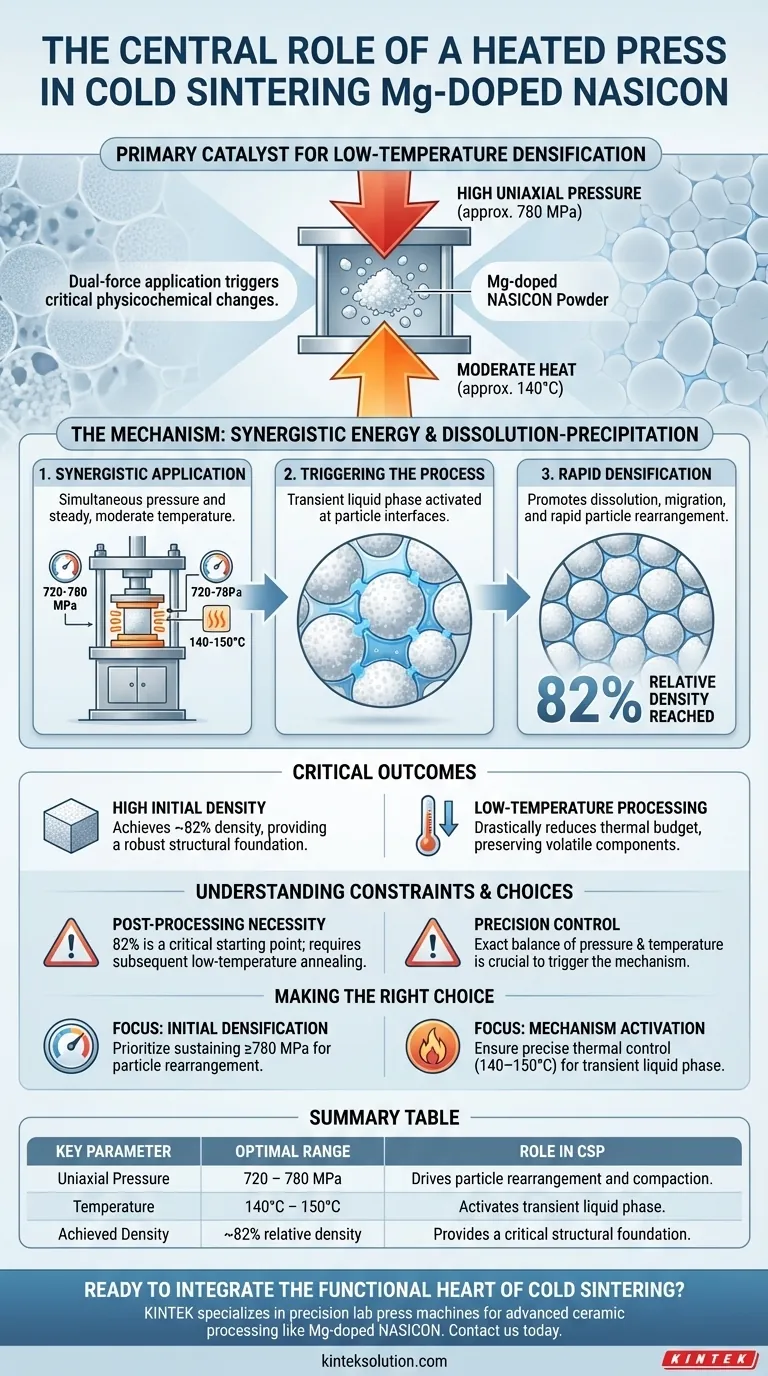
The central role of the press machine is to act as the primary catalyst for low-temperature densification by simultaneously applying high uniaxial pressure and moderate heat. This dual-force application triggers the critical physicochemical changes necessary to compact Mg-doped NASICON powder into a dense solid without the extreme temperatures required by conventional methods.
The Core Insight The press machine does not merely shape the powder; it creates a specific thermodynamic environment where high pressure (approx. 780 MPa) and moderate heat (approx. 140°C) work synergistically. This combination activates a dissolution-precipitation mechanism, allowing the material to reach a high relative density of roughly 82% before final annealing.
The Mechanism of Densification
Synergistic Application of Energy
The defining feature of this equipment is its ability to deliver two forms of energy concurrently.
Rather than separating compaction and heating steps, the machine subjects the material to significant pressure (ranging from 720 to 780 MPa) while maintaining a steady, moderate temperature (between 140°C and 150°C).
Triggering the Dissolution-Precipitation Process
This simultaneous environment is engineered to facilitate a specific chemical mechanism known as dissolution-precipitation.
Under these conditions, a transient liquid phase is activated at the interfaces of the powder particles.
This liquid phase promotes the dissolution of the ceramic material at contact points and aids its migration, allowing particles to rearrange and bond rapidly.
Critical Outcomes for Mg-doped NASICON
Achieving High Initial Density
The press machine is directly responsible for achieving a substantial initial density, typically around 82%.
This is a high density value for a ceramic processed at such low temperatures, providing a robust structural foundation for the material.
Enabling Low-Temperature Processing
By utilizing mechanical pressure to drive densification, the process drastically reduces the thermal budget required.
This capability allows the electrolyte to densify at temperatures significantly below those used in conventional sintering, preserving the stoichiometry of volatile components.
Understanding the Process Constraints
The Necessity of Post-Processing
While the press machine achieves impressive initial densification, it is not the final step in the manufacturing chain.
The references indicate that the 82% density achieved is a "critical" starting point for a subsequent low-temperature annealing step.
Therefore, the press must be viewed as an enabler for final performance, rather than a standalone solution for full densification.
Precision Control Requirements
The effectiveness of the process relies heavily on the specific balance of pressure and temperature.
Deviating from the optimal parameters (e.g., 780 MPa and 140°C) may fail to trigger the necessary transient liquid phase, preventing the dissolution-precipitation mechanism from occurring effectively.
Making the Right Choice for Your Goal
To maximize the efficacy of the Cold Sintering Process for Mg-doped NASICON, focus on these operational priorities:
- If your primary focus is Initial Densification: Prioritize pressure capabilities, ensuring your equipment can sustain at least 780 MPa to drive particle rearrangement.
- If your primary focus is Mechanism Activation: Ensure precise thermal control around 140°C–150°C to successfully trigger the transient liquid phase without overheating the sample.
The press machine is the functional heart of the Cold Sintering Process, converting mechanical force into structural integrity through precise chemical activation.
Summary Table:
| Key Parameter | Optimal Range | Role in CSP |
|---|---|---|
| Uniaxial Pressure | 720 - 780 MPa | Drives particle rearrangement and compaction. |
| Temperature | 140°C - 150°C | Activates transient liquid phase for dissolution-precipitation. |
| Achieved Density | ~82% relative density | Provides a critical structural foundation before annealing. |
Ready to integrate the functional heart of the Cold Sintering Process into your lab?
KINTEK specializes in precision lab press machines, including automatic and heated lab presses designed for advanced ceramic processing like Mg-doped NASICON. Our equipment delivers the exact pressure and thermal control required to successfully trigger dissolution-precipitation mechanisms and achieve high initial densities at low temperatures.
Contact us today using the form below to discuss how our solutions can accelerate your materials research and development.
Visual Guide
Related Products
- Automatic High Temperature Heated Hydraulic Press Machine with Heated Plates for Lab
- Automatic Heated Hydraulic Press Machine with Hot Plates for Laboratory
- Automatic Heated Hydraulic Press Machine with Heated Plates for Laboratory
- 24T 30T 60T Heated Hydraulic Lab Press Machine with Hot Plates for Laboratory
- Heated Hydraulic Press Machine with Heated Plates for Vacuum Box Laboratory Hot Press
People Also Ask
- Function of a Laboratory Hydraulic Press with Heated Platens in SSE? Enhance Battery Density & Conductivity
- What are the requirements for electrode pressing with high-viscosity ionic liquids like EMIM TFSI? Optimize Performance
- How does a laboratory heated hydraulic press facilitate PBN sample prep for WAXS? Achieve Precise X-Ray Scattering
- What are the industrial applications of heated hydraulic presses? Master Heat & Force for Precision Manufacturing
- Why is a laboratory hydraulic press with heating plates required for PLA/TEC films? Achieve Precise Sample Integrity



















