
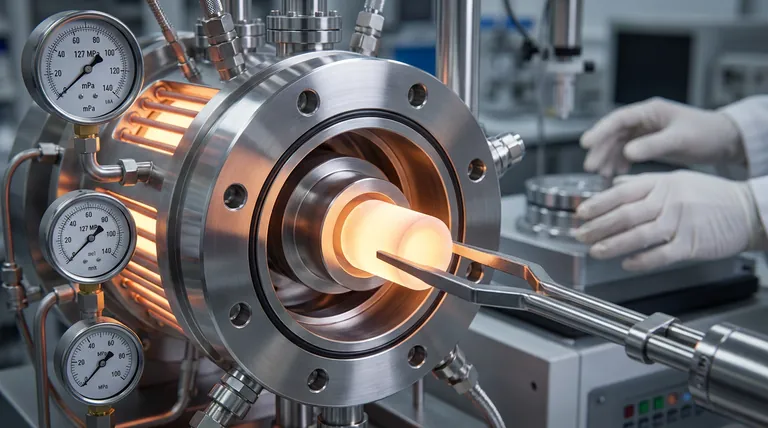
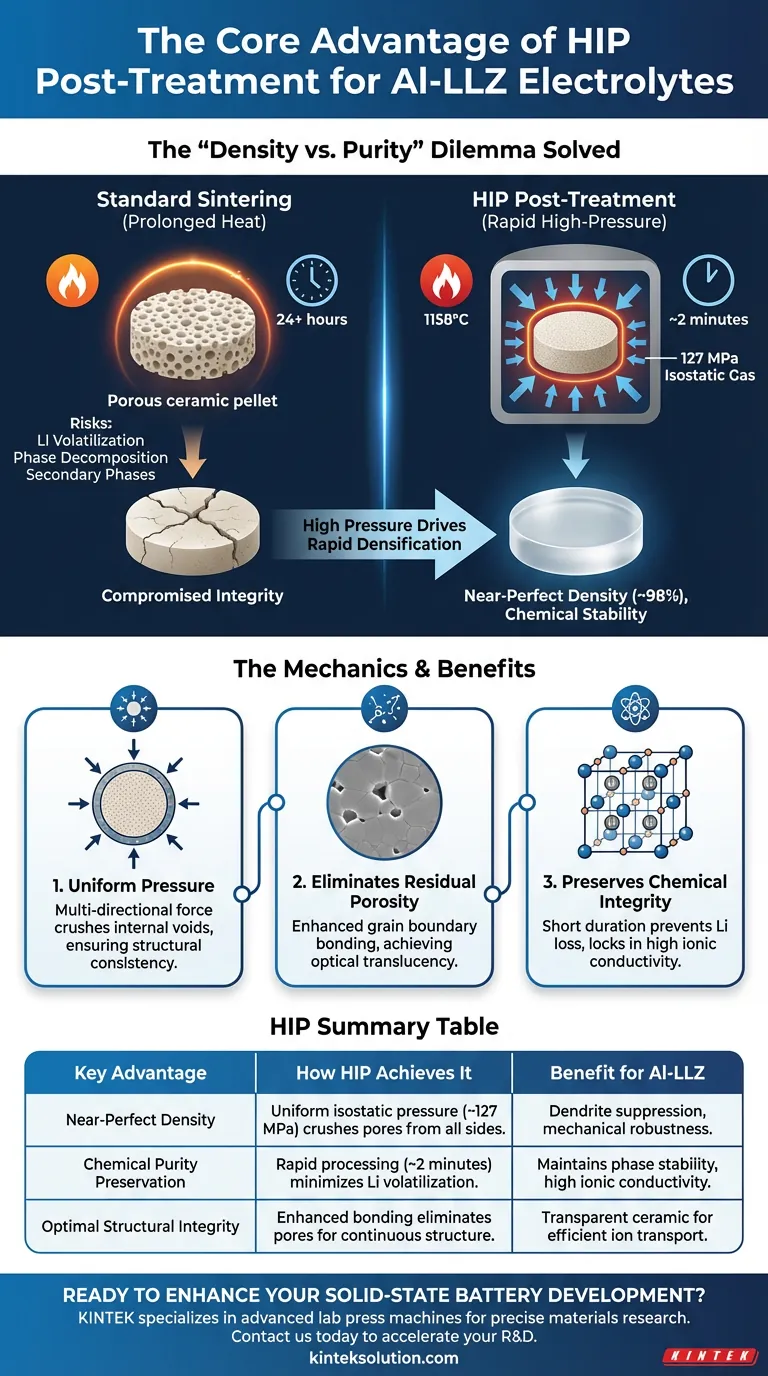
The primary advantage of using a Hot Isostatic Press (HIP) post-treatment on Al-LLZ electrolytes is the achievement of near-perfect material density without compromising chemical stability. By applying high temperature (e.g., 1158°C) and uniform high-pressure gas (e.g., 127 MPa) simultaneously, the process eliminates residual porosity to reach a relative density of approximately 98%. This creates a mechanically robust ceramic structure essential for high-performance solid-state batteries.
Core Insight: The HIP process solves the "density vs. purity" dilemma. It utilizes high pressure to drive rapid densification in as little as two minutes, effectively closing internal pores while preventing the lithium volatilization and phase decomposition often caused by prolonged exposure to high heat.
The Mechanics of Densification
Applying Uniform Pressure
Unlike uniaxial hot-pressing techniques that apply force in a single direction, HIP utilizes a gas medium to apply uniform isostatic pressure to the ceramic pellet.
This multi-directional force, often reaching 127 MPa, acts on the material from all sides. It effectively crushes internal voids and forces particles together, ensuring consistent structural integrity throughout the entire volume of the electrolyte.
Eliminating Residual Porosity
Standard sintering methods frequently leave microscopic pores within the ceramic material.
HIP acts as a definitive post-treatment step that eliminates this residual porosity. The combination of heat and pressure promotes enhanced grain boundary bonding, boosting the relative density to approximately 98%.
Achieving Optical Translucency
The elimination of pores is so effective that the resulting ceramic structure can become transparent.
This high level of density is not merely aesthetic; it is a visual indicator that the material has achieved the structural continuity required for optimal electrochemical function.
Preserving Chemical Integrity
The Efficiency of Rapid Processing
A critical feature of the HIP process is its speed. The immense driving force provided by high pressure allows for complete densification in a very short duration, typically around 2 minutes.
This efficiency is a distinct technological advantage over conventional sintering, which requires longer dwell times to achieve similar densities.
Preventing Lithium Volatilization
Extended exposure to high temperatures is a known risk for Al-LLZ materials, often leading to the evaporation of lithium.
By minimizing the dwell time at high temperatures (e.g., 1158°C), the rapid HIP process prevents lithium volatilization. This ensures the chemical composition remains stable and preserves the material's phase purity.
Avoiding Secondary Phases
Longer heat treatments can induce material decomposition or the formation of undesirable secondary phases that impede performance.
The short-duration HIP treatment effectively bypasses these issues. It locks in the desired crystal structure, ensuring the final product retains high ionic conductivity.
Understanding the Operational Trade-offs
The Necessity of Precision Timing
While HIP is powerful, its advantage relies heavily on the "short-duration" strategy mentioned in the reference data.
The benefit of HIP is lost if the material is exposed to these extreme temperatures for too long. If the process duration extends beyond the efficient window (e.g., significantly longer than 2 minutes), the risk of material decomposition and lithium loss returns, negating the benefits of the high-pressure environment.
Balancing Density and Purity
The process is a balancing act between physical mechanics and chemical stability.
You are using extreme force to improve mechanical properties (density) while racing against the clock to maintain chemical properties (purity). Success depends on utilizing the high pressure to finish the job before thermal degradation sets in.
Making the Right Choice for Your Goal
When integrating HIP into your Al-LLZ fabrication workflow, align the process parameters with your specific performance targets.
- If your primary focus is Safety and Durability: Prioritize achieving a relative density of 98% or higher, as this highly dense structure is crucial for suppressing lithium dendrite growth.
- If your primary focus is Efficiency and Conductivity: Strictly control the processing time to approximately 2 minutes to minimize interfacial resistance and prevent the formation of resistive secondary phases.
By leveraging the high-pressure speed of HIP, you transform a porous ceramic into a dense, conductive, and chemically pure electrolyte suitable for advanced energy storage.
Summary Table:
| Key Advantage | How HIP Achieves It | Benefit for Al-LLZ Electrolytes |
|---|---|---|
| Near-Perfect Density | Uniform isostatic pressure (e.g., 127 MPa) crushes pores from all sides. | Achieves ~98% relative density, enabling dendrite suppression and mechanical robustness. |
| Chemical Purity Preservation | Rapid processing (~2 minutes) at high temperature minimizes lithium volatilization. | Maintains phase stability and high ionic conductivity. |
| Optimal Structural Integrity | Enhanced grain boundary bonding eliminates residual porosity. | Creates a continuous, transparent ceramic structure for efficient ion transport. |
Ready to enhance your solid-state battery development with precision lab press technology? KINTEK specializes in advanced lab press machines, including isostatic presses, designed to meet the exacting demands of materials research like Al-LLZ electrolyte fabrication. Our equipment delivers the uniform pressure and rapid processing capabilities essential for achieving high-density, high-purity materials.
Contact us today to explore how our solutions can accelerate your R&D and improve your battery performance.
Get in touch with our experts now!
Visual Guide
Related Products
- Warm Isostatic Press for Solid State Battery Research Warm Isostatic Press
- Automatic High Temperature Heated Hydraulic Press Machine with Heated Plates for Lab
- Automatic Heated Hydraulic Press Machine with Hot Plates for Laboratory
- Automatic Heated Hydraulic Press Machine with Heated Plates for Laboratory
- Manual Heated Hydraulic Lab Press with Integrated Hot Plates Hydraulic Press Machine
People Also Ask
- Why must composite cathodes be sealed in vacuum lamination bags for WIP? Ensure Battery Stability and Density
- How do sacrificial volume materials (SVM) maintain microchannels in isostatic pressing? Ensure Structural Integrity
- What is the function of elastic molds in warm isostatic pressing? Achieve Uniform Density in Composite Particles
- What is the function of hydraulic pressure in warm isostatic pressing? Achieve Uniform Material Density
- What is the significance of temperature control in Warm Isostatic Pressing? Unlock Uniform Densification and Process Stability



















