
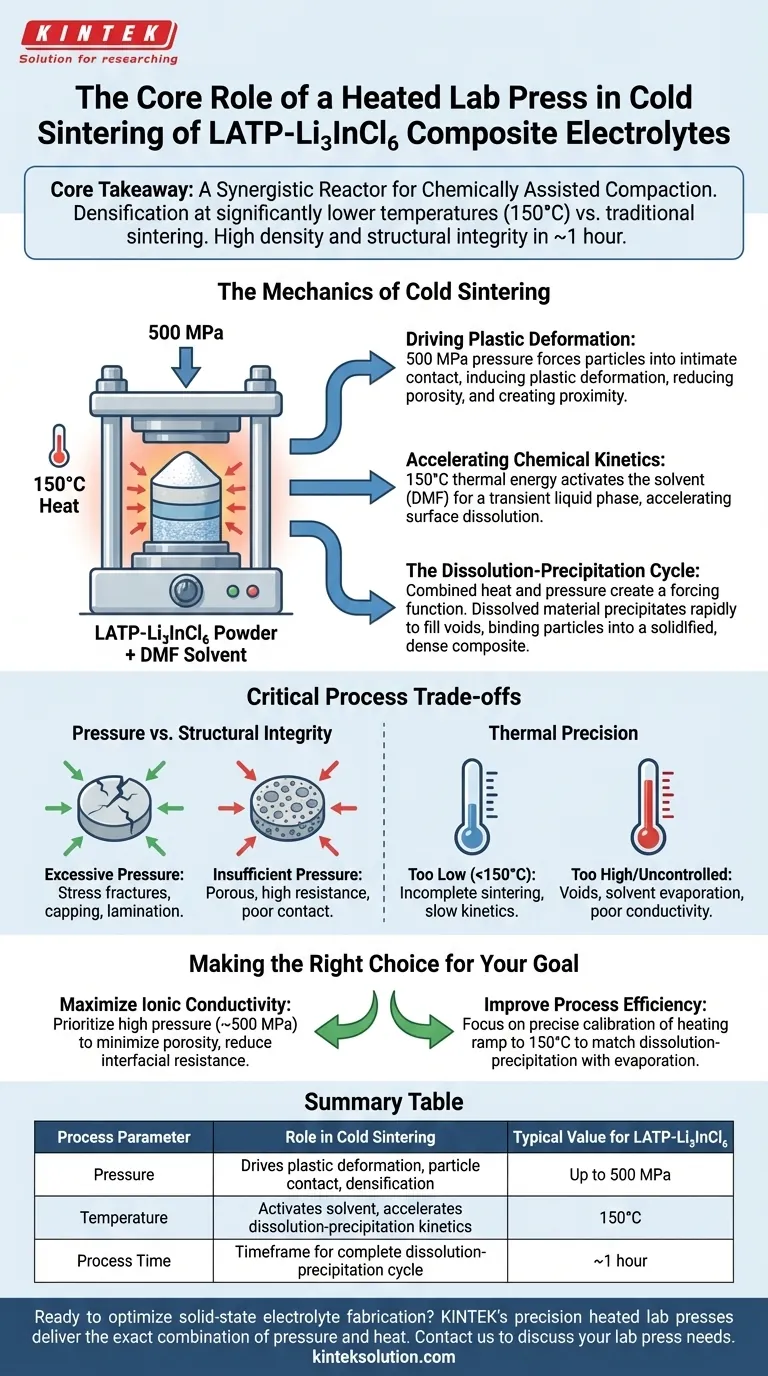
The core role of a heated lab press in this process is to act as a synergistic reactor, facilitating densification not through melting, but through chemically assisted compaction. Specifically for LATP-Li₃InCl₆ composites, the press simultaneously applies high uniaxial pressure (up to 500 MPa) and controlled low-temperature heat (150°C) to drive a solvent-mediated dissolution-precipitation reaction.
Core Takeaway: The heated press allows for the densification of ceramic electrolytes at temperatures significantly lower than traditional sintering. By combining mechanical force with a transient liquid phase (DMF), it achieves high material density and structural integrity in approximately one hour, bypassing the need for high-thermal energy consumption.
The Mechanics of Cold Sintering
The "cold sintering" process is fundamentally different from traditional ceramic firing or polymer hot pressing. The heated lab press orchestrates a complex interaction between physical mechanics and chemical kinetics.
Driving Plastic Deformation
The primary function of the press is to deliver substantial uniaxial force, specifically up to 500 MPa.
At this magnitude, the pressure does more than simply pack the powder. It forces the LATP and Li₃InCl₆ particles into intimate contact, inducing plastic deformation. This mechanical compaction significantly reduces porosity and minimizes the distance between particles, creating the physical proximity required for the chemical reactions to occur.
Accelerating Chemical Kinetics
While the pressure provides the contact, the thermal element—specifically 150°C—actuates the chemical process.
In this composite system, a solvent (typically DMF) is introduced to the powder. The heat applied by the press is not sufficient to melt the ceramic component. Instead, it serves to activate the solvent, creating a transient liquid phase. This heat accelerates the dissolution of surface materials into the solvent.
The Dissolution-Precipitation Cycle
The combined action of heat and pressure creates a "forcing function" for mass transport.
Under 500 MPa of pressure and 150°C heat, the dissolved material at the particle interfaces precipitates rapidly. This fills the voids between the compacted particles. The press ensures that as the solvent evaporates or is consumed, the material does not recoil but rather binds together, resulting in a solidified, dense composite in a short timeframe.
Critical Process Trade-offs
While the heated press enables efficient fabrication, the balance of parameters is unforgiving. Understanding these variables is essential for reproducibility.
Pressure vs. Structural Integrity
Applying high pressure is necessary for density, but excessive or uneven pressure can lead to stress fractures in the pellet, known as capping or lamination. Conversely, insufficient pressure prevents the particles from reaching the "percolation threshold" needed for the chemical reaction to bridge the gaps, resulting in a porous, highly resistive electrolyte.
Thermal Precision
The temperature must be precise. If the temperature is too low (below the optimal 150°C), the dissolution kinetics slow down, and the solvent may not activate effectively, leading to incomplete sintering.
If the temperature is too uncontrolled or high, the solvent may evaporate before the dissolution-precipitation process completes, leaving behind voids that cripple ionic conductivity.
Making the Right Choice for Your Goal
To optimize the fabrication of LATP-Li₃InCl₆ electrolytes, you must adjust your equipment usage based on your primary performance metric.
- If your primary focus is Ionic Conductivity: Prioritize maximizing pressure (approaching 500 MPa) to minimize porosity and reduce interfacial resistance, ensuring the most direct ion transport pathways.
- If your primary focus is Process Efficiency: Focus on the precise calibration of the heating ramp to 150°C to ensure the dissolution-precipitation reaction matches the evaporation rate of the DMF solvent.
Ultimately, the heated lab press transforms the electrolyte fabrication from a thermal challenge into a controlled, mechano-chemical process.
Summary Table:
| Process Parameter | Role in Cold Sintering | Typical Value for LATP-Li₃InCl₆ |
|---|---|---|
| Pressure | Drives plastic deformation, particle contact, and densification | Up to 500 MPa |
| Temperature | Activates solvent, accelerates dissolution-precipitation kinetics | 150°C |
| Process Time | Timeframe for complete dissolution-precipitation cycle | ~1 hour |
Ready to optimize your solid-state electrolyte fabrication?
KINTEK's precision heated lab presses are engineered to deliver the exact combination of high pressure (up to 500 MPa) and controlled, low-temperature heat (like 150°C) required for successful cold sintering processes. Whether your goal is maximizing ionic conductivity or improving process efficiency for materials like LATP-Li₃InCl₆, our automatic lab presses, isostatic presses, and heated lab presses provide the reproducibility and control your laboratory needs.
Contact us today to discuss how our lab press machines can transform your R&D and production workflows. Let's achieve superior material density together.
Visual Guide
Related Products
- Automatic High Temperature Heated Hydraulic Press Machine with Heated Plates for Lab
- 24T 30T 60T Heated Hydraulic Lab Press Machine with Hot Plates for Laboratory
- Lab Heat Press Special Mold
- Cylindrical Lab Electric Heating Press Mold for Laboratory Use
- Automatic Heated Hydraulic Press Machine with Hot Plates for Laboratory
People Also Ask
- Function of a Laboratory Hydraulic Press with Heated Platens in SSE? Enhance Battery Density & Conductivity
- What are the requirements for electrode pressing with high-viscosity ionic liquids like EMIM TFSI? Optimize Performance
- How does a laboratory heated hydraulic press facilitate PBN sample prep for WAXS? Achieve Precise X-Ray Scattering
- What are the industrial applications of heated hydraulic presses? Master Heat & Force for Precision Manufacturing
- Why is a laboratory hydraulic press with heating plates required for PLA/TEC films? Achieve Precise Sample Integrity



















