
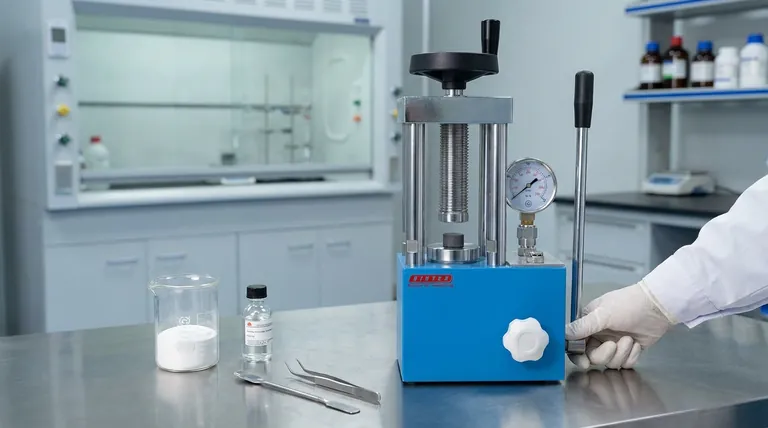
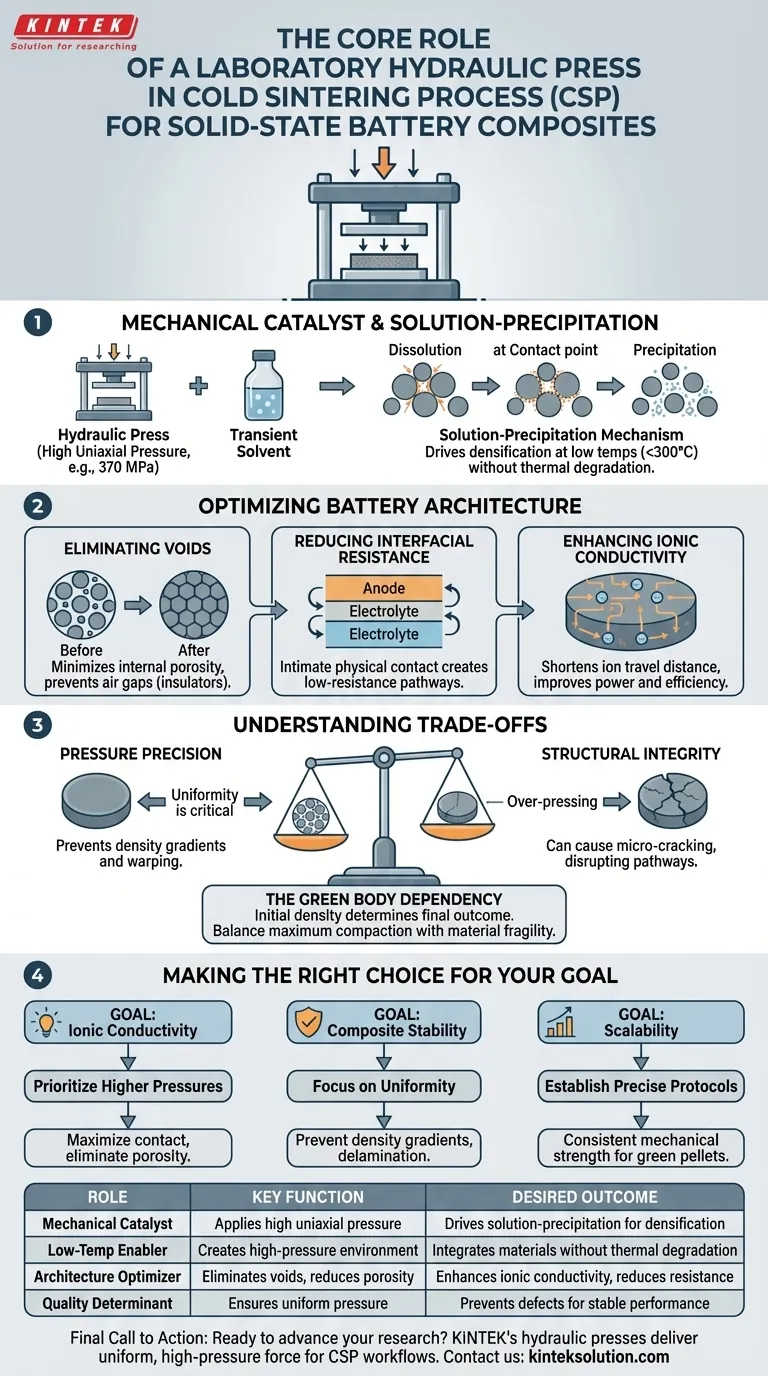
The laboratory hydraulic press acts as the primary mechanical catalyst in the Cold Sintering Process (CSP) for solid-state battery composites. Its core role is to apply high uniaxial pressure—often reaching several hundred megapascals—which drives the "solution-precipitation" mechanism. This mechanical force works synergistically with a transient solvent to enable the densification of ceramics and polymers at temperatures significantly lower (below 300°C) than traditional methods allow.
Core Insight: In Cold Sintering, the hydraulic press is not merely a shaping tool; it provides the essential thermodynamic driving force that allows mass transport to occur at low temperatures. Without this intense, precise pressure, the chemical integration of heterogeneous materials and the elimination of microscopic voids would be impossible.
The Mechanism of Densification
Driving Solution-Precipitation
In CSP, the press does more than compact powder; it facilitates a chemical process. The applied pressure increases the solubility of the solid material at particle contact points in the presence of a transient solvent.
This forces the dissolved material to diffuse through the liquid phase and precipitate on lower-stress areas of the particles. This "solution-precipitation" mechanism is the fundamental engine of CSP, directly converting mechanical energy into chemical stability.
Achieving Low-Temperature Integration
Standard sintering requires extreme heat to fuse materials, which often degrades polymers or sensitive battery components. The hydraulic press creates a high-pressure environment that allows densification below 300°C.
This low-temperature window enables the integration of disparate materials, such as ceramics and polymers, into a single composite. The press ensures these materials fuse without thermally decomposing the polymer matrix.
Optimizing Battery Architecture
Eliminating Voids and Porosity
A primary function of the press is the physical elimination of voids between active material powders and solid electrolytes. High pressure, such as 370 MPa, forces particles into a tightly packed arrangement.
This creates a dense electrode structure with minimized internal porosity. Reducing these voids is critical, as air gaps act as insulators that impede ion flow.
Reducing Interfacial Resistance
For solid-state batteries to function, ions must move freely between distinct layers. The press brings active materials and conductive additives into intimate physical contact.
By tightly pressing components—such as sodium metal anodes against electrolyte separators—the machine establishes low-resistance pathways. This continuous contact is essential for stable ion transport and accurate electrochemical performance.
Enhancing Ionic Conductivity
Ionic conductivity is directly linked to the density of the material. By compressing powders like LATP, LLZO, or LGPS into solid pellets, the press shortens the distance ions must travel.
This densification creates efficient, continuous pathways for electron and ion transport. The result is a significant improvement in the overall power capability and efficiency of the battery.
Understanding the Trade-offs
Pressure Precision vs. Structural Integrity
While high pressure is necessary, it must be applied with extreme precision. Uniformity is critical; uneven pressure can lead to density gradients within the composite.
If the pressure is uncontrolled, it may result in warping or internal stress concentrations. This can cause micro-cracking in the final pellet, which paradoxically disrupts the conductive pathways the process aims to create.
The "Green Body" Dependency
In contexts where the press creates a precursor "green pellet" for subsequent processing, the quality of the press determines the final outcome. A pellet that is not pressed to sufficient density initially will likely fail to achieve full density later.
However, over-pressing can crush fragile particle structures before they bond. The operator must balance maximum compaction with material fragility, ensuring the green body has enough mechanical strength to survive handling without compromising the particle morphology.
Making the Right Choice for Your Goal
To maximize the utility of a hydraulic press in your CSP workflow, align your pressure parameters with your specific material objectives.
- If your primary focus is Ionic Conductivity: Prioritize higher pressures (up to 370 MPa) to maximize particle contact area and eliminate virtually all internal porosity for unobstructed ion flow.
- If your primary focus is Composite Stability: Focus on the uniformity of the pressure application to prevent density gradients that could lead to delamination between ceramic and polymer phases.
- If your primary focus is Scalability: Establish precise, repeatable pressure protocols to ensure that "green pellets" have consistent mechanical strength for downstream processing.
Ultimately, the hydraulic press transforms the theoretical potential of solid-state materials into physical reality by replacing thermal energy with mechanical force.
Summary Table:
| Role of the Hydraulic Press | Key Function | Desired Outcome |
|---|---|---|
| Mechanical Catalyst | Applies high uniaxial pressure (up to 370 MPa) | Drives the solution-precipitation mechanism for densification |
| Low-Temperature Enabler | Creates a high-pressure environment | Allows integration of ceramics & polymers without thermal degradation |
| Architecture Optimizer | Eliminates voids and reduces porosity | Enhances ionic conductivity and reduces interfacial resistance |
| Quality Determinant | Ensures uniform pressure application | Prevents density gradients and micro-cracking for stable performance |
Ready to advance your solid-state battery research with precise, high-pressure compaction?
KINTEK's laboratory hydraulic presses are engineered to deliver the uniform, high-pressure force required for successful Cold Sintering Process (CSP) workflows. Whether you are developing dense electrode structures, optimizing ionic conductivity, or scaling your process for production, our automatic lab presses, isostatic presses, and heated lab presses provide the reliability and control your laboratory needs.
Contact us today using the form below to discuss how our press solutions can help you achieve superior densification and performance in your battery composites.
Visual Guide
Related Products
- Automatic High Temperature Heated Hydraulic Press Machine with Heated Plates for Lab
- Laboratory Hydraulic Split Electric Lab Pellet Press
- Manual Laboratory Hydraulic Pellet Press Lab Hydraulic Press
- Automatic Laboratory Hydraulic Press Lab Pellet Press Machine
- Electric Split Lab Cold Isostatic Pressing CIP Machine
People Also Ask
- Function of a Laboratory Hydraulic Press with Heated Platens in SSE? Enhance Battery Density & Conductivity
- What are the requirements for electrode pressing with high-viscosity ionic liquids like EMIM TFSI? Optimize Performance
- How does a laboratory heated hydraulic press facilitate PBN sample prep for WAXS? Achieve Precise X-Ray Scattering
- What are the industrial applications of heated hydraulic presses? Master Heat & Force for Precision Manufacturing
- Why is a laboratory hydraulic press with heating plates required for PLA/TEC films? Achieve Precise Sample Integrity



















