
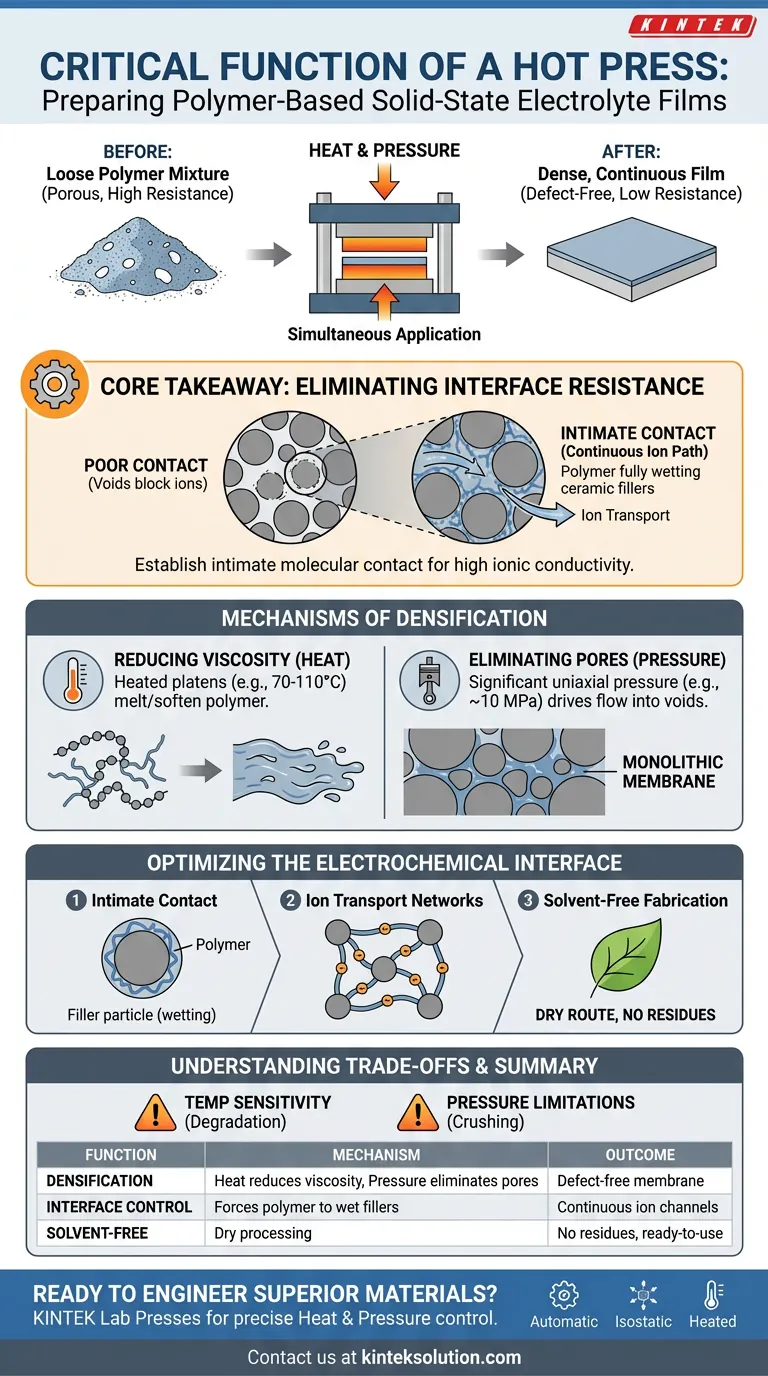
The critical function of a hot press in solid-state battery fabrication is to facilitate the simultaneous application of heat and mechanical pressure to transform loose polymer mixtures into dense, continuous films.
By heating the thermoplastic polymer to its softening or melting point, the press lowers the material's viscosity, allowing it to flow. Concurrently, the applied pressure forces this molten polymer to fill interstitial voids and pore spaces. This results in a defect-free, monolithic membrane with the high density required for effective electrochemical performance.
Core Takeaway While shaping the material is a visible output, the hot press’s true value lies in eliminating interface resistance. By forcing the polymer to flow into microscopic voids, it establishes the intimate molecular contact necessary for creating continuous ion transport channels and high ionic conductivity.
The Mechanisms of Densification
The hot press operates on two physical principles to overcome the limitations of solid materials: viscosity reduction and pore elimination.
Reducing Viscosity Through Heat
Solid polymers are naturally resistant to flow. The hot press utilizes heated platens to raise the temperature of the polymer mixture (often between 70°C and 110°C for PEO-based systems).
This heat triggers a phase transition, melting or softening the polymer matrix. This enables molecular chain rearrangement, allowing the material to behave like a fluid rather than a rigid solid.
Eliminating Pores Through Pressure
Once the polymer is softened, heat alone is insufficient to create a high-quality electrolyte. The press applies significant uniaxial pressure (often around 10 MPa or higher) to the material.
This pressure drives the molten polymer into the empty spaces (voids) between solid particles. This process, known as densification, eliminates internal pores that would otherwise act as barriers to ion movement.
Creating a Monolithic Film
The combination of these forces results in a "green" or finished pellet that is mechanically robust.
Unlike loose powders, the resulting film is self-supporting, flexible, and possesses uniform thickness. This mechanical stability is vital for the safety and cycle life of the final battery assembly.
Optimizing the Electrochemical Interface
The most significant challenge in solid-state batteries is the "solid-solid" interface resistance. The hot press solves this by physically merging the components.
Establishing Intimate Contact
In composite electrolytes (e.g., polymer mixed with ceramic fillers like LLZTO), the polymer must fully encapsulate the ceramic particles.
The hot press ensures that the polymer matrix "wets" the surface of these particles. This tight physical contact creates a bridge between materials, significantly reducing the resistance that ions face when moving from one phase to another.
Facilitating Ion Transport Networks
Ionic conductivity relies on continuous pathways. If there are gaps or air pockets between the polymer and the conductive salts or ceramics, ions cannot flow.
By eliminating porosity and ensuring component dispersion at a molecular level, the hot press creates a continuous ion conduction network. This directly correlates to higher overall battery performance.
Solvent-Free Fabrication
The hot press enables a "dry" manufacturing route. Traditional methods often use solvents to dissolve polymers, which can leave residues that degrade performance.
Hot pressing allows for solvent-free fabrication, where raw materials are mixed and pressed directly. This avoids contamination issues and yields a film that is immediately ready for assembly.
Understanding the Trade-offs
While hot pressing is essential for densification, it introduces specific processing variables that must be carefully managed to avoid damaging the materials.
Temperature Sensitivity
Excessive heat can degrade the polymer backbone or decompose sensitive lithium salts.
You must identify the precise window where the polymer flows sufficiently without chemically breaking down. Operating above this thermal ceiling will destroy the electrolyte's electrochemical stability.
Pressure Limitations
While high pressure increases density, excessive force can be detrimental to composite materials.
If the pressure is too high, it may crush brittle ceramic fillers or deform the electrode structure. This structural damage can create new defects rather than solving them, leading to short circuits or mechanical failure.
Making the Right Choice for Your Goal
The hot press is a versatile tool, but your operational parameters should shift based on your specific performance targets.
- If your primary focus is Ionic Conductivity: Prioritize higher temperatures (within safety limits) to maximize polymer flow, ensuring the most intimate contact between the polymer and conductive fillers.
- If your primary focus is Mechanical Strength: Prioritize higher pressure to ensure maximum densification and the complete elimination of microscopic pores that could lead to cracks.
- If your primary focus is Process Efficiency: Prioritize the solvent-free capability to eliminate drying steps and reduce fabrication time.
Mastering the hot press is not just about flattening material; it is about precisely engineering the microscopic interface that allows a solid-state battery to function.
Summary Table:
| Function | Mechanism | Outcome |
|---|---|---|
| Densification | Heat reduces polymer viscosity; pressure eliminates pores. | Defect-free, monolithic membrane. |
| Interface Control | Forces polymer to flow and 'wet' filler particles. | Continuous ion transport channels, reduced resistance. |
| Solvent-Free Fabrication | Dry processing of raw material mixtures. | No solvent residues, ready-to-use films. |
Ready to Engineer Superior Solid-State Battery Materials?
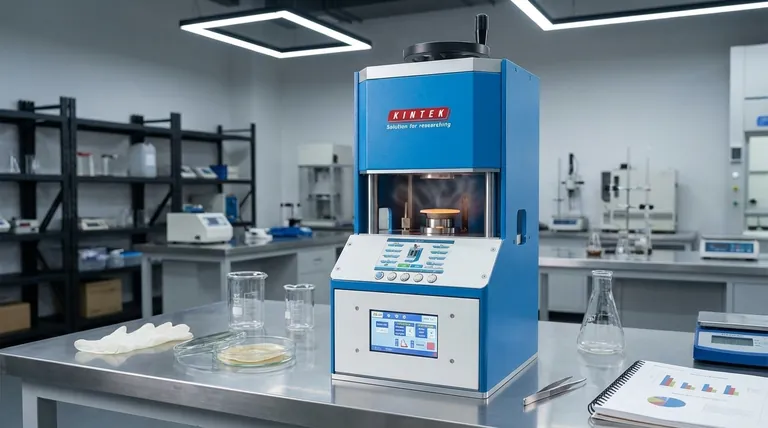
Mastering the precise application of heat and pressure is critical for developing high-performance, dense polymer electrolytes and electrodes. KINTEK specializes in advanced lab press machines, including automatic lab presses, isostatic presses, and heated lab presses, designed to meet the exacting demands of laboratory research and development.
Our equipment empowers you to:
- Achieve optimal densification and eliminate interface resistance.
- Precisely control temperature and pressure for solvent-free fabrication.
- Accelerate your R&D with reliable, reproducible results.
Contact us today via our [#ContactForm] to discuss how our lab press solutions can enhance your solid-state battery development process.
Visual Guide
Related Products
- Lab Heat Press Special Mold
- Warm Isostatic Press for Solid State Battery Research Warm Isostatic Press
- Lab Polygon Press Mold
- Special Shape Lab Press Mold for Laboratory Applications
- Cylindrical Lab Electric Heating Press Mold for Laboratory Use
People Also Ask
- How is a laboratory heat press used to evaluate bio-based aliphatic polyesters? Prepare Reliable Samples for Analysis
- How is a laboratory heat press utilized in MEA preparation? Achieve High-Efficiency Iron-Chromium Redox Flow Batteries
- Why is a laboratory heat press necessary for biodegradable films? Unlock Precision Bonding and Barrier Performance
- What is the purpose of incorporating cartridge heaters into a lab press mold for MLCC block compression? Optimize Results
- What is the significance of pressure and temperature control in a laboratory heated press for ZIF-8/NF coatings?
















