
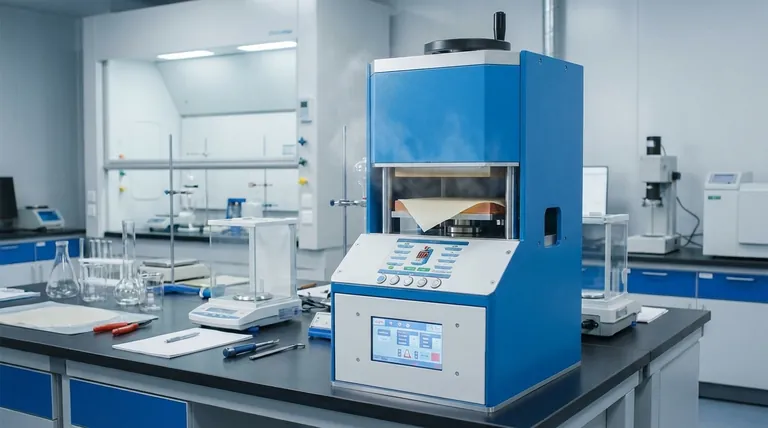
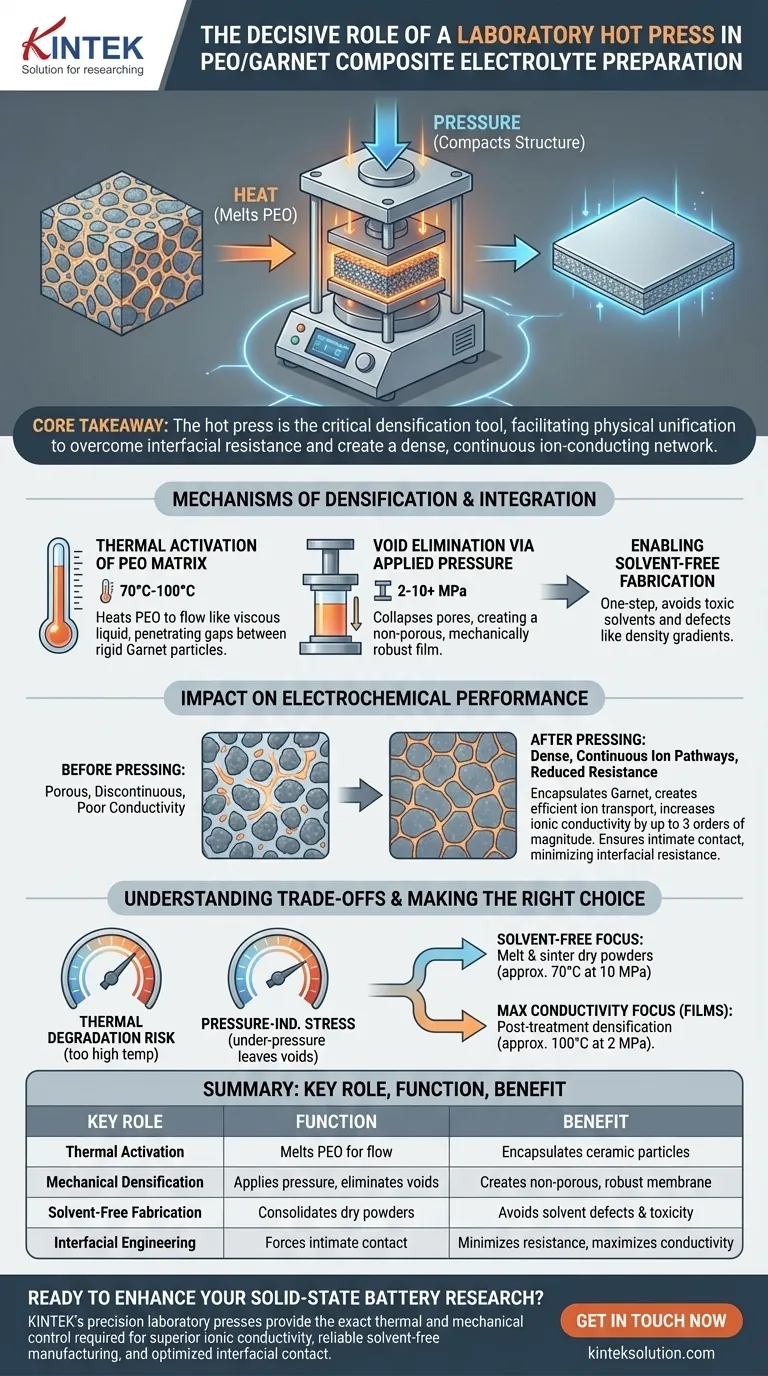
The decisive role of a laboratory hot press in preparing PEO/Garnet composite electrolytes is to facilitate the physical unification of the organic polymer and inorganic ceramic phases. By simultaneously applying precise heat (to melt the PEO) and pressure (to compact the structure), the press eliminates voids and forces the polymer to fully encapsulate the Garnet particles, creating a dense, continuous ion-conducting network.
Core Takeaway The hot press functions as the critical densification tool that overcomes the natural interfacial resistance between polymers and ceramics. Without this thermal-mechanical processing, the membrane remains porous and discontinuous, leading to poor ionic conductivity and structural failure.
Mechanisms of Densification and Integration
To understand why the hot press is indispensable, one must look at how the materials interact under stress and thermal energy. The equipment orchestrates a phase transition that simple mixing cannot achieve.
Thermal Activation of the PEO Matrix
The PEO polymer acts as the binder and the primary flexible transport medium. The hot press heats the material to specific temperatures (typically around 70°C to 100°C) to soften or melt the PEO crystals.
This phase change allows the polymer to flow like a viscous liquid. This flow is essential for penetrating the microscopic gaps between the rigid Garnet (LLZTO) ceramic particles.
Void Elimination via Applied Pressure
While heat allows flow, pressure ensures density. The press applies mechanical force (ranging from 2 MPa to over 10 MPa depending on the method) to compact the material.
This pressure collapses internal pores—whether they are gaps in a dry powder mix or microscopic voids left behind after solvent evaporation. The result is a non-porous, mechanically robust film.
Enabling Solvent-Free Fabrication
The hot press allows for a "one-step, solvent-free" manufacturing route. Instead of dissolving PEO in toxic solvents, raw powders can be pressed directly.
This avoids common issues associated with solvent casting, such as residual solvent trapping or density gradients caused by uneven evaporation.
Impact on Electrochemical Performance
The physical structure of the membrane directly dictates its performance in a battery. The hot press transforms the composite from a physical mixture into a functional electrochemical system.
Establishing Continuous Ion Pathways
For ions to move, they need a connected path. By forcing the molten PEO to encapsulate the Garnet particles, the hot press creates a continuous percolation network.
This tight integration creates efficient ion transport channels. In some cases, proper hot pressing can increase room-temperature ionic conductivity by up to three orders of magnitude compared to non-pressed samples.
Reducing Interfacial Resistance
A major failure point in composite electrolytes is the "loose" contact between the polymer and the ceramic filler.
Hot pressing ensures intimate physical contact at the molecular level. This maximization of the interfacial area minimizes the resistance ions face when transferring between the PEO matrix and the Garnet fillers.
Understanding the Trade-offs
While hot pressing is effective, it requires precise control. Incorrect parameters can damage the composite or yield suboptimal results.
The Risk of Thermal Degradation
Operating at temperatures significantly higher than the melting point of PEO can degrade the polymer chains or reacting agents.
You must identify the minimal thermal budget required to achieve flow without compromising the chemical stability of the polymer or the lithium salts involved.
Pressure-Induced Mechanical Stress
While PEO is flexible, the Garnet filler is a brittle ceramic. Excessive pressure (typically associated with cold pressing ceramics, e.g., >200 MPa) is generally unnecessary for PEO composites and could theoretically induce stress concentrations.
However, the primary risk in PEO/Garnet pressing is usually under-pressure, which leaves voids, rather than over-pressure, as the molten polymer distributes the load evenly.
Making the Right Choice for Your Goal
The specific application of the hot press depends on your initial fabrication method.
- If your primary focus is Solvent-Free Manufacturing: Use the hot press to melt and sinter dry powder mixtures directly (approx. 70°C at 10 MPa) to avoid environmental toxicity and solvent defects.
- If your primary focus is Maximizing Conductivity of Cast Films: Use the hot press as a post-treatment step (approx. 100°C at 2 MPa) to remove microscopic pores left by solvent evaporation and densify the pre-formed film.
Ultimately, the laboratory hot press is not just a shaping tool; it is the bridge that turns a mixture of ingredients into a cohesive, high-performance solid electrolyte.
Summary Table:
| Key Role | Function | Benefit |
|---|---|---|
| Thermal Activation | Melts PEO polymer for flow | Enables polymer to encapsulate ceramic particles |
| Mechanical Densification | Applies pressure to eliminate voids | Creates a non-porous, mechanically robust membrane |
| Solvent-Free Fabrication | Consolidates dry powders in one step | Avoids solvent-related defects and toxicity |
| Interfacial Engineering | Forces intimate contact between phases | Minimizes ionic resistance, maximizes conductivity |
Ready to Enhance Your Solid-State Battery Research?
Creating a dense, high-conductivity PEO/Garnet composite electrolyte is essential for next-generation battery performance. KINTEK's precision laboratory presses—including automatic, heated, and isostatic models—provide the exact thermal and mechanical control required to eliminate voids and ensure perfect material integration.
Our equipment helps researchers like you achieve:
- Superior Ionic Conductivity through complete densification.
- Reliable, Solvent-Free Manufacturing for safer, more consistent results.
- Optimized Interfacial Contact between polymer and ceramic phases.
Contact us today to discuss how our lab press solutions can accelerate your development of high-performance solid electrolytes.
Visual Guide
Related Products
- Laboratory Split Manual Heated Hydraulic Press Machine with Hot Plates
- 24T 30T 60T Heated Hydraulic Lab Press Machine with Hot Plates for Laboratory
- Heated Hydraulic Press Machine with Heated Plates for Vacuum Box Laboratory Hot Press
- Laboratory Manual Heated Hydraulic Press Machine with Hot Plates
- Automatic Heated Hydraulic Press Machine with Hot Plates for Laboratory
People Also Ask
- Why is a laboratory hydraulic press with heating plates required for PLA/TEC films? Achieve Precise Sample Integrity
- What role does a laboratory heated hydraulic press play in LTCC? Essential for High-Density Ceramic Lamination
- Why reduce load when applying composite strengthening tabs? Protect Specimen Integrity and Data Accuracy
- Why is a laboratory heated hydraulic press required? Ensure Precise Vulcanization for NBR/EPDM Nanocomposites
- What role does a laboratory heated hydraulic press play in PI/PA based SPE membranes? Optimize Solid Battery Performance



















