
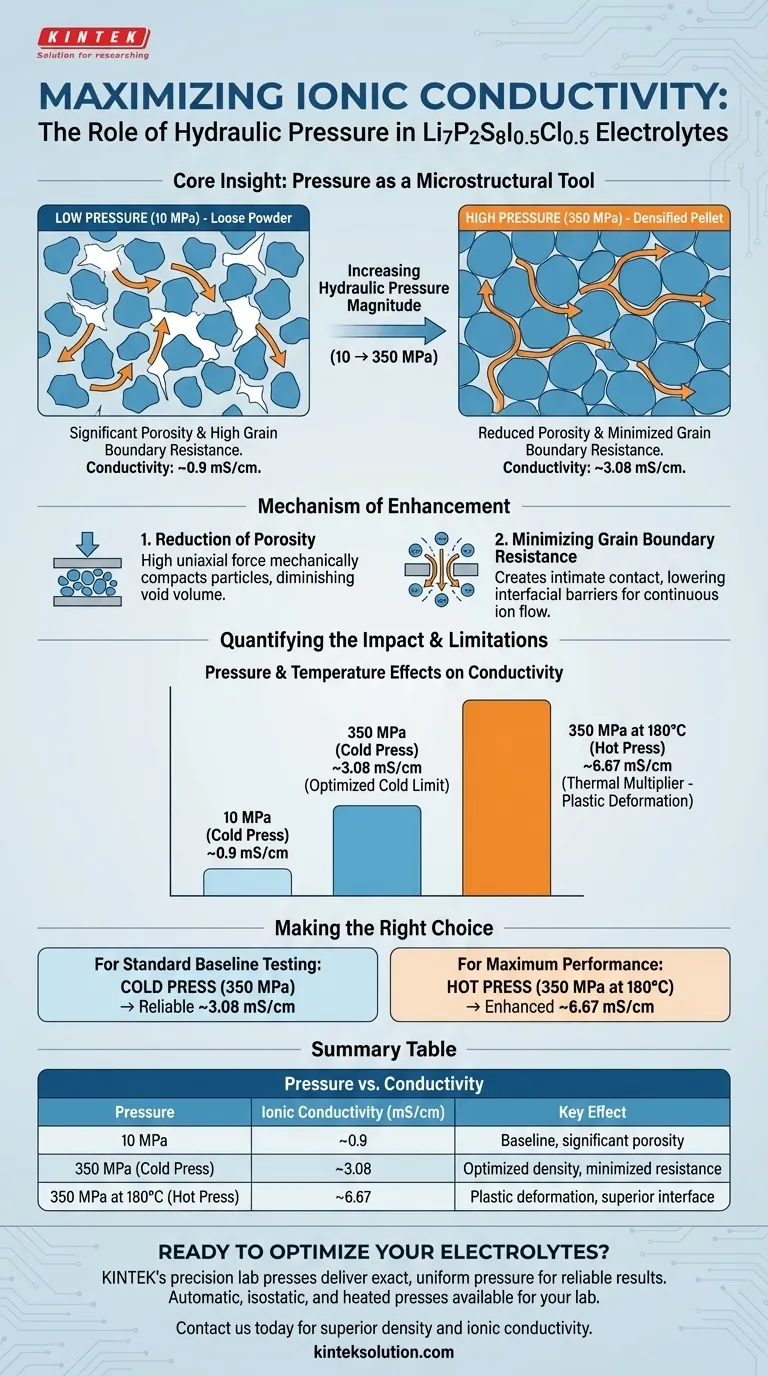
Increasing the hydraulic pressure magnitude has a direct, positive correlation with the ionic conductivity of Li7P2S8I0.5Cl0.5 electrolyte pellets. Specifically, raising the applied pressure from 10 MPa to 350 MPa steadily increases the total ionic conductivity from 0.9 mS/cm to 3.08 mS/cm.
Core Insight: The application of hydraulic pressure is not merely for shaping; it is a critical microstructural engineering tool that eliminates inter-particle voids, thereby minimizing grain boundary resistance and establishing continuous channels for lithium-ion transport.
The Mechanism of Conductivity Enhancement
Reduction of Porosity
The primary physical change driven by the hydraulic press is the densification of the green pellet.
At lower pressures, the electrolyte powder retains significant internal cracks and pores.
By applying high uniaxial pressure, you mechanically force the particles together, significantly diminishing the void volume between them.
Minimizing Grain Boundary Resistance
For ions to move through a solid electrolyte, they must traverse the interfaces between individual powder particles.
These interfaces, or grain boundaries, act as barriers that impede ion flow.
High pressure creates intimate physical contact between particles, drastically lowering this interfacial resistance and improving the total conductivity of the pellet.
Quantifying the Pressure Impact
The 10 MPa to 350 MPa Range
Experimental data identifies a clear operational window for cold pressing Li7P2S8I0.5Cl0.5.
At a low pressure of 10 MPa, the material exhibits a baseline conductivity of approximately 0.9 mS/cm.
As pressure is ramped up to 350 MPa, the microstructure optimizes, resulting in a conductivity of 3.08 mS/cm.
Uniformity and Reliability
Beyond the raw conductivity numbers, the hydraulic press ensures the consistency of the pellet.
Uniform pressure application creates a homogeneous density profile.
This uniformity is essential for obtaining accurate, reproducible measurements of the material’s intrinsic bulk properties.
Understanding the Limitations: Cold vs. Hot Pressing
The Ceiling of Cold Pressing
While increasing pressure to 350 MPa yields significant gains, cold pressing relies solely on mechanical force.
There is a physical limit to how effectively voids can be closed when the material is rigid at room temperature.
Once the maximum density for cold compaction is reached, further pressure increases yield diminishing returns.
The Thermal Multiplier
To surpass the limits of standard hydraulic pressing, temperature must be introduced alongside pressure.
Using a heated press (e.g., 350 MPa at 180°C) induces plastic deformation and softening of the electrolyte particles.
This combination creates a superior solid-solid interface, boosting ionic conductivity from the cold-press limit of 3.08 mS/cm to an enhanced 6.67 mS/cm.
Making the Right Choice for Your Goal
To maximize the performance of your solid-state electrolyte, you must match your processing method to your conductivity targets.
- If your primary focus is standard baseline testing: Apply 350 MPa via cold pressing to achieve a reliable conductivity of ~3.08 mS/cm by minimizing grain boundary resistance.
- If your primary focus is maximum performance: Utilize hot pressing (350 MPa at 180°C) to induce plastic deformation, achieving the highest possible conductivity of ~6.67 mS/cm.
High pressure is the fundamental prerequisite for transforming loose powder into a functional, high-rate solid-state conductor.
Summary Table:
| Pressure Magnitude | Ionic Conductivity (mS/cm) | Key Effect |
|---|---|---|
| 10 MPa | ~0.9 | Baseline, significant porosity |
| 350 MPa (Cold Press) | ~3.08 | Optimized density, minimized grain boundary resistance |
| 350 MPa at 180°C (Hot Press) | ~6.67 | Plastic deformation, superior interface contact |
Ready to optimize your solid-state electrolyte pellets?
KINTEK's precision lab presses are engineered to deliver the exact, uniform pressure required for reliable and reproducible results. Whether your goal is consistent baseline testing with cold pressing or achieving maximum conductivity with hot pressing, our automatic lab presses, isostatic presses, and heated lab presses provide the control and performance your laboratory needs.
Contact us today using the form below to discuss how our expertise can help you achieve superior pellet density and ionic conductivity. #ContactForm
Visual Guide
Related Products
- Manual Heated Hydraulic Lab Press with Integrated Hot Plates Hydraulic Press Machine
- Automatic High Temperature Heated Hydraulic Press Machine with Heated Plates for Lab
- Automatic Heated Hydraulic Press Machine with Hot Plates for Laboratory
- Laboratory Hydraulic Press 2T Lab Pellet Press for KBR FTIR
- Automatic Laboratory Hydraulic Press Lab Pellet Press Machine
People Also Ask
- Why is a laboratory hydraulic press with heating plates required for PLA/TEC films? Achieve Precise Sample Integrity
- Why is a manual hydraulic heated lab press essential for compleximer materials? Unlock Advanced Material Synthesis
- Function of a Laboratory Hydraulic Press with Heated Platens in SSE? Enhance Battery Density & Conductivity
- What role does a lab manual hydraulic press play in Li9B19S33 ionic conductivity? Optimize Pellet Characterization
- What are the main benefits of performing proper maintenance on a heated lab press? Ensure Accuracy & Safety



















