
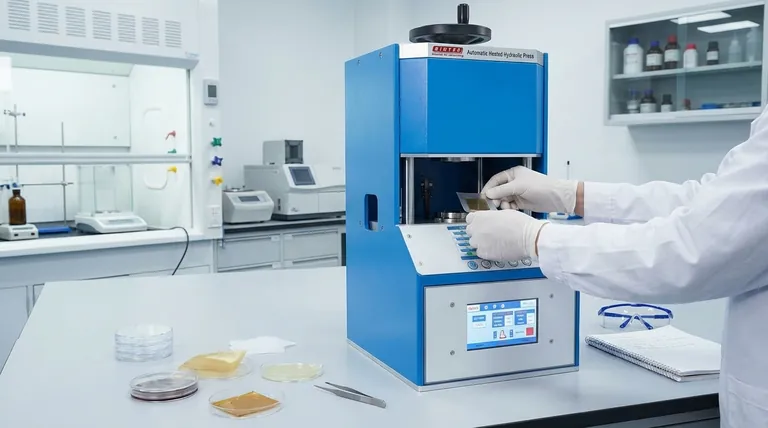
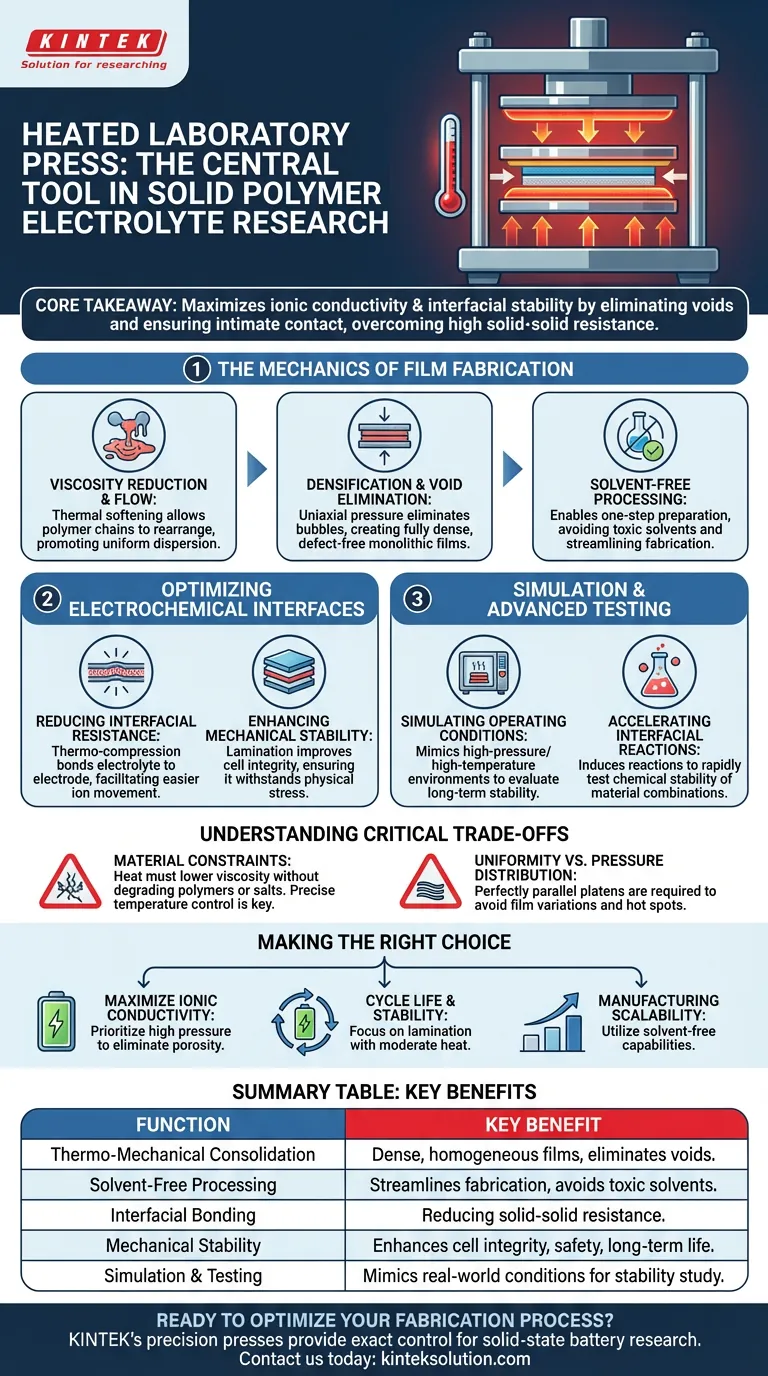
A heated laboratory press acts as the central fabrication tool in solid polymer electrolyte research by simultaneously applying precise thermal and mechanical energy. Its primary function is to consolidate polymer materials into dense, homogeneous films and to bond these electrolytes securely to electrodes, creating a unified stack essential for functional solid-state batteries.
Core Takeaway While simple casting can create films, a heated press is required to maximize ionic conductivity and interfacial stability. By eliminating microscopic voids and ensuring intimate contact between layers, the press overcomes the high solid-solid resistance that typically limits the performance of solid-state batteries.
The Mechanics of Film Fabrication
To understand the value of the heated press, one must look at how it alters the physical state of the polymer during processing.
Viscosity Reduction and Flow
The heating function of the press is used to reduce the viscosity of thermoplastic polymers (like PEO) until they soften or melt.
This thermal softening allows the polymer chains to rearrange and flow. It promotes the uniform dispersion of components at a molecular level, ensuring that the polymer matrix effectively "wets" any inorganic fillers or additives.
Densification and Void Elimination
Once the polymer is softened, the press applies uniaxial pressure to force the material into a specific shape.
This pressure eliminates internal bubbles and pores that naturally form during mixing. The result is a fully dense, defect-free monolithic film, which is critical for creating continuous ion transport channels.
Solvent-Free Processing
The heated press enables "one-step, solvent-free" preparation methods.
Instead of dissolving materials in toxic solvents, researchers can mix raw materials (polymer, salts, plasticizers) and press them directly. This streamlines fabrication and avoids the chemical complications associated with residual solvents.
Optimizing Electrochemical Interfaces
Beyond creating the film itself, the heated press is vital for integrating the electrolyte into the battery system.
Reducing Interfacial Resistance
The greatest challenge in solid-state batteries is the high resistance at the point where the electrode meets the electrolyte.
The heated press performs thermo-compression or lamination, bonding the electrolyte layer to the electrode. This forces intimate physical contact, significantly reducing impedance and facilitating easier ion movement between layers.
Enhancing Mechanical Stability
A pressed assembly is mechanically superior to loosely stacked components.
The lamination process improves the mechanical integrity of the cell, ensuring it can withstand physical stress without delaminating. This directly contributes to the battery's safety profile and long-term cycle life.
Simulation and Advanced Testing
The heated press is not merely a manufacturing tool; it is also an analytical environment.
Simulating Operating Conditions
Researchers use the press to mimic the high-pressure and high-temperature environment of an operational solid-state battery.
By co-pressing mixtures at specific temperatures, scientists can evaluate how materials behave under real-world stress. This allows for the study of long-term stability and chemical compatibility before a full battery is assembled.
Accelerating Interfacial Reactions
The press can be used to induce reactions for testing purposes.
By applying heat and pressure to electrode-electrolyte mixtures, researchers can intentionally accelerate potential chemical reactions at the interface. This provides rapid feedback on the chemical stability of different material combinations.
Understanding the Critical Trade-offs
While powerful, the heated press introduces specific variables that must be managed to avoid compromising the research.
Material Constraints
The process relies heavily on the thermoplastic nature of the polymer.
The heat applied must be sufficient to lower viscosity for flow, but not so high that it degrades the polymer chain or damages temperature-sensitive lithium salts. Precise temperature control is non-negotiable to avoid chemically altering the electrolyte.
Uniformity vs. Pressure Distribution
Achieving a perfectly flat film requires perfectly parallel platens.
If the pressure distribution is uneven, the electrolyte film will have variations in thickness. This leads to inconsistent ionic conductivity across the cell and creates "hot spots" of current density that can cause early battery failure.
Making the Right Choice for Your Goal
The way you utilize a heated press should depend on the specific bottleneck you are trying to solve in your solid polymer electrolyte research.
- If your primary focus is Maximizing Ionic Conductivity: Prioritize high-pressure settings to completely eliminate porosity, as even microscopic voids act as barriers to ion transport.
- If your primary focus is Cycle Life and Stability: Focus on the lamination stage, using moderate heat to ensure the electrolyte bonds perfectly to the electrode without triggering chemical degradation.
- If your primary focus is Manufacturing Scalability: Utilize the "one-step, solvent-free" capabilities to demonstrate that your material can be processed without complex solvent drying steps.
Mastering the balance of heat and pressure is the key to transforming a theoretical polymer mixture into a viable, high-performance battery component.
Summary Table:
| Function | Key Benefit for Solid Polymer Electrolyte Research |
|---|---|
| Thermo-Mechanical Consolidation | Creates dense, homogeneous films by eliminating microscopic voids. |
| Solvent-Free Processing | Streamlines fabrication, avoiding complications from toxic solvents. |
| Interfacial Bonding (Lamination) | Reduces solid-solid resistance between electrolyte and electrode. |
| Mechanical Stability | Enhances cell integrity, safety, and long-term cycle life. |
| Simulation & Testing | Mimics real-world operating conditions to study material stability. |
Ready to optimize your solid polymer electrolyte fabrication process?
KINTEK's precision heated laboratory presses provide the exact control over heat and pressure required to maximize ionic conductivity and interfacial stability in your research. Our automatic lab presses, isostatic presses, and heated lab presses are engineered to help you create dense, defect-free films and reliable battery assemblies.
Contact us today to discuss how our lab press solutions can accelerate your development of high-performance solid-state batteries. Get in touch via our Contact Form
Visual Guide
Related Products
- 24T 30T 60T Heated Hydraulic Lab Press Machine with Hot Plates for Laboratory
- Heated Hydraulic Press Machine with Heated Plates for Vacuum Box Laboratory Hot Press
- Laboratory Split Manual Heated Hydraulic Press Machine with Hot Plates
- Automatic Heated Hydraulic Press Machine with Hot Plates for Laboratory
- Automatic Heated Hydraulic Press Machine with Heated Plates for Laboratory
People Also Ask
- Function of a Laboratory Hydraulic Press with Heated Platens in SSE? Enhance Battery Density & Conductivity
- Why is a laboratory hydraulic press with heating plates required for PLA/TEC films? Achieve Precise Sample Integrity
- What role does a laboratory heated hydraulic press play in LTCC? Essential for High-Density Ceramic Lamination
- What is the primary function of a laboratory heated hydraulic press? Mastering Thermoplastic Carbon Fiber Composites
- What is the critical role of a laboratory heated hydraulic press? Mastering PVC Sample Prep for Testing



















