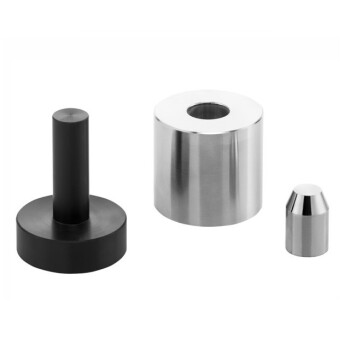
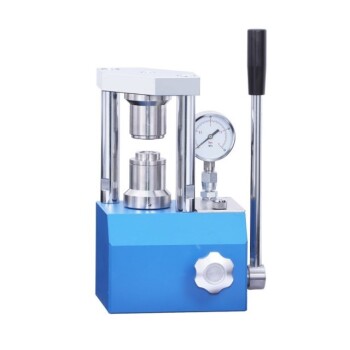
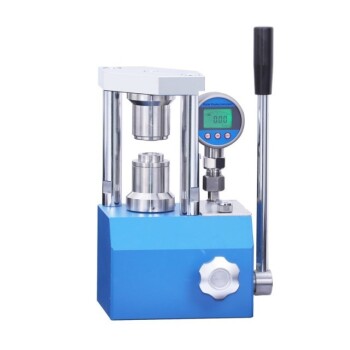
A high-precision battery crimper serves the dual purpose of creating a hermetic mechanical seal and applying uniform, stable pressure to the internal cell stack. For CR2032 coin cells utilizing Silane-Crosslinked Cellulose-Based Separators (PBF-GPTMS), this precision is strictly necessary to eliminate internal contact resistance and maintain structural integrity during repetitive charge-discharge cycles.
Core Takeaway Reliable electrochemical data depends on the mechanical consistency of the cell assembly. A high-precision crimper transforms a loose stack of components into a unified electrochemical system by ensuring intimate interfacial contact and preventing environmental contamination.
Optimizing the Electrochemical Interface
The primary function of the crimper extends beyond simple packaging; it dictates the internal physical environment of the battery.
Achieving Uniform Component Contact
The crimper applies a calculated force to compress the internal "stack," which consists of the lithium metal anode, the PBF-GPTMS separator, the cathode, and spacers.
This compression ensures that the cellulose-based separator maintains tight physical contact with the electrodes on either side.
Without this uniform pressure, gaps may form between the separator and the lithium anode, disrupting ion flow.
Minimizing Internal Resistance
A precise crimp eliminates contact resistance fluctuations caused by uneven packaging pressure.
By firmly pressing the current collectors and electrodes against the casing and spacers, the crimper establishes a low-resistance conductive pathway.
This allows for the accurate measurement of the PBF-GPTMS separator's performance without interference from assembly-related impedance.
Ensuring Long-Term Cell Integrity
The mechanical seal formed by the crimper is the first line of defense for the sensitive chemistry inside the coin cell.
Preventing Electrolyte Leakage
The crimping process deforms the gasket to create a tight seal against the liquid electrolyte.
This ensures the electrolyte remains contained within the active region of the PBF-GPTMS separator and electrodes.
Effective sealing prevents the cell from drying out, which would otherwise lead to premature failure.
Blocking Environmental Contamination
Lithium metal anodes are highly reactive to moisture and oxygen in the air.
The crimper provides a hermetic seal that effectively isolates the internal materials from the external atmosphere.
This protection is critical for obtaining valid data during long-term cycling tests, as air ingress causes immediate degradation of the lithium interface.
The Role of Precision in Data Validity
For researchers relying on electrochemical data, the crimper is a calibration tool for consistency.
Standardizing Assembly Pressure
High-precision hydraulic crimpers provide standardized pressure that manual methods often lack.
This consistency eliminates the variable of "packaging pressure" from your experimental data.
It ensures that differences in performance are due to the material chemistry, not inconsistent assembly techniques.
Validating Impedance and Cycle Life
Accurate Electrochemical Impedance Spectroscopy (EIS) requires a stable physical interface that does not shift over time.
Similarly, long-term charge-discharge curves rely on the crimp maintaining constant pressure as the battery expands and contracts.
A precision crimper ensures the PBF-GPTMS separator remains mechanically stable throughout hundreds of cycles.
Understanding the Trade-offs
While high precision is critical, the application of pressure involves inherent risks that must be managed.
The Risk of Over-Compression
Applying excessive force during crimping can physically crush the porous structure of the cellulose-based separator.
This can lead to pore closure, reducing ionic conductivity, or even cause internal short circuits if the separator is punctured.
The Consequence of Under-Compression
Insufficient pressure results in poor interfacial contact and high impedance.
This often manifests as "noise" in data or unstable voltage profiles during cycling.
It creates a false negative, suggesting material failure when the root cause is actually assembly failure.
Making the Right Choice for Your Goal
The selection of crimping parameters should be driven by the specific requirements of your testing protocol.
- If your primary focus is material characterization (EIS): Prioritize pressure consistency to ensure the PBF-GPTMS separator interface is identical across all test cells.
- If your primary focus is long-term cycle life: Prioritize the integrity of the hermetic seal to prevent electrolyte loss or air ingress over weeks of testing.
Ultimately, the crimper acts as the final quality control step, ensuring that your innovative separator materials are tested in a physically stable and chemically isolated environment.
Summary Table:
| Feature | Primary Function | Impact on PBF-GPTMS Separator |
|---|---|---|
| Mechanical Sealing | Creates a hermetic barrier | Prevents electrolyte leakage and moisture contamination |
| Pressure Control | Applies uniform stack compression | Eliminates contact resistance and ensures ion flow consistency |
| Structural Integrity | Stabilizes the internal stack | Maintains interfacial contact during long-term cycling |
| Process Calibration | Standardizes assembly force | Ensures data repeatability by removing assembly variables |
Elevate Your Battery Research with KINTEK Precision
Don't let inconsistent assembly compromise your electrochemical data. KINTEK specializes in comprehensive laboratory pressing solutions designed for the rigorous demands of battery research. Whether you are working with innovative PBF-GPTMS separators or advanced lithium chemistries, our range of manual, automatic, heated, and glovebox-compatible crimpers, as well as cold and warm isostatic presses, ensures your CR2032 coin cells achieve the perfect hermetic seal and uniform pressure every time.
Ready to achieve superior cell consistency? Contact KINTEK today to find the perfect crimping solution for your lab!
References
- Jinghao Cui, Wei Li. A Silane Cross-Linked Cellulose-Based Separator for Long-Life Lithium Metal Batteries Application. DOI: 10.3390/polym17091203
This article is also based on technical information from Kintek Solution Knowledge Base .
Related Products
- Lab Button Battery Tablet Press Sealing Mold
- Manual Button Battery Sealing Machine for Battery Sealing
- Button Battery Sealing Machine for Button Batteries
- Button Battery Sealing Press Machine for Lab
- Laboratory Hydraulic Press Lab Pellet Press Button Battery Press
People Also Ask
- How does a sealed battery mold facilitate the assembly and testing of asymmetric supercapacitors using VO2?
- Why use standardized CR2032 components & high-precision presses? Ensure reliability in lithium metal battery research.
- Why is a laboratory battery sealing press essential for desolvation energy testing? Ensure Reliable Kinetic Data
- What is the function of specialized battery molds and sealing consumables? Optimize Your In-situ XRD Testing Today
- What role does a laboratory sealing press play in thermal analysis of solid dispersion films? Ensure Data Integrity