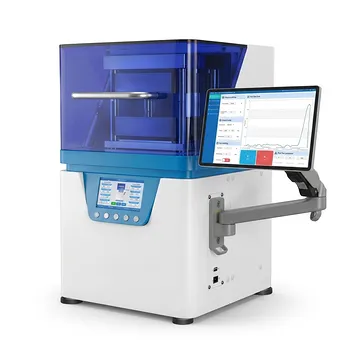
In secondary processing, a hydraulic press combined with die steel extrusion molds performs cold extrusion on sintered aluminum matrix composites. This critical step utilizes large plastic deformation to increase material density, refine the aluminum matrix grains, and induce work-hardening, which significantly enhances the strength and stiffness of the final product.
Core Takeaway: The combination of a hydraulic press and die steel molds transforms sintered composites into high-performance materials by using extreme pressure to eliminate porosity and reconfigure the microscopic grain structure.
Enhancing Material Density and Microstructure
Elimination of Residual Porosity
During secondary processing, the hydraulic press applies immense axial pressure to push the sintered material through the die steel extrusion mold. This force overcomes internal friction, inducing plastic deformation that collapses any remaining voids or pores left over from the initial sintering stage. By reaching near-theoretical density, the composite gains the structural integrity required for demanding industrial applications.
Grain Refinement and Elongation
As the material is forced through the die, the aluminum matrix grains undergo large plastic deformation, causing them to elongate along the direction of extrusion. This process refines the grain structure, creating a more uniform and oriented micro-architecture. This directional alignment is a primary driver for the improved mechanical performance found in extruded composites compared to their cast or sintered counterparts.
Increasing Dislocation Density
The cold extrusion process significantly increases dislocation density within the metal matrix. These dislocations—microscopic irregularities in the crystal lattice—interact and impede each other's movement as the material deforms. This phenomenon, known as work-hardening, is essential for reaching the high levels of strength and stiffness required for the final composite material.
The Role of Precision Tooling and Stable Pressure
Structural Integrity via Die Steel Molds
Die steel is specifically chosen for extrusion molds because it can withstand the extreme stresses of the extrusion process without losing its shape. The mold provides the precise geometry necessary to guide the flowing metal, ensuring that the mechanical interlocking of the composite particles is consistent throughout the entire part.
Precision Pressure Control
A hydraulic press provides the stable, high-tonnage pressure (often ranging from 300 to 1000 MPa) necessary to maintain a constant extrusion rate. Precise control over the pressing stroke and force is vital to ensure the material flows smoothly through the die. Inconsistent pressure can lead to internal defects or "non-uniform density," which compromises the composite’s reliability.
Particle Dispersion and Breaking
In advanced secondary processing, such as forging or high-pressure extrusion, the hydraulic press can break down large quasicrystal particles or reinforcements. By shattering these particles and dispersing them more uniformly throughout the matrix, the process enhances the ductility and fracture toughness of the material, preventing the brittle failure common in poorly processed composites.
Understanding the Trade-offs
Tooling Wear and Longevity
While die steel is robust, the presence of hard reinforcement particles in aluminum matrix composites (such as silicon carbide or alumina) causes significant abrasive wear. High-volume secondary processing requires frequent mold inspection and maintenance to ensure dimensional accuracy is maintained.
Limits of Plasticity
Aggressive cold extrusion can lead to cracking or edge defects if the material's ductility limits are exceeded. A careful balance must be struck between the amount of deformation (reduction in area) and the inherent brittleness of the composite to avoid ruining the preform during the stroke.
Applying This Process to Your Material Goals
Maximizing Performance in Aluminum Composites
- If your primary focus is maximum tensile strength: Utilize high-reduction extrusion ratios to maximize dislocation density and grain refinement via work-hardening.
- If your primary focus is uniform density and shape: Ensure the hydraulic press is calibrated for a constant, slower stroke to allow for consistent particle rearrangement without internal tearing.
- If your primary focus is fracture toughness: Focus on high-tonnage impacts within the die to break up and redistribute large reinforcement clusters.
The synergy between hydraulic force and precision steel dies is what ultimately transitions an aluminum composite from a porous, brittle preform into a high-strength engineering material.
Summary Table:
| Process Aspect | Key Function | Impact on Composite Property |
|---|---|---|
| Cold Extrusion | Collapses residual voids/pores | Achieves near-theoretical material density |
| Plastic Deformation | Refines and elongates aluminum matrix grains | Enhances directional strength and stiffness |
| High-Pressure Flow | Increases dislocation density (Work-hardening) | Boosts structural integrity and hardness |
| Precision Tooling | Directs material flow through die steel | Ensures uniform particle dispersion and toughness |
| Pressure Stability | Maintains constant extrusion rate (300-1000 MPa) | Prevents internal defects and ensures consistency |
Optimize Your Composite Research with KINTEK
To achieve the high-density and refined microstructures required for advanced engineering, you need precision-engineered equipment. KINTEK specializes in comprehensive laboratory pressing solutions, offering manual, automatic, heated, multifunctional, and glovebox-compatible models. Our range also includes high-performance cold and warm isostatic presses, widely applied in cutting-edge battery research and material science.
Why partner with KINTEK?
- Precision Control: Achieve stable, high-tonnage pressure essential for grain refinement.
- Versatility: Solutions tailored for everything from simple sample prep to complex extrusion.
- Expert Support: We help you select the right technology to maximize your material's tensile strength and fracture toughness.
Contact KINTEK today to find the perfect press for your laboratory!
References
- Sridhar Idapalapati, Karthic R. Narayanan. Processing and characterization of MWCNT reinforced aluminum matrix composites. DOI: 10.1007/s10853-009-3290-5
This article is also based on technical information from Kintek Solution Knowledge Base .
Related Products
- Automatic Hydraulic Hot Press with Large Plate and Precision Temperature Control for Advanced Material Sample Preparation and Industrial Research
- Automatic Hydraulic Heat Press Machine with Multi Stage Programmable Control and Integrated Water Cooling Plate Size 180x180mm
- Automatic High Temperature Heated Hydraulic Press Machine with Heated Plates for Lab
- Automatic Heated Hydraulic Lab Press with Programmable Touch Screen Controls and Precision Temperature Regulation
- Manual Heated Hydraulic Lab Press with Integrated Hot Plates Hydraulic Press Machine
People Also Ask
- What are the specific features and applications of hydraulic hot press machines? Precision Solutions for Modern Labs
- How does an automatic hydraulic press operate? Achieve Precision and Consistency in Lab Pelleting
- What are the advantages and common applications of an automatic hydraulic press? Elevate Your Lab's Precision
- What is the technical significance of setting a precise dwell time? Achieve Peak Material Density and Stability
- When is an automatic hydraulic press more suitable than a manual press? Scale Your Lab with Precision & Speed