
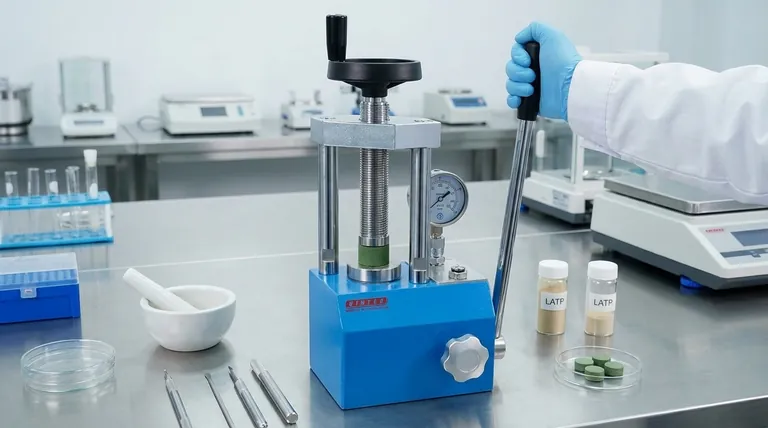
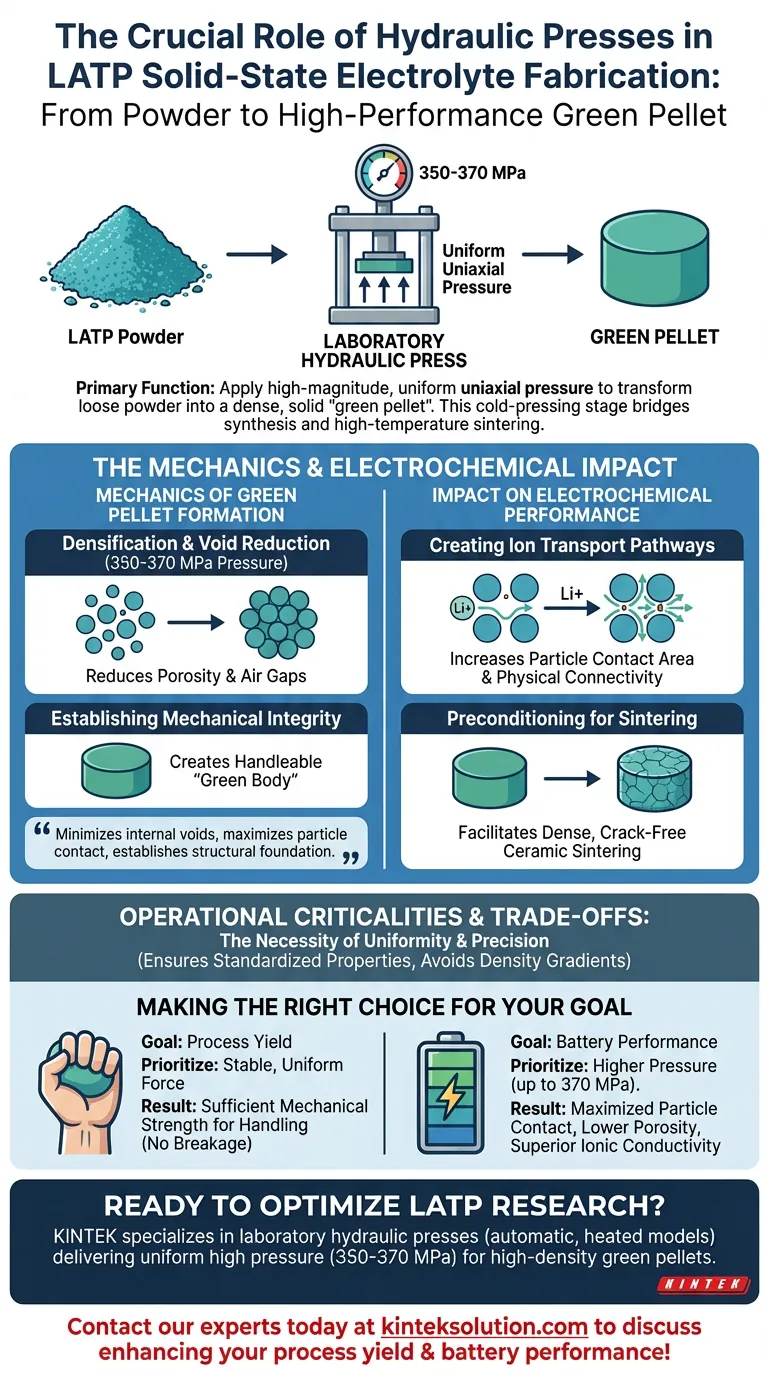
The primary function of a laboratory hydraulic press in LATP fabrication is to apply high-magnitude, uniform uniaxial pressure to transform loose powder into a dense, solid "green pellet." This cold-pressing stage is the bridge between raw material synthesis and high-temperature sintering, ensuring the powder is compacted with sufficient mechanical strength to be handled without breaking during subsequent processing.
By minimizing internal voids and maximizing particle contact, the hydraulic press establishes the structural foundation necessary for lithium-ion transport. A high-quality green pellet is the non-negotiable prerequisite for achieving a sintered ceramic electrolyte with high ionic conductivity and low interfacial resistance.
The Mechanics of Green Pellet Formation
Densification and Void Reduction
The immediate physical goal of the press is to eliminate air gaps within the bulk material. By applying stable pressure—often reaching magnitudes between 350 MPa and 370 MPa—the machine forces LATP particles into close proximity. This significantly reduces internal porosity, changing the material from a low-density powder into a compact solid.
Establishing Mechanical Integrity
Before the LATP can be sintered into a final ceramic, it must exist as a "green body" that holds its shape. The hydraulic press compacts the powder within a mold to create a pellet with defined geometry and initial mechanical strength. This structural integrity is vital, ensuring the sample remains intact while being transferred from the mold to the furnace for sintering.
Impact on Electrochemical Performance
Creating Ion Transport Pathways
The performance of a solid-state battery relies on how easily lithium ions can move through the electrolyte. The high-pressure compaction increases the contact area between individual electrolyte particles. This physical connectivity builds the continuous pathways required for efficient lithium-ion transport.
Preconditioning for Sintering
The pressing stage dictates the success of the final heating process. Achieving a high "green density" is critical because it facilitates the formation of a dense, crack-free ceramic during high-temperature sintering. If the initial compaction is insufficient, the final product will suffer from high porosity and poor ionic conductivity.
Operational Criticalities and Trade-offs
The Necessity of Uniformity
Applying pressure is not merely about force; it is about distribution. The hydraulic press must deliver uniform pressure across the entire surface of the mold. If pressure is uneven, the pellet may develop density gradients, leading to warping or cracking during the sintering phase.
Precision vs. Force
While high pressure is required to maximize density, the application must be precise and stable. The press acts as a control instrument, allowing researchers to dial in specific parameters (e.g., 350 MPa). This control is essential to replicate results and standardize the mechanical properties of the electrolyte batches.
Making the Right Choice for Your Goal
To maximize the utility of your laboratory hydraulic press for LATP fabrication, consider your primary objective:
- If your primary focus is Process Yield: Prioritize the press’s ability to deliver stable, uniform force to ensure green pellets possess sufficient mechanical strength for handling without breakage.
- If your primary focus is Battery Performance: Focus on achieving higher pressure magnitudes (up to 370 MPa) to maximize particle contact area and minimize porosity for superior ionic conductivity.
Ultimately, the laboratory hydraulic press transforms a theoretical chemical compound into a functional physical structure, serving as the critical enabler for high-performance solid-state batteries.
Summary Table:
| Function | Key Parameter | Impact on LATP Pellet |
|---|---|---|
| Densification & Void Reduction | 350 - 370 MPa Pressure | Reduces porosity, increases particle contact area |
| Establishing Mechanical Integrity | Uniform Uniaxial Pressure | Creates a handleable "green body" for sintering |
| Preconditioning for Sintering | High Green Density | Facilitates formation of a dense, crack-free ceramic |
| Creating Ion Transport Pathways | Maximized Particle Contact | Builds continuous pathways for efficient lithium-ion transport |
Ready to optimize your LATP solid-state electrolyte research with precise and reliable compaction?
KINTEK specializes in laboratory hydraulic presses, including automatic and heated models, designed to meet the exacting demands of battery material fabrication. Our presses deliver the uniform high pressure (350-370 MPa) essential for creating high-density green pellets with superior mechanical integrity and electrochemical potential.
Contact our experts today to discuss how a KINTEK lab press can enhance your process yield and battery performance by ensuring consistent, high-quality results in your laboratory.
Visual Guide
Related Products
- Automatic Laboratory Hydraulic Press Lab Pellet Press Machine
- Manual Laboratory Hydraulic Press Lab Pellet Press
- Manual Laboratory Hydraulic Pellet Press Lab Hydraulic Press
- Automatic Laboratory Hydraulic Press for XRF and KBR Pellet Pressing
- Laboratory Hydraulic Split Electric Lab Pellet Press
People Also Ask
- What is the primary purpose of a manual lab hydraulic pellet press? Ensure Accurate Sample Prep for XRF and FTIR
- What is the primary purpose of manual lab hydraulic pellet presses? Achieve High-Precision Sample Preparation for Spectroscopy
- What are the advantages of using an automatic laboratory hydraulic press? Enhance Precision in Sample Preparation
- How does an automatic laboratory hydraulic press improve KBr pellet preparation? Achieve Precision IR Spectroscopy
- What are the technical advantages of an automatic laboratory hydraulic press for biomimetic surfaces?



















