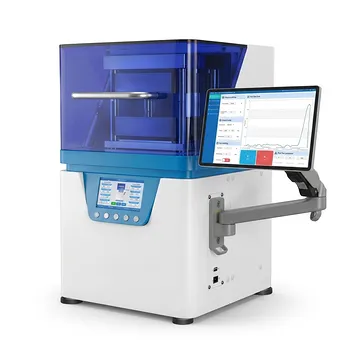
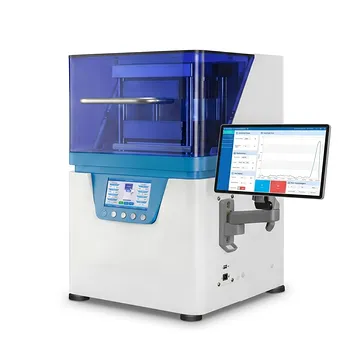
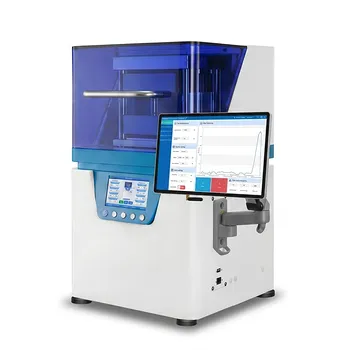
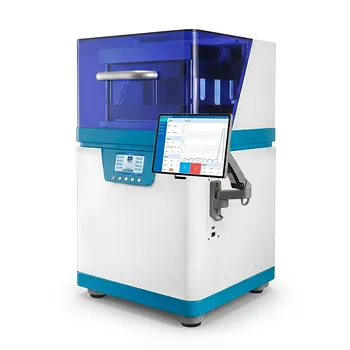
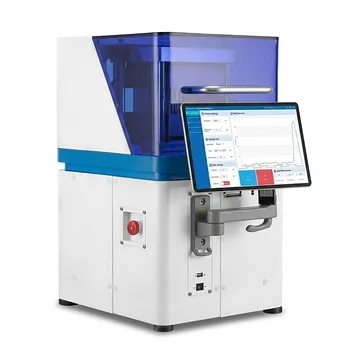
The laboratory hydraulic press is the critical engine for high-performance natural fiber laminate fabrication. It provides the precise, high-pressure compression—often up to 6000 kgf/cm—required to drive resin through dense fiber stacks, achieving a high theoretical fiber volume fraction of 40% to 60% while purging structural voids.
A laboratory hydraulic press transforms a loose stack of fibers and resin into a high-density composite by providing the mechanical force necessary to ensure total matrix penetration and the elimination of interlaminar air bubbles.
Overcoming Resistance: The Mechanics of Impregnation
Facilitating Deep Matrix Penetration
When preparing laminates with high layer counts, such as 45 layers of ramie fabric, gravity or manual hand-layup methods are insufficient for saturation. The hydraulic press applies a slow compression process that forces the epoxy resin matrix to move uniformly through the dense reinforcement layers.
Maximizing Fiber Volume Fraction
High-performance composites require a high ratio of fiber to resin to optimize strength-to-weight characteristics. The press achieves a theoretical fiber volume fraction of 40% to 60% by mechanically compacting the fiber bed and squeezing out excess resin.
Managing Matrix Viscosity and Flow
In applications involving thermoplastic matrices or FR-4 laminates, the press often incorporates heated plates. This heat reduces resin viscosity, allowing it to flow more easily into the micro-gaps between fibers before the curing or solidification phase begins.
Structural Integrity: Eliminating Micro-Scale Defects
Expelling Interlaminar Air Bubbles
Air trapped between layers during the layup process creates voids that act as stress concentrators. The high-pressure environment of the press effectively expels these bubbles, ensuring a dense, void-free internal structure that is essential for mechanical reliability.
Ensuring Dimensional Consistency
A hydraulic press provides precise control over the final thickness and density of the laminate. This ensures that the finished specimen is homogeneous and meets strict dimensional tolerances for subsequent mechanical testing or industrial application.
Improving Interfacial Bonding
In specialized structures like hybrid membranes or wood particle mats, the press forces different material layers to bond tightly at the molecular or microscopic level. This mechanical compaction eliminates density gradients and prevents delamination under stress.
Understanding the Trade-offs
Risk of Fiber Damage
While high pressure is necessary for high-volume fractions, exceeding the structural limits of the natural fibers can cause crushing or fragmentation. This mechanical degradation can paradoxically lower the tensile strength of the finished laminate despite the high fiber content.
Resin Starvation and "Wash-Out"
Applying pressure too quickly can lead to a "wash-out" effect, where resin is forced out of the mold before it has fully wetted the fibers. This results in dry spots and internal defects that compromise the integrity of the composite.
Complexity of Pressure Cycles
Maintaining a constant and precise pressure throughout the entire curing cycle is technically demanding. Fluctuations in pressure can lead to micro-cracks or non-uniform density, particularly in thicker laminates.
Making the Right Choice for Your Goal
When utilizing a laboratory hydraulic press for laminate preparation, your specific objective should dictate your pressure and temperature parameters:
- If your primary focus is maximizing mechanical strength: Prioritize a slow, incremental pressure increase to ensure total resin impregnation without fracturing the delicate natural fibers.
- If your primary focus is minimizing internal defects: Focus on the air expulsion phase by maintaining high pressure throughout the entire curing or cross-linking reaction.
- If your primary focus is dimensional precision: Utilize a press with high-precision heating plates and a digital pressure-control system to ensure uniform density across the entire specimen.
The laboratory hydraulic press remains the definitive tool for researchers seeking to bridge the gap between loose natural fibers and high-performance, structural-grade composite materials.
Summary Table:
| Key Function | Impact on Natural Fiber Laminates |
|---|---|
| High-Pressure Compression | Achieves 40%-60% fiber volume fraction and drives resin through dense stacks. |
| Thermal Management | Heated plates reduce resin viscosity to ensure deep matrix penetration in micro-gaps. |
| Void Elimination | Expels interlaminar air bubbles to prevent stress concentrations and delamination. |
| Dimensional Control | Ensures uniform thickness and homogeneous density for precise mechanical testing. |
| Incremental Loading | Prevents fiber damage and resin "wash-out" during the curing process. |
Elevate Your Material Science with KINTEK Precision
Ready to achieve superior structural integrity in your composite research? KINTEK specializes in comprehensive laboratory pressing solutions designed for high-performance applications. We offer a versatile range of manual, automatic, heated, multifunctional, and glovebox-compatible models, alongside cold and warm isostatic presses.
Whether you are optimizing high-volume natural fiber laminates or conducting cutting-edge battery research, our equipment provides the precise pressure and temperature control necessary for void-free, high-density results.
Contact us today to find the perfect laboratory press for your research!
References
- Marcelo Vitor Ferreira Machado, Sérgio Neves Monteiro. Bending and tensile tests for mechanical characterization of polymer laminated composite with medium and high theoreti-cal volume fractions of ramie woven fabric intended to wind energy industry applications. DOI: 10.54033/cadpedv22n6-156
This article is also based on technical information from Kintek Solution Knowledge Base .
Related Products
- Laboratory Hydraulic Press Lab Pellet Press Machine for Glove Box
- Laboratory Hydraulic Press 2T Lab Pellet Press for KBR FTIR
- 24T 30T 60T Heated Hydraulic Lab Press Machine with Hot Plates for Laboratory
- Laboratory Hydraulic Press Lab Pellet Press Button Battery Press
- Laboratory Hydraulic Pellet Press for XRF KBR FTIR Lab Press
People Also Ask
- How does a laboratory hydraulic press contribute to the preparation of Li3-3xScxSb samples? Optimize Ionic Conductivity
- What is the function of a laboratory hydraulic press in FT-IR of curcumin-coated MWCNTs? Achieve Optical Clarity.
- Why is a laboratory hydraulic press required for compression molding boron-siloxane? Solve High-Loading Density Challenges
- What role does a laboratory hydraulic press play in the preparation of piezoelectric ceramic discs for DC-PG? | KINTEK
- What role does a laboratory hydraulic press play in reaction pellets? Optimizing Lunar Soil and Metal Fuel Density