
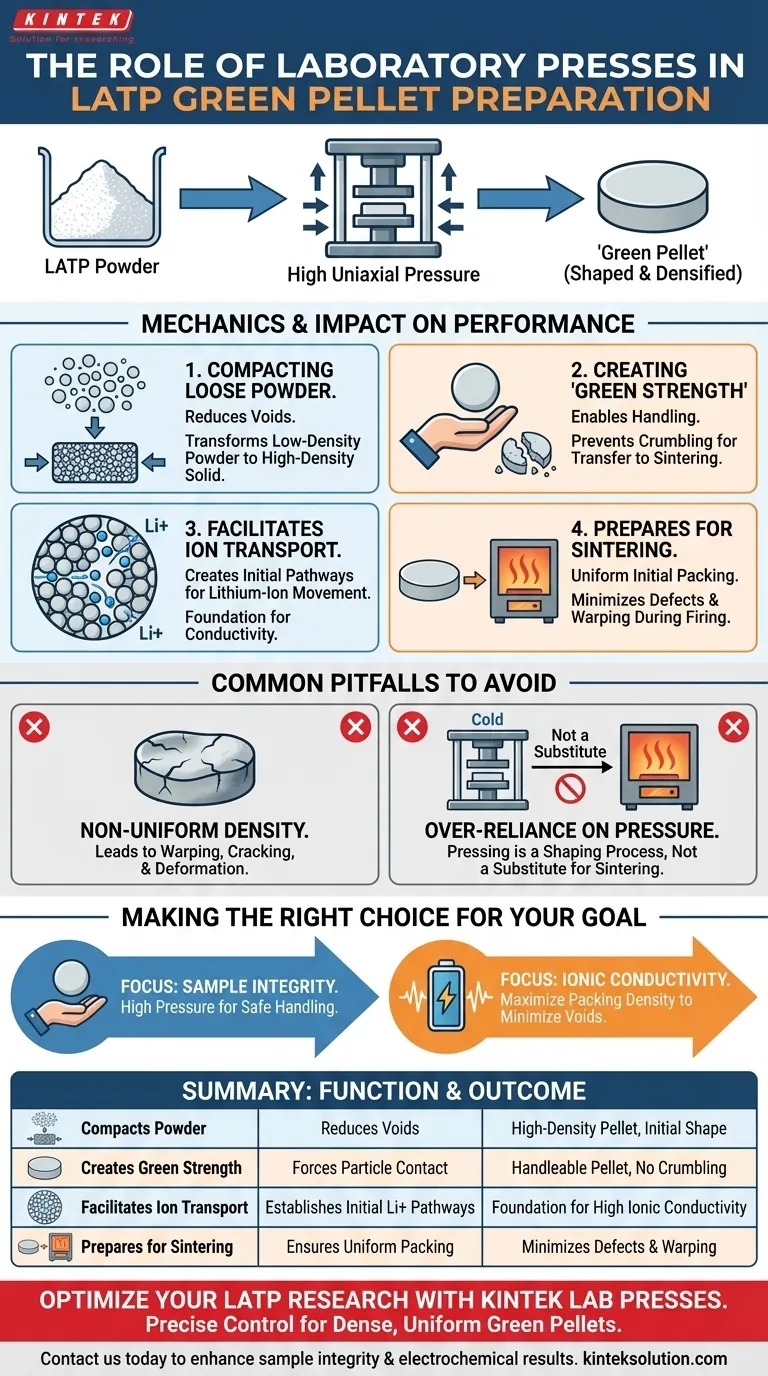
A laboratory press machine serves as the primary shaping and densification tool in the fabrication of LATP (Lithium Aluminum Titanium Phosphate) solid-state electrolytes. Its specific function is to apply high, uniaxial pressure to loose ceramic powder, transforming it into a cohesive, geometric solid known as a "green pellet."
The laboratory press does more than simply shape the material; it establishes the initial particle-to-particle contact required for successful sintering. Without this critical densification step, the electrolyte cannot achieve the mechanical stability or ionic conductivity necessary for battery performance.

The Mechanics of Green Pellet Formation
Compacting Loose Powder
The primary mechanical function of the press is volume reduction. It applies force (often hydraulic) to LATP powder confined within a rigid mold or die.
This pressure significantly reduces the voids (air gaps) between individual powder particles. The result is a transition from a low-density powder state to a high-density solid compact.
Creating "Green Strength"
The immediate output of the press is a "green pellet"—a ceramic compact that has been pressed but not yet fired (sintered).
The press ensures this pellet has sufficient mechanical strength to be ejected from the mold and handled by laboratory personnel. Without this initial structural integrity, the sample would crumble before it could be transferred to a furnace for heat treatment.
Impact on Electrochemical Performance
Facilitating Ion Transport
While the press shapes the object, its deeper purpose is electrochemical. By forcing particles into intimate contact, the press creates the initial pathways for lithium-ion movement.
High-pressure compaction acts as a prerequisite for building continuous transport channels. This reduces interfacial resistance within the material, directly influencing the final ionic conductivity of the electrolyte.
Preparing for Sintering
The press determines the "initial packing density" of the material. A uniform, dense green pellet is the foundation for high-quality sintering.
If the particles are packed tightly and uniformly by the press, the subsequent high-temperature sintering process will result in better densification. This minimizes microscopic defects and porosity in the final ceramic sheet.
Common Pitfalls to Avoid
Non-Uniform Density
If the laboratory press applies pressure unevenly, or if the die is loaded incorrectly, the green pellet will have density gradients (hard spots and soft spots).
This often leads to warping, cracking, or deformation during the sintering phase. Uniform uniaxial pressure is non-negotiable for a usable sample.
Over-Reliance on Pressure
While the press increases contact area, it is not a substitute for sintering. It is a shaping process that creates the potential for performance.
Cold pressing alone cannot achieve the full material density or grain boundary fusion required for a functional solid-state battery; it simply prepares the architecture for the heat treatment that follows.
Making the Right Choice for Your Goal
When configuring your laboratory press for LATP preparation, consider your primary objective:
- If your primary focus is Sample Integrity: Ensure the pressure is high enough to interlock particles for safe handling, preventing edges from crumbling during transfer.
- If your primary focus is Ionic Conductivity: distinct emphasis must be placed on maximizing packing density to minimize voids and reduce the distance lithium ions must travel between particles.
The laboratory press is the gatekeeper of your material's quality, defining the structural baseline upon which all electrochemical performance is built.
Summary Table:
| Function | Impact on LATP Pellet | Key Outcome |
|---|---|---|
| Compacts Loose Powder | Reduces voids between particles | High-density green pellet with initial shape |
| Creates Green Strength | Forces particle-to-particle contact | Pellet can be handled without crumbling |
| Facilitates Ion Transport | Establishes initial pathways for lithium ions | Foundation for high ionic conductivity |
| Prepares for Sintering | Ensures uniform initial packing density | Minimizes defects and warping during firing |
Ready to optimize your LATP solid-state electrolyte research?
The precise pressure control of a KINTEK lab press is critical for creating dense, uniform green pellets—the essential first step towards achieving high-performance, high-ionic-conductivity materials. Our automatic lab presses, isostatic presses, and heated lab presses are engineered to meet the exacting demands of battery materials development.
Contact us today to discuss how our laboratory press solutions can enhance your sample integrity and electrochemical results.
Get in touch with our experts now!
Visual Guide
Related Products
- Laboratory Hydraulic Split Electric Lab Pellet Press
- Manual Laboratory Hydraulic Pellet Press Lab Hydraulic Press
- Automatic Laboratory Hydraulic Press Lab Pellet Press Machine
- Automatic Laboratory Hydraulic Press for XRF and KBR Pellet Pressing
- Laboratory Hydraulic Press Lab Pellet Press Machine for Glove Box
People Also Ask
- What are the emerging trends in the design and materials of lab pellet presses? Modernize Your Lab Efficiency
- How do lab pellet presses support customization and flexibility? Optimize Your Sample Prep for Any Material
- What are common lab pellet press issues? Expert Troubleshooting Guide for Reliable Material Research
- What are the common operational types of lab pellet presses? Choosing the Right Manual, Automatic, or Hydraulic System
- Why use a laboratory pellet press for solid-state battery evaluation? Ensure Accuracy in Interface Stability Testing



















