
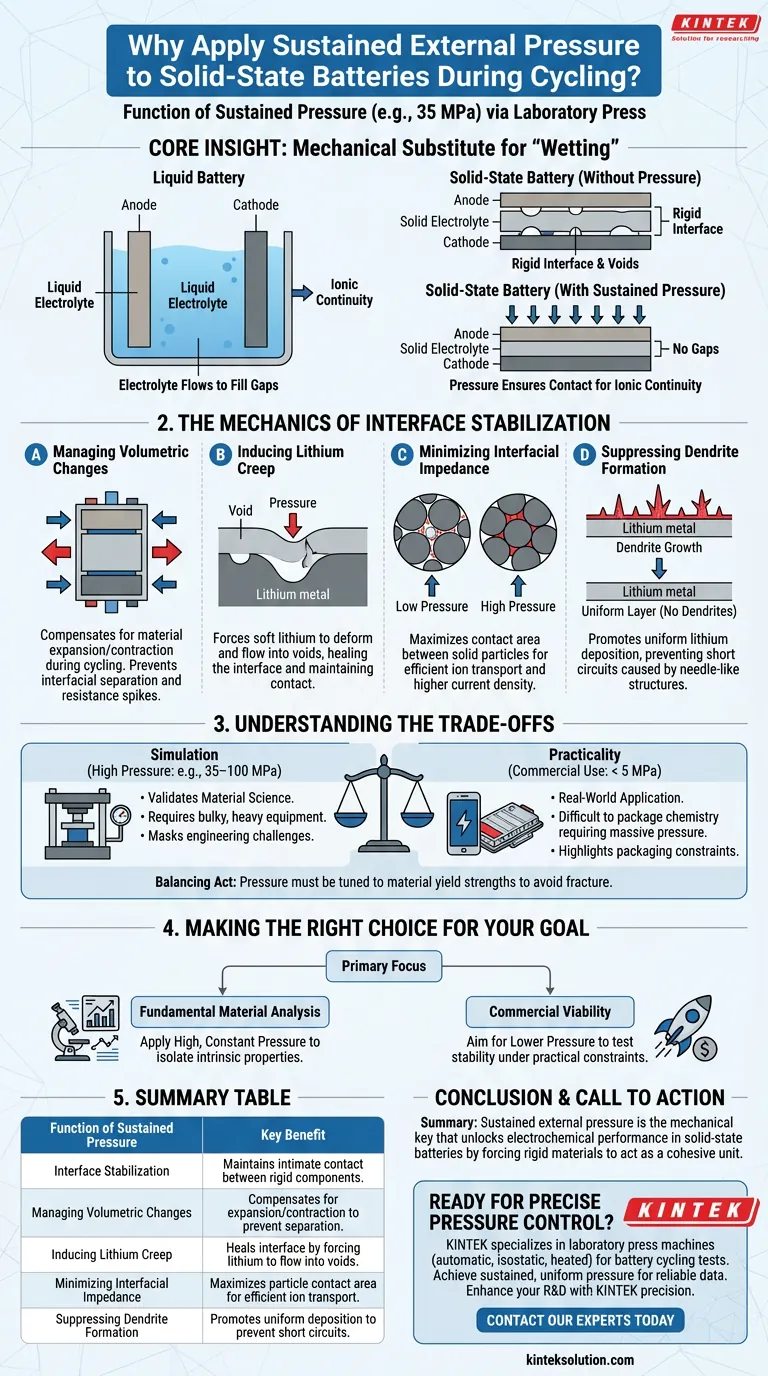
Applying sustained external pressure, such as 35 MPa, during solid-state battery cycling is primarily a mechanical substitute for the "wetting" action found in liquid electrolytes. It forces the rigid solid components—the cathode, solid electrolyte, and anode—to maintain intimate physical contact. This pressure is critical for compensating for the volume expansion and contraction of materials during charging and discharging, ensuring that lithium ions can move efficiently across the interfaces without encountering gaps or voids.
Core Insight: In a liquid battery, the electrolyte flows to fill gaps; in a solid-state battery, the interface is rigid and unforgiving. Sustained external pressure is the only mechanism that ensures continuous ionic continuity by mechanically compressing layers together to counteract material shifting and void formation.
The Mechanics of Interface Stabilization
Managing Volumetric Changes
During the charge and discharge cycles, battery materials naturally expand and contract. In a solid-state system, these volumetric changes can physically push layers apart.
Without external pressure, this movement leads to interfacial separation. Once the layers separate, the path for lithium ions is broken, causing a rapid spike in resistance and immediate performance degradation.
Inducing Lithium Creep
A specific challenge in solid-state batteries is the "stripping" of lithium during discharge, which leaves behind vacancies or voids at the interface.
Applying high pressure (like 35 MPa or higher) utilizes the mechanical property of lithium known as creep. The pressure forces the soft lithium metal to deform and "flow" into these voids, actively healing the interface and maintaining the contact area required for the reaction to continue.
Minimizing Interfacial Impedance
For a battery to function, ions must travel from one solid particle to another. This requires an "intimate" connection—essentially, the particles must be smashed together tightly.
Pressure ensures a low-impedance solid-solid interface. By maximizing the contact area between the electrode particles and the electrolyte, you reduce the barrier to ion transport, directly improving the battery’s critical current density.
Suppressing Dendrite Formation
In anode-free configurations or systems utilizing lithium metal, irregularities at the interface can lead to dendrite growth (needle-like structures that cause shorts).
External stack pressure helps maintain a uniform lithium layer. By suppressing void formation and ensuring the lithium deposits evenly, the pressure acts as a mechanical constraint that helps prevent dendrites from penetrating the electrolyte layer.
Understanding the Trade-offs
While high pressure is beneficial for performance data, it introduces specific challenges regarding real-world application.
Simulation vs. Practicality
Laboratory tests often use high pressures (e.g., 62.4 MPa to 100 MPa) to achieve stable data. However, applying this magnitude of pressure requires heavy, bulky steel frames or hydraulic presses.
The trade-off is that a battery chemistry requiring massive external pressure may be difficult to package for commercial use (like in an EV or phone). Therefore, while high pressure validates the material science, it may mask engineering challenges related to packaging constraints.
Material Integrity
Applying pressure is a balancing act. The goal is to maximize density and contact, but excessive pressure on the wrong materials could potentially fracture brittle ceramic electrolytes or deform internal structures beyond their elastic limit. The pressure applied must be tuned to the specific yield strengths of the materials involved.
Making the Right Choice for Your Goal
When designing your testing protocol, the amount of pressure you apply depends on what you are trying to prove.
- If your primary focus is Fundamental Material Analysis: Apply high, constant pressure (e.g., 35–100 MPa) to eliminate interfacial artifacts and isolate the intrinsic electrochemical properties of your materials.
- If your primary focus is Commercial Viability: Aim to lower the external pressure closer to practical pack-level constraints (< 5 MPa) to see if the chemistry remains stable without heavy external reinforcement.
Summary: Sustained external pressure is the mechanical key that unlocks electrochemical performance in solid-state batteries by forcing rigid materials to behave as a cohesive, ionically conductive unit.
Summary Table:
| Function of Sustained Pressure | Key Benefit |
|---|---|
| Interface Stabilization | Maintains intimate contact between rigid solid components (cathode, electrolyte, anode). |
| Managing Volumetric Changes | Compensates for material expansion/contraction during cycling to prevent separation. |
| Inducing Lithium Creep | Forces lithium to flow into voids, healing the interface and maintaining reaction area. |
| Minimizing Interfacial Impedance | Maximizes particle contact area for efficient ion transport and higher current density. |
| Suppressing Dendrite Formation | Promotes uniform lithium deposition to prevent short circuits. |
Ready to achieve precise and reliable pressure control for your solid-state battery research?
KINTEK specializes in laboratory press machines, including automatic lab presses, isostatic presses, and heated lab presses, designed to meet the exacting demands of battery cycling tests. Our equipment delivers the sustained, uniform pressure essential for stabilizing interfaces, suppressing dendrites, and obtaining accurate, reproducible data—whether for fundamental material analysis or assessing commercial viability.
Enhance your R&D with KINTEK's precision lab presses. Contact our experts today to discuss your specific testing requirements and discover the right solution for your laboratory's needs.
Visual Guide
Related Products
- Laboratory Hydraulic Press Lab Pellet Press Button Battery Press
- Laboratory Hydraulic Press 2T Lab Pellet Press for KBR FTIR
- Laboratory Hydraulic Press Lab Pellet Press Machine for Glove Box
- Laboratory Split Manual Heated Hydraulic Press Machine with Hot Plates
- Laboratory Hydraulic Pellet Press for XRF KBR FTIR Lab Press
People Also Ask
- How is a laboratory hydraulic press used for HAP composite gels? Master Mineral Substrate Standardization
- What role does a laboratory hydraulic press play in reaction pellets? Optimizing Lunar Soil and Metal Fuel Density
- What role does a laboratory hydraulic press play in the preparation of piezoelectric ceramic discs for DC-PG? | KINTEK
- Why is a laboratory hydraulic press required for PBAT and PLA sample preparation? Achieve Flawless Characterization
- What role does a laboratory hydraulic press play in the assembly of all-solid-state battery test cells? Expert Guide



















