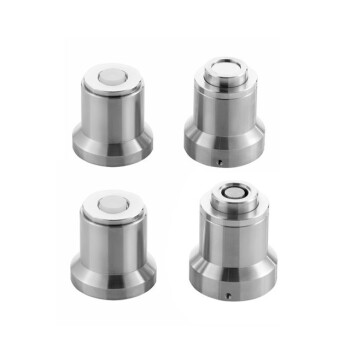
Specialized battery molds and sealing consumables serve a critical dual purpose in In-situ XRD testing: they enable the transmission of X-ray beams while simultaneously maintaining a hermetic seal against the environment. By utilizing materials like polyimide (Kapton) films or beryllium, these components allow researchers to capture precise internal phase change data without exposing sensitive battery materials, such as sulfides, to destructive oxidation.
The success of In-situ XRD relies on successfully managing two opposing requirements: physically isolating the battery chemistry to prevent failure while remaining virtually invisible to X-ray analysis tools.
The Challenge of In-situ Observation
Bridging the Data Gap
Standard battery casings are often too dense for X-rays to penetrate effectively, blocking the signal required for analysis.
Conversely, removing the casing exposes the internal chemistry to the atmosphere.
Specialized molds bridge this gap by integrating specific "beam windows" designed to be transparent to X-rays but impermeable to air.
Protecting Sensitive Chemistries
The primary reference highlights that maintaining an oxygen-free environment is not merely a precaution; it is a necessity for materials like sulfides.
If these materials interact with oxygen, they undergo oxidative failure.
This degradation fundamentally alters the sample, meaning any data collected would reflect a failing battery rather than the operational phase changes you intend to study.
Material Selection for Beam Windows
Polyimide (Kapton) Films
High-sealing consumables often utilize polyimide films, commonly known as Kapton.
These films provide high transmittance, allowing X-rays to pass through with minimal interference or signal loss.
Despite their transparency to radiation, they form a tight, effective seal that keeps the internal environment stable.
Beryllium Windows
Beryllium is frequently cited as a premier material for these specialized molds.
It offers exceptional X-ray transparency, ensuring that the detector captures weak signals from internal phase changes.
Like Kapton, it serves as a robust barrier between the laboratory atmosphere and the volatile battery electrolyte.
Understanding the Operational Trade-offs
Signal Intensity vs. Environmental Integrity
While high-transmittance consumables are essential, they introduce a delicate balance.
Materials that are thin enough to allow maximum X-ray penetration may be less robust against mechanical stress or internal pressure.
You must ensure the chosen consumable is strong enough to maintain the oxygen-free seal throughout the entire duration of the test, or the sample will be compromised.
Ensuring Data Integrity in Your Experiments
To achieve reliable results in In-situ XRD testing, you must select molds and consumables that align with your specific material constraints.
- If your primary focus is Signal Clarity: Prioritize materials with high transmittance, such as Beryllium or thin Kapton, to minimize beam attenuation and capture subtle phase changes.
- If your primary focus is Material Stability: Ensure your sealing consumables are rigorously tested for oxygen impermeability to prevent the immediate degradation of sulfide-based components.
By selecting the right combination of mold design and window material, you ensure that your data reflects true electrochemical evolution rather than environmental contamination.
Summary Table:
| Component | Key Material | Primary Function | Advantage for XRD |
|---|---|---|---|
| Beam Window | Beryllium / Kapton | X-ray transmission | High transparency, minimal signal attenuation |
| Sealing Consumables | Polyimide Films | Environmental isolation | Prevents oxidation of sensitive materials (e.g., sulfides) |
| Specialized Molds | Integrated Designs | Structural integrity | Maintains hermetic seal under mechanical stress |
Elevate Your Battery Research with KINTEK Precision
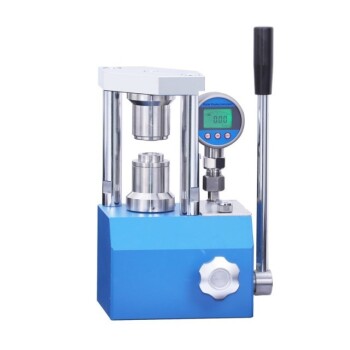
Don't let environmental contamination compromise your In-situ XRD data. KINTEK specializes in comprehensive laboratory pressing solutions, offering manual, automatic, heated, and glovebox-compatible models, alongside cold and warm isostatic presses tailored for advanced battery research. Our high-performance molds and sealing consumables ensure your sensitive materials remain stable while delivering maximum signal clarity.
Ready to achieve superior data integrity? Contact KINTEK today to find the perfect solution for your lab!
References
- Hamin Choi, K. D. Chung. Phase-Controlled Dual Redox Mediator Enabled High-Performance All-Solid-State Lithium–Sulfur Batteries. DOI: 10.2139/ssrn.5984637
This article is also based on technical information from Kintek Solution Knowledge Base .
Related Products
- Lab Button Battery Disassembly and Sealing Mold
- Lab Button Battery Tablet Press Sealing Mold
- Carbide Lab Press Mold for Laboratory Sample Preparation
- Lab Cylindrical Press Mold for Laboratory Use
- Lab Infrared Press Mold for Laboratory Applications
People Also Ask
- How does a sealed battery mold facilitate the assembly and testing of asymmetric supercapacitors using VO2?
- How does the geometry of laboratory molds influence mycelium-based composites? Optimize Density and Strength
- Why are specialized battery test molds used? Ensure Peak Performance for All-Solid-State Sodium Batteries (ASSIBs)
- What role do battery testing molds play in electrolyte performance? Exploring Pressure vs. Viscoelasticity
- Why are high-precision laboratory molds and specific compaction processes required? Ensure Data Integrity in Soil Research