
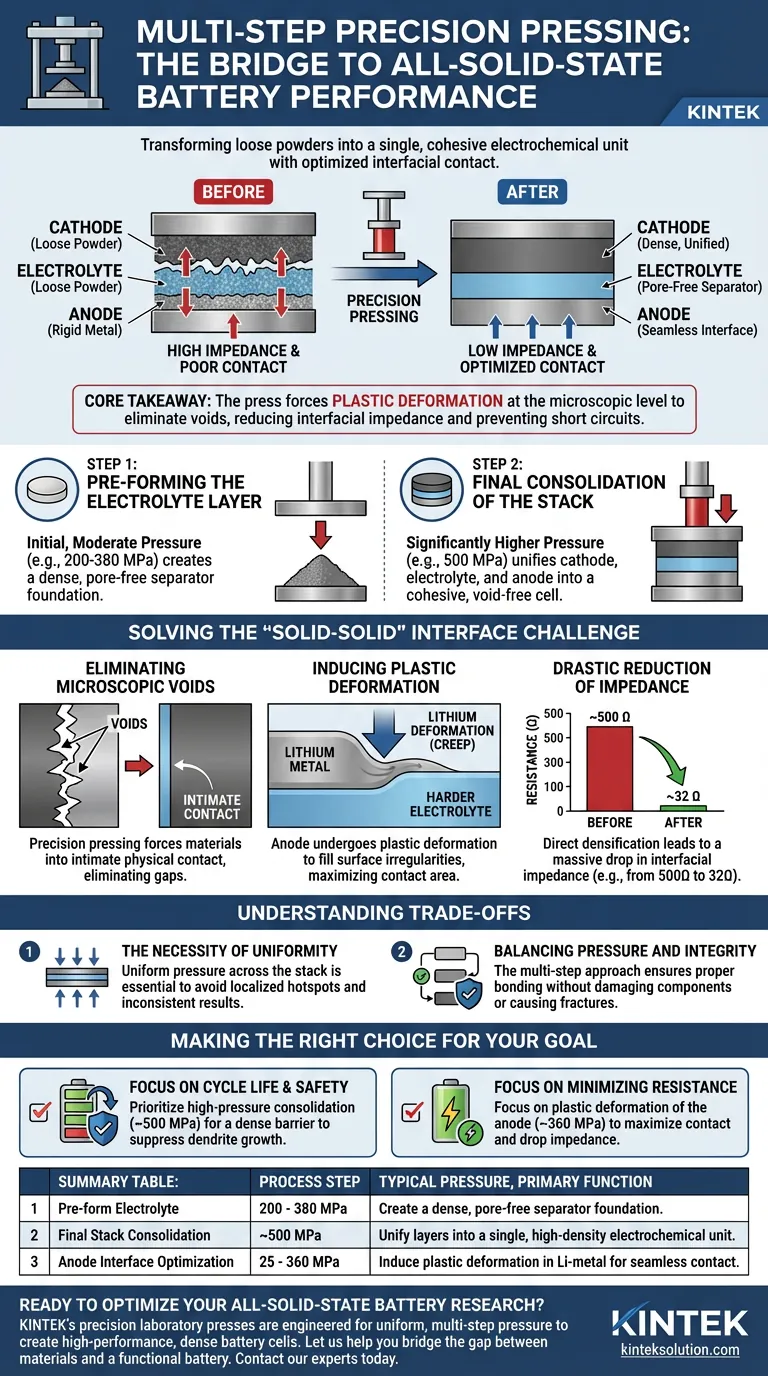
The primary function of the multi-step precision pressing process is to transform loose electrolyte powders and rigid electrode materials into a single, cohesive electrochemical unit with optimized interfacial contact.
This process generally involves an initial lower-pressure step (e.g., 200 MPa) to pre-form the electrolyte separator, followed by a significantly higher-pressure step (e.g., 500 MPa) to consolidate the cathode and anode layers. This stepwise approach creates a dense, void-free structure essential for facilitating ion transport and ensuring structural integrity.
Core Takeaway In all-solid-state lithium-sulfur batteries, the solid-solid interface is the primary bottleneck for performance. The hydraulic press does not merely shape the battery; it forces plastic deformation at the microscopic level to eliminate voids, thereby reducing interfacial impedance and preventing internal short circuits.
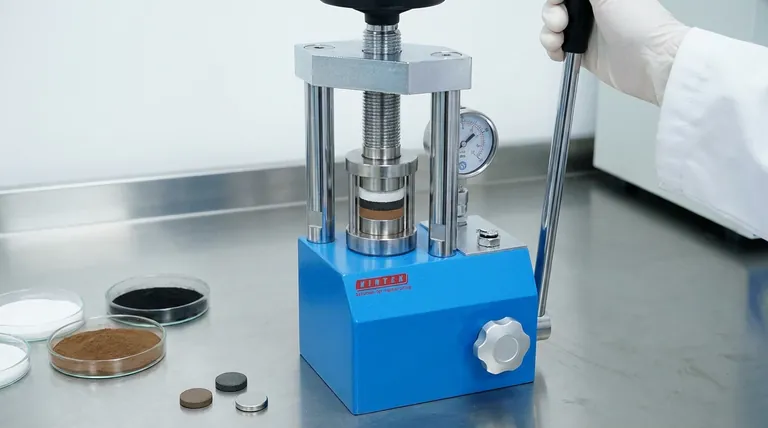
The Mechanics of the Multi-Step Process
Step 1: Pre-forming the Electrolyte Layer
The first stage of assembly focuses on the solid-state electrolyte powder (such as Li6PS5Cl). A laboratory hydraulic press applies an initial, moderate pressure—references suggest values like 200 MPa to 380 MPa depending on the specific material.
This creates a pre-formed "separator" pellet. The goal here is not final unification, but to create a foundation that is dense and pore-free enough to prevent electrical shorts between the anode and cathode, while remaining receptive to the subsequent addition of electrode layers.
Step 2: Final Consolidation of the Stack
Once the electrolyte pellet is formed, the cathode (often a sulfur-electrolyte mix) and the anode (often Lithium metal) are positioned on opposite sides. The press is then utilized to apply a much higher pressure, frequently reaching 500 MPa.
This high-intensity compression consolidates the three distinct layers into a unified cell. This ensures the cathode material achieves high density with minimal porosity, which is fundamental for high ionic conductivity and efficient sulfur utilization.
Solving the "Solid-Solid" Interface Challenge
Eliminating Microscopic Voids
Unlike liquid electrolytes that flow into pores, solid components are rigid. Without extreme pressure, microscopic gaps remain between the electrode and the electrolyte.
These gaps act as barriers to ion flow. Precision pressing forces the materials into intimate physical contact, ensuring that the active materials physically touch the electrolyte particles.
Inducing Plastic Deformation
For components like the lithium metal anode, the press performs a critical metallurgical function. Under pressures like 25 MPa to 360 MPa, the lithium metal undergoes plastic deformation (creep).
This forces the metal to flow into and fill the microscopic surface irregularities of the harder electrolyte layer. This creates a physically seamless interface that maximizes the effective contact area.
Drastic Reduction of Impedance
The direct result of this physical densification is a massive drop in interfacial impedance.
For example, proper application of pressure can reduce resistance from over 500 Ω down to approximately 32 Ω. This reduction is non-negotiable for enabling efficient ion transport and stabilizing electrochemical measurements.
Understanding the Trade-offs
The Necessity of Uniformity
It is not enough to simply apply force; the pressure must be uniform across the entire stack.
A laboratory hydraulic press provides this precision. If pressure is uneven, current distribution becomes non-uniform. This can lead to localized "hotspots" of ion flux, which may accelerate failure mechanisms or lead to inconsistent experimental data.
Balancing Pressure and Integrity
While high pressure is required for densification, the multi-step aspect is critical to avoid damaging components.
Pre-forming the electrolyte at a lower pressure before the final high-pressure consolidation helps ensure the layers bond correctly without causing internal fractures or misalignments that could lead to immediate short circuits.
Making the Right Choice for Your Goal
When designing your assembly protocol, align the pressure parameters with your specific research objectives:
- If your primary focus is Cycle Life and Safety: Prioritize high-pressure consolidation (e.g., ~500 MPa) to create a void-free, dense barrier that physically suppresses lithium dendrite growth and prevents internal shorts.
- If your primary focus is Minimizing Resistance: Focus on the plastic deformation of the anode (e.g., ~360 MPa on the Li-metal interface) to maximize surface contact area and drop interfacial impedance to its lowest possible value.
Ultimately, the hydraulic press acts as a bridge between separate materials and a functional battery, trading mechanical force for electrochemical efficiency.
Summary Table:
| Process Step | Typical Pressure | Primary Function |
|---|---|---|
| Pre-form Electrolyte | 200 - 380 MPa | Create a dense, pore-free separator foundation. |
| Final Stack Consolidation | ~500 MPa | Unify layers into a single, high-density electrochemical unit. |
| Anode Interface Optimization | 25 - 360 MPa | Induce plastic deformation in Li-metal for seamless contact. |
Ready to optimize your all-solid-state battery research?
KINTEK's precision laboratory presses—including automatic, isostatic, and heated models—are engineered to deliver the uniform, multi-step pressure required for creating high-performance, dense battery cells with minimal interfacial resistance.
Let us help you bridge the gap between materials and a functional battery. Contact our experts today to discuss your specific lab press needs.
Visual Guide
Related Products
- Laboratory Hydraulic Press Lab Pellet Press Button Battery Press
- Laboratory Hydraulic Press 2T Lab Pellet Press for KBR FTIR
- Laboratory Hydraulic Press Lab Pellet Press Machine for Glove Box
- 24T 30T 60T Heated Hydraulic Lab Press Machine with Hot Plates for Laboratory
- Automatic Laboratory Hydraulic Press Lab Pellet Press Machine
People Also Ask
- How is a laboratory hydraulic press used for HAP composite gels? Master Mineral Substrate Standardization
- What role does a laboratory hydraulic press play in the preparation of piezoelectric ceramic discs for DC-PG? | KINTEK
- What role does a laboratory hydraulic press play in reaction pellets? Optimizing Lunar Soil and Metal Fuel Density
- Why is a laboratory hydraulic press required for PBAT and PLA sample preparation? Achieve Flawless Characterization
- What role does a laboratory hydraulic press play in the assembly of all-solid-state battery test cells? Expert Guide



















