
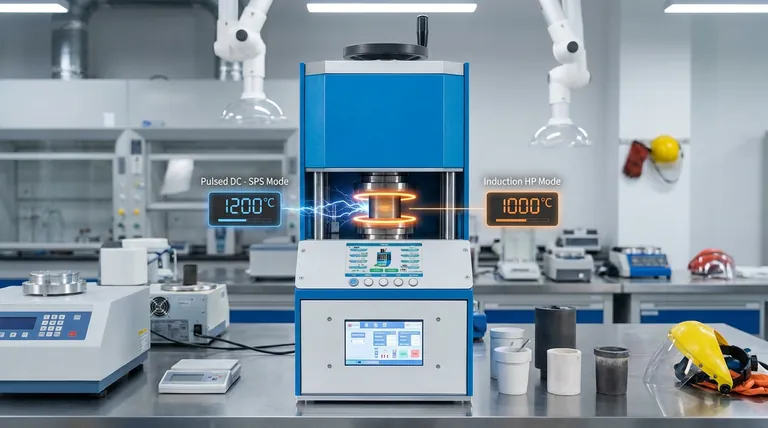
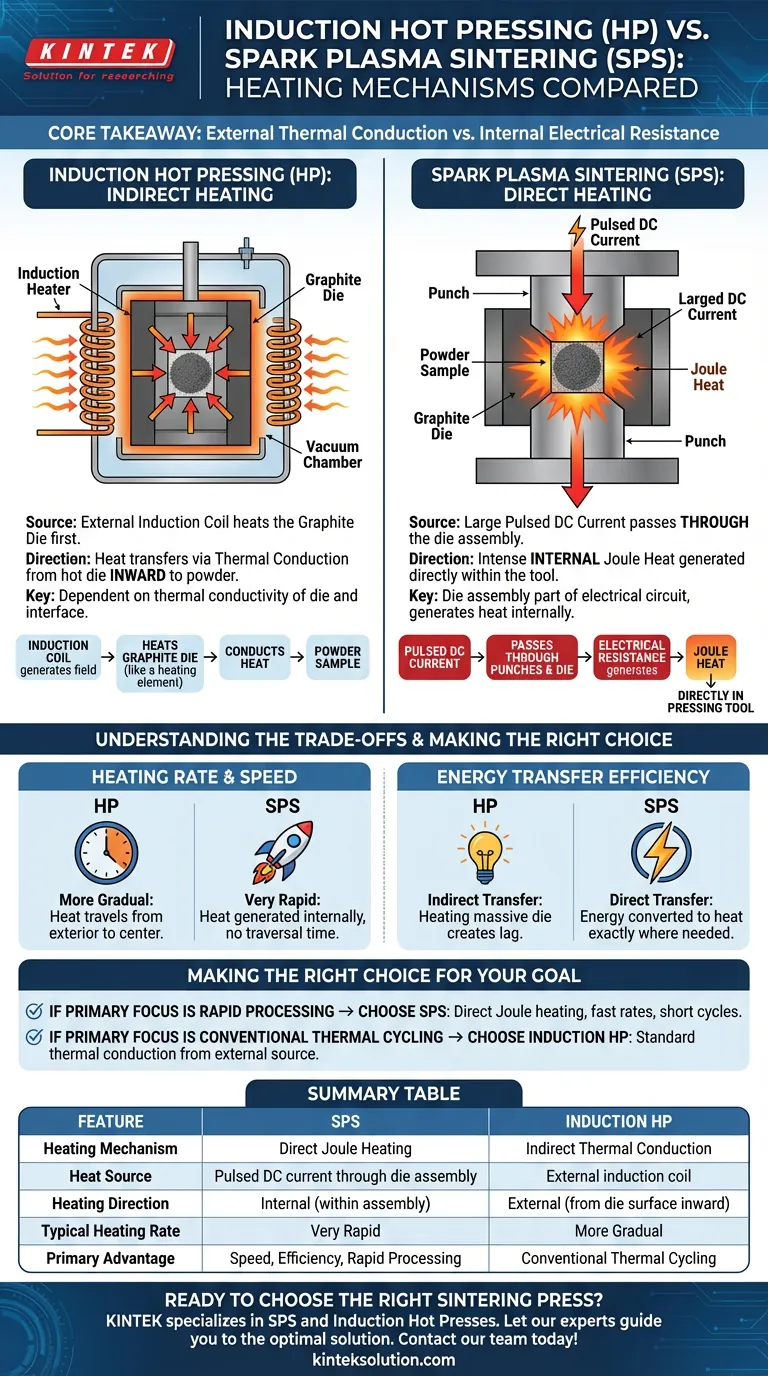
The fundamental distinction lies in the directionality and source of heat generation. Induction Hot Pressing (HP) relies on indirect heating, where an external induction coil heats the graphite die, which then transfers thermal energy inward to the powder via conduction. In contrast, Spark Plasma Sintering (SPS) utilizes direct heating, passing a large pulsed DC current directly through the die assembly to generate intense internal Joule heat.
Core Takeaway: The choice between these methods is a choice between external thermal conduction and internal electrical resistance. SPS generates heat from within the assembly for rapid temperature rise, whereas induction HP relies on heat traveling from the outside in.
Analyzing the Mechanics of Heat Transfer
To understand which method suits your material processing needs, you must look at how the energy is delivered to the sample.
Induction Hot Pressing (HP): The Indirect Approach
In induction HP, the heat source is physically separated from the sample. An induction coil is positioned outside the die assembly.
This coil generates a field that heats the graphite die first. The die effectively acts as a heating element.
The thermal energy must then conduct from the hot die inward to the powder sample. This makes the heating process dependent on the thermal conductivity of the die and the interface between the die and the powder.
Spark Plasma Sintering (SPS): The Direct Approach
SPS fundamentally changes the thermal path by making the die assembly part of the electrical circuit.
The system drives a large pulsed DC current through the punches and the graphite die itself.
Because the die assembly has electrical resistance, the passing current generates Joule heat internally. This results in heat being generated directly within the pressing tool, rather than waiting for it to arrive from an external source.
Understanding the Trade-offs
The difference in heating mechanisms leads to distinct operational characteristics regarding speed and efficiency.
Heating Rate and Speed
Because SPS generates heat internally via electrical resistance, it allows for rapid heating of the sample. The energy does not have to traverse the thickness of the die before reaching the powder.
Induction HP is inherently limited by thermal conduction rates. The heat must travel from the exterior surface of the die to the center, resulting in a more gradual heating profile compared to SPS.
Energy Transfer Efficiency
SPS represents a more direct transfer of energy. By utilizing the electrical resistance of the assembly, energy is converted to heat exactly where it is needed.
Induction HP involves an intermediate step—heating the massive die first—which inherently creates a lag between the energy source and the target sample.
Making the Right Choice for Your Goal
While both methods require complex vacuum or atmosphere furnaces capable of withstanding temperatures above 1000°C, the heating mechanism dictates their performance.
- If your primary focus is rapid processing: Choose SPS, as the direct Joule heating allows for fast heating rates and shorter cycle times.
- If your primary focus is conventional thermal cycling: Choose Induction HP, which provides heat via standard thermal conduction from an external source.
Ultimately, SPS offers a kinetic advantage through direct electrical heating, while induction HP relies on the traditional physics of thermal conduction.
Summary Table:
| Feature | Spark Plasma Sintering (SPS) | Induction Hot Pressing (HP) |
|---|---|---|
| Heating Mechanism | Direct Joule Heating | Indirect Thermal Conduction |
| Heat Source | Pulsed DC current through die assembly | External induction coil |
| Heating Direction | Internal (from within the assembly) | External (from die surface inward) |
| Typical Heating Rate | Very Rapid | More Gradual |
| Primary Advantage | Speed, Efficiency, Rapid Processing | Conventional Thermal Cycling |
Ready to Choose the Right Sintering Press for Your Lab?
Understanding the fundamental heating mechanism is the first step to optimizing your material synthesis. The right equipment is critical for achieving the desired density, microstructure, and properties in your sintered materials.
KINTEK specializes in advanced lab press machines, including Spark Plasma Sintering (SPS) systems and Induction Hot Presses. We help researchers and laboratories select the perfect solution for their specific application, whether it's rapid prototyping with SPS or controlled sintering with induction HP.
Let our experts guide you to the optimal solution. We provide:
- Technical Consultation: Determine if SPS or Induction HP is best for your materials and goals.
- High-Performance Equipment: Reliable automatic lab presses, isostatic presses, and heated lab presses.
- Unmatched Support: From installation to ongoing maintenance.
Don't let the heating mechanism be a bottleneck in your research. Contact our team today to discuss your project requirements and discover how KINTEK can enhance your laboratory's capabilities.
Visual Guide
Related Products
- Heated Hydraulic Press Machine with Heated Plates for Vacuum Box Laboratory Hot Press
- Automatic High Temperature Heated Hydraulic Press Machine with Heated Plates for Lab
- Automatic Heated Hydraulic Press Machine with Hot Plates for Laboratory
- Laboratory Split Manual Heated Hydraulic Press Machine with Hot Plates
- Laboratory Manual Heated Hydraulic Press Machine with Hot Plates
People Also Ask
- How does a laboratory heated hydraulic press facilitate PBN sample prep for WAXS? Achieve Precise X-Ray Scattering
- What are the requirements for electrode pressing with high-viscosity ionic liquids like EMIM TFSI? Optimize Performance
- What are the industrial applications of heated hydraulic presses? Master Heat & Force for Precision Manufacturing
- Function of a Laboratory Hydraulic Press with Heated Platens in SSE? Enhance Battery Density & Conductivity
- How are heated hydraulic presses utilized in the preparation of thin films? Key Mechanisms and Applications



















