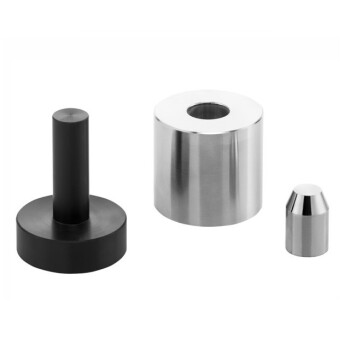
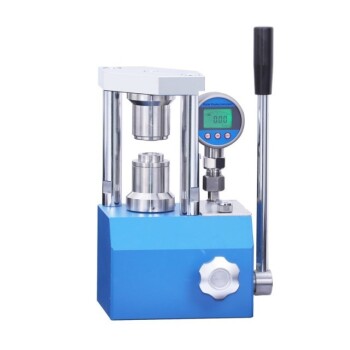
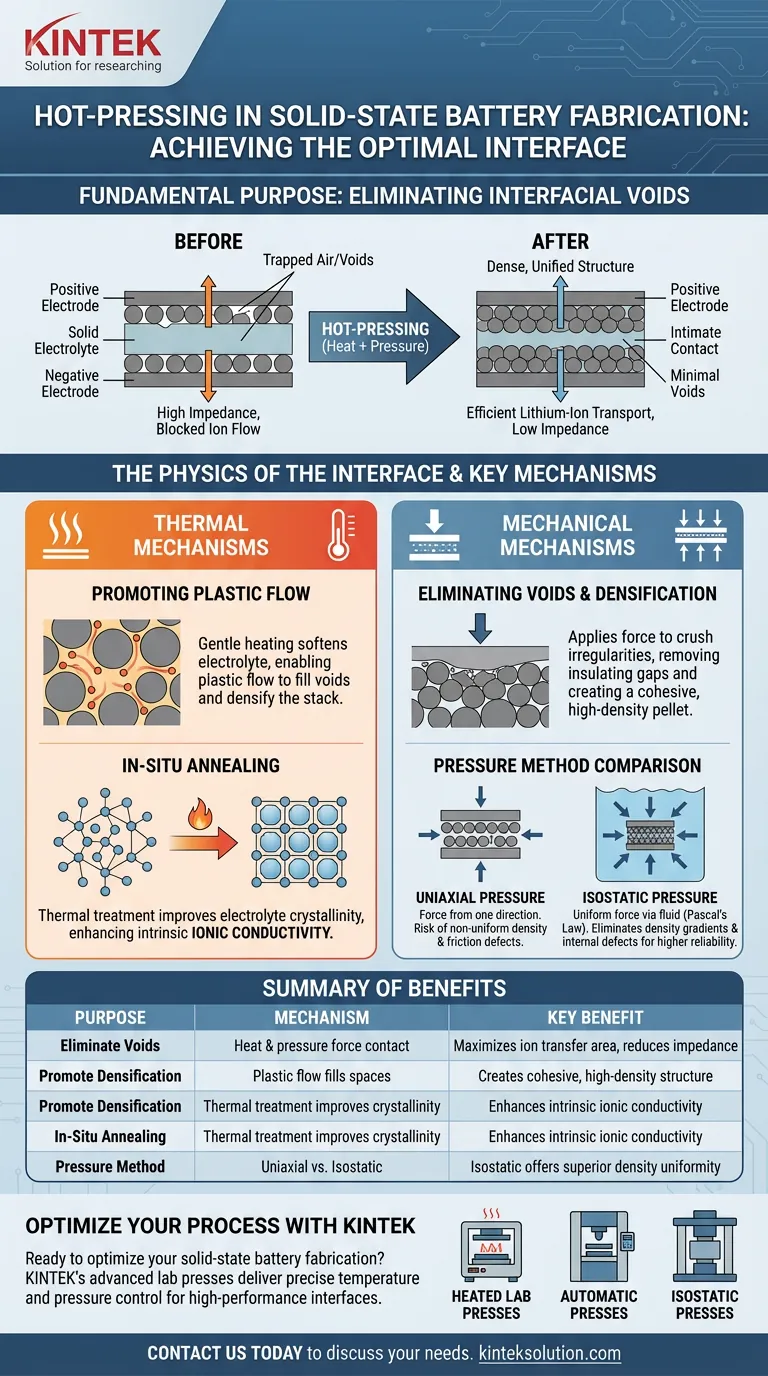
The fundamental purpose of the hot-pressing process is to eliminate microscopic voids between the positive and negative electrodes and the solid electrolyte particles. By applying simultaneous high temperature and pressure, the process forces these rigid materials into intimate physical contact, significantly increasing the effective area available for ion transfer.
In solid-state batteries, the lack of a liquid electrolyte means ions cannot bridge air gaps between layers. Hot-pressing solves this by merging discrete solid layers into a dense, unified structure, creating the low-impedance interface required for efficient lithium-ion transport.
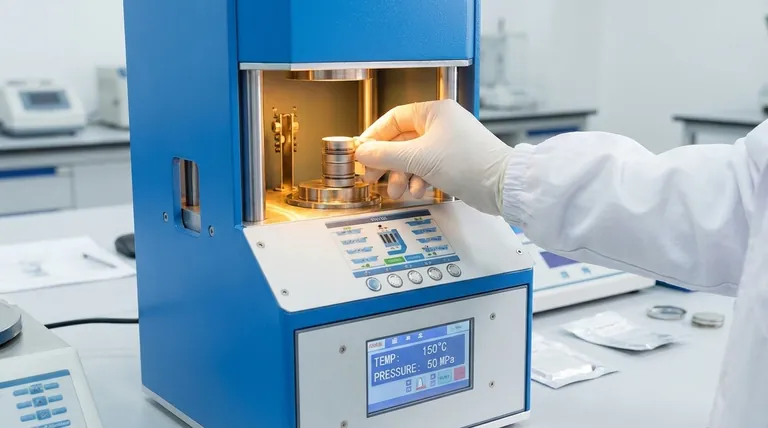
The Physics of the Interface
The Challenge of Solid Contact
Unlike traditional batteries where liquid electrolytes flow into pores, solid-state components are rigid. Without intervention, the "stack" contains trapped air pockets and surface irregularities.
Eliminating Interfacial Voids
Hot-pressing applies mechanical force to crush these irregularities. This action removes the gaps that act as insulators, ensuring that the solid electrolyte particles physically touch the active material particles in the electrodes.
Reducing Impedance
The primary metric improved by this process is impedance. By maximizing the contact area, the internal resistance of the battery drops, allowing for higher rate performance and better cycle stability.
Thermal and Mechanical Mechanisms
Promoting Plastic Flow
Applying heat is critical, particularly for composite cathodes with low bulk modulus. Gentle heating (often below 150°C) softens the electrolyte particles, allowing them to flow plastically under pressure.
Densification and Cohesion
This plastic flow enables the material to fill interstitial spaces that pressure alone might miss. The result is a highly dense pellet or stack with minimal internal porosity and superior mechanical integrity.
In-Situ Annealing
Beyond shaping, the thermal component acts as an annealing treatment. This improves the crystallinity of the electrolyte, which can directly enhance its intrinsic ionic conductivity.
Understanding the Trade-offs
Uniaxial vs. Isostatic Pressure
Standard uniaxial presses apply force from one direction. While effective for simple pellets, friction can cause non-uniform density, leading to potential weak points in the battery structure.
The Isostatic Advantage
Isostatic pressing uses a fluid medium to apply uniform pressure from all directions (Pascal's law). This eliminates density gradients and internal defects, offering higher reliability than uniaxial methods, though often at a higher equipment cost.
Thermal Sensitivity
While heat aids contact, precise control is required. The temperature must be high enough to induce softening and annealing but low enough to avoid degrading the chemical structure of the active materials or separators.
Making the Right Choice for Your Goal
Achieving the optimal interface requires balancing pressure distribution with thermal limits.
- If your primary focus is increasing ionic conductivity: Utilize hot-pressing to leverage the in-situ annealing effect, which improves electrolyte crystallinity.
- If your primary focus is maximizing density uniformity: Opt for isostatic pressing methods to eliminate pressure gradients and internal defects caused by friction.
- If your primary focus is composite cathode performance: Apply gentle heat to induce plastic flow, ensuring the electrolyte fills voids within the compressible electrode structure.
Ultimately, hot-pressing transforms a stack of loose powders and films into a cohesive electrochemical system capable of high-performance energy storage.
Summary Table:
| Purpose | Mechanism | Key Benefit |
|---|---|---|
| Eliminate Interfacial Voids | Applies heat & pressure to force rigid particles into contact | Maximizes ion transfer area, reduces impedance |
| Promote Plastic Flow & Densification | Heat softens particles, allowing them to fill interstitial spaces | Creates a cohesive, high-density structure with minimal porosity |
| In-Situ Annealing | Thermal treatment improves electrolyte crystallinity | Enhances intrinsic ionic conductivity of the electrolyte |
| Pressure Method Comparison | Uniaxial (one direction) vs. Isostatic (uniform, all directions) | Isostatic pressing offers superior density uniformity and reliability |
Ready to optimize your solid-state battery fabrication process?
KINTEK's advanced lab press machines, including automatic, isostatic, and heated lab presses, are engineered to deliver the precise temperature and pressure control required for creating high-performance, low-impedance battery interfaces. Whether your goal is maximizing density uniformity with isostatic pressing or improving ionic conductivity with precise thermal annealing, our equipment provides the reliability and consistency your R&D needs.
Contact us today using the form below to discuss how our specialized lab presses can enhance your solid-state battery development. Let KINTEK be your partner in innovation.
Visual Guide
Related Products
- Warm Isostatic Press for Solid State Battery Research Warm Isostatic Press
- Laboratory Hydraulic Press Lab Pellet Press Button Battery Press
- Button Battery Sealing Press Machine for Lab
- Lab Infrared Press Mold for Laboratory Applications
- Lab Button Battery Tablet Press Sealing Mold
People Also Ask
- Why must composite cathodes be sealed in vacuum lamination bags for WIP? Ensure Battery Stability and Density
- What is the function of elastic molds in warm isostatic pressing? Achieve Uniform Density in Composite Particles
- How do sacrificial volume materials (SVM) maintain microchannels in isostatic pressing? Ensure Structural Integrity
- What is the function of hydraulic pressure in warm isostatic pressing? Achieve Uniform Material Density
- What is the mechanism of a Warm Isostatic Press (WIP) on cheese? Master Cold Pasteurization for Superior Safety