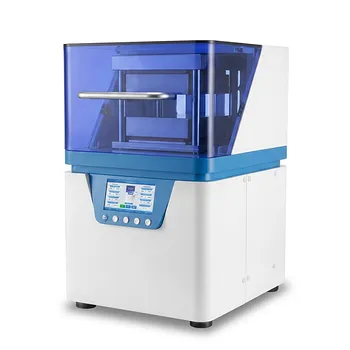
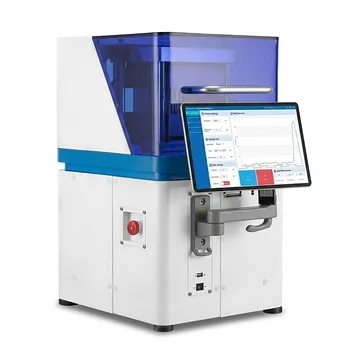
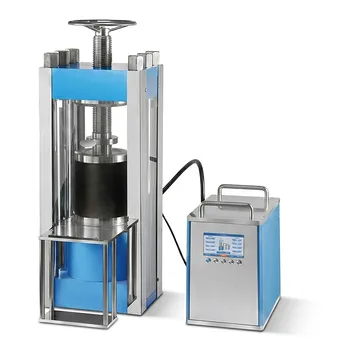
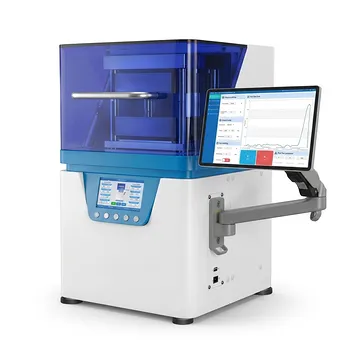
The fundamental working principle of a hot press machine centers on the simultaneous application of positive pressure from above and negative pressure (vacuum) from below, working in conjunction with specialized adhesives.
Primarily powered by oil pressure and compressed air, the machine processes materials by altering their internal energy through heat transfer while applying significant force. This dual-pressure approach is specifically engineered to bond materials quickly at relatively low temperatures, ensuring a secure hold without damaging the workpiece.
The core advantage of this method is its ability to process large-area workpieces without causing deformation—a common failure point in equipment that relies solely on negative pressure. By utilizing high pressure, controlled low temperatures, and short processing times, the hot press ensures both the quality and structural integrity of the final product.
The Mechanics of Pressure Application
Positive and Negative Pressure Synergy
Unlike standard presses that apply force from a single direction, a high-quality hot press utilizes a compound pressure system.
It applies positive pressure (downward force) on top of the material while simultaneously engaging negative pressure (vacuum suction) underneath.
This combination ensures that the material is held flat and firm, effectively resolving issues of workpiece deformation during the bonding process.
Hydraulic Force and Pascal’s Law
The immense force required for this process is generated via a hydraulic system, which operates on Pascal’s Law.
This principle dictates that pressure applied to a confined fluid (oil) is transmitted equally in all directions, allowing a small input force to generate a massive output force on the press platens.
To maintain precision, the system requires a rigid steel frame to prevent the machine itself from deforming under these high loads.
The Operational Workflow
Preparation and Parameter Control
The process begins with placing the prepared material—often coated with special glue—between the heating platens or into a mold.
Operators must strictly configure process parameters, including target temperature, pressure rates, and holding times, to match the specific "special glue" and material characteristics.
Heating, Pressing, and Dwell
Once activated, the machine executes a rapid heating cycle to bring the platens to the target temperature.
Simultaneously, the pressing system engages, applying the pre-set high pressure for a "short film pressure time."
This dwell period allows the adhesive to cure and the materials to bond physically or chemically without being exposed to heat for long enough to warp.
Understanding the Trade-offs
Temperature vs. Time Sensitivity
A critical aspect of the hot press principle is the balance between heat and exposure time.
While high heat cures glue faster, the hot press prioritizes low temperature and short pressure time to protect the material.
Failing to calibrate this balance can lead to either weak bonds (insufficient heat/time) or material degradation (excessive heat/time).
Stability vs. Complexity
The dual-pressure system (positive + negative) offers superior quality but introduces mechanical complexity.
Standard negative-pressure-only equipment is simpler but prone to causing deformation in large workpieces.
Therefore, the hot press trades simplicity for the assurance of flatness and dimensional stability.
Making the Right Choice for Your Goal
To select the right hot press configuration or operating mode, consider your specific production requirements:
- If your primary focus is preventing deformation in large panels: Prioritize a machine capable of applying positive pressure on top of negative pressure to ensure surface flatness.
- If your primary focus is high-precision bonding (e.g., electronics): Look for pulse heating technology and a rigid four-column structure to control temperature and alignment within tight tolerances.
- If your primary focus is production speed: Ensure the hydraulic system features automatic pressure replenishment and rapid heating/cooling cycles to reduce the dwell time.
Mastering the hot press process requires viewing it not just as a heating tool, but as a precision instrument that balances hydraulic force with thermal dynamics to alter material properties.
Summary Table:
| Feature | Description | Benefit |
|---|---|---|
| Pressure Type | Combined Positive & Negative Pressure | Prevents deformation in large workpieces |
| Force Origin | Hydraulic System (Pascal's Law) | Delivers massive, uniform output force |
| Heating Goal | Low Temperature + Short Dwell Time | Ensures bond quality without material damage |
| Adhesion | Specialized Adhesives & Heat Transfer | Rapid curing and structural integrity |
Optimize Your Material Bonding with KINTEK Precision
Elevate your research and production quality with KINTEK’s advanced pressing technology. Whether you are developing next-generation battery components or precision composites, we specialize in comprehensive laboratory pressing solutions tailored to your needs.
Our range includes manual, automatic, heated, multifunctional, and glovebox-compatible models, as well as high-performance cold and warm isostatic presses designed for maximum stability and accuracy.
Ready to achieve superior flatness and bonding strength? Contact us today to find the perfect pressing solution for your lab!
Related Products
- Automatic High Temperature Heated Hydraulic Press Machine with Heated Plates for Lab
- Automatic Hydraulic Heat Press Machine with Multi Stage Programmable Control and Integrated Water Cooling Plate Size 180x180mm
- Heated Hydraulic Press Machine with Heated Plates for Vacuum Box Laboratory Hot Press
- Automatic Heated Hydraulic Press Machine with Hot Plates for Laboratory
- Laboratory Split Manual Heated Hydraulic Press Machine with Hot Plates
People Also Ask
- Function of a Laboratory Hydraulic Press with Heated Platens in SSE? Enhance Battery Density & Conductivity
- How does a laboratory heated hydraulic press facilitate PBN sample prep for WAXS? Achieve Precise X-Ray Scattering
- What are the requirements for electrode pressing with high-viscosity ionic liquids like EMIM TFSI? Optimize Performance
- What are the industrial applications of heated hydraulic presses? Master Heat & Force for Precision Manufacturing
- Why is a laboratory hydraulic press with heating plates required for PLA/TEC films? Achieve Precise Sample Integrity