
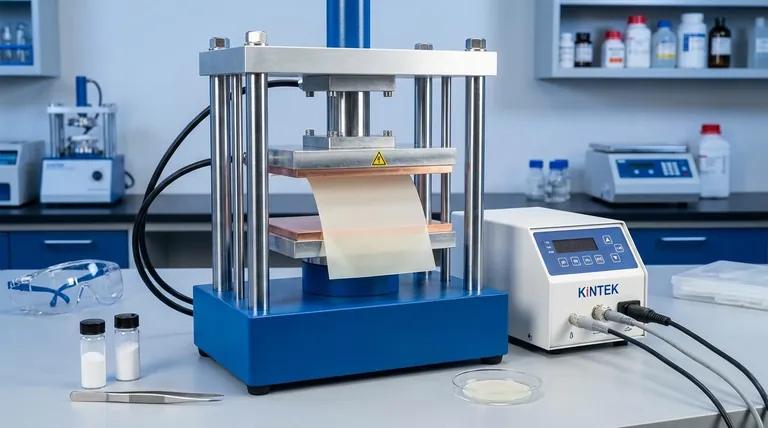
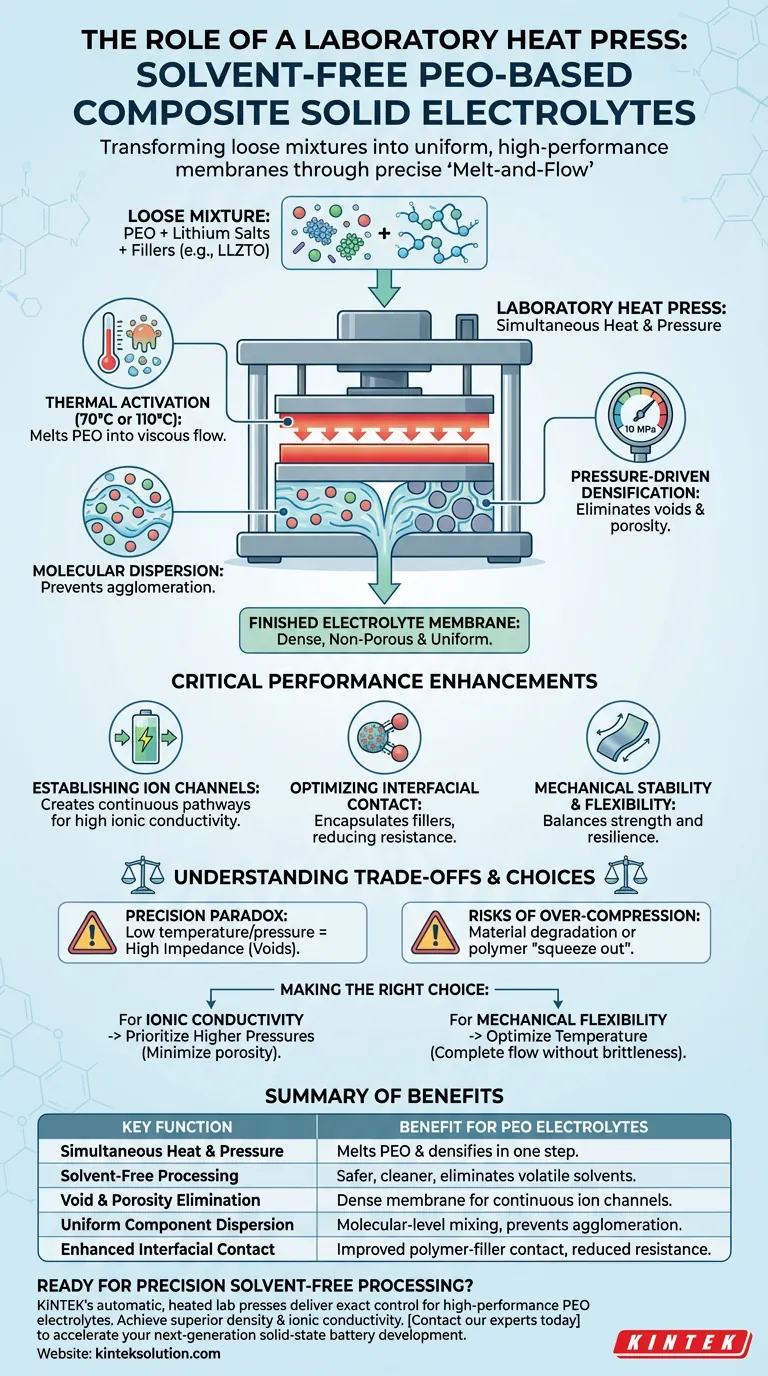
The laboratory heat press functions as the definitive shaping instrument in the solvent-free fabrication of PEO-based composite solid electrolytes. It simultaneously applies precise heat to melt the polymer matrix and controlled pressure to densify the material, converting a loose mixture of PEO, lithium salts, and fillers into a uniform, non-porous membrane.
The heat press eliminates the need for volatile solvents by utilizing a "melt-and-flow" mechanism. This results in a finished electrolyte film with superior density and interfacial contact, establishing the continuous pathways necessary for high ionic conductivity.
The Mechanism of Membrane Formation
Simultaneous Thermal and Mechanical Activation
The primary function of the heat press is to facilitate a phase change while constraining the material. By heating the mixture to temperatures such as 70°C or 110°C, the machine melts the PEO polymer, allowing it to transition into a viscous flow state.
Molecular-Level Dispersion
Once the PEO matrix softens, it can flow freely around other components. This promotes the uniform dispersion of lithium salts and ceramic fillers (like LLZTO) at a molecular level, preventing the agglomeration that can occur in dry mixing.
Pressure-Driven Densification
Concurrently, the application of uniaxial pressure (e.g., 10 MPa) forces the softened polymer to fill interstitial spaces. This mechanical force is critical for eliminating internal voids and porosity, creating a "green body" that is dense and structurally sound.
Critical Performance Enhancements
Establishing Ion Transport Channels
The elimination of pores is not just structural; it is electrochemical. By ensuring a dense, void-free structure, the hot-pressing process creates continuous ion transport channels, which are directly responsible for achieving high ionic conductivity.
Optimizing Interfacial Contact
In composite electrolytes, the boundary between the polymer matrix and ceramic fillers is often a bottleneck for ion movement. The heat press ensures the polymer fully encapsulates these particles, maximizing interfacial contact and reducing resistance.
Mechanical Stability and Flexibility
The process yields a self-supporting film that balances mechanical strength with flexibility. This robustness is vital for the electrolyte to withstand the physical stresses of battery assembly and the volume changes that occur during cycling.
Understanding the Trade-offs
The Precision Paradox
While hot pressing simplifies the process by removing solvents, it introduces a high sensitivity to process parameters. If the temperature is too low, the PEO will not flow sufficiently to fill voids, resulting in high impedance.
Risks of Over-Compression
Conversely, excessive pressure or temperature can lead to material degradation or the "squeezing out" of the polymer matrix, altering the intended ratio of polymer to filler. Achieving the optimal balance between flow and confinement is the primary technical challenge when using this equipment.
Making the Right Choice for Your Goal
To maximize the effectiveness of your hot-pressing process, align your parameters with your specific performance targets:
- If your primary focus is Ionic Conductivity: Prioritize higher pressures during the melt phase to minimize porosity and maximize the continuity of ion pathways.
- If your primary focus is Mechanical Flexibility: optimize the temperature to ensure complete polymer flow without effectively "sintering" the material into a brittle state.
Ultimately, the laboratory heat press transforms the theoretical advantage of solvent-free chemistry into a physically viable, high-performance battery component.
Summary Table:
| Key Function | Benefit for PEO-Based Electrolytes |
|---|---|
| Simultaneous Heat & Pressure | Melts PEO matrix and applies pressure for densification in a single step. |
| Solvent-Free Processing | Eliminates volatile solvents, creating a safer, cleaner manufacturing process. |
| Void & Porosity Elimination | Creates a dense, non-porous membrane for continuous ion transport channels. |
| Uniform Component Dispersion | Ensures molecular-level mixing of polymer, salts, and fillers, preventing agglomeration. |
| Enhanced Interfacial Contact | Improves contact between polymer and ceramic fillers, reducing ionic resistance. |
Ready to transform your battery material research with precision solvent-free processing?
KINTEK's range of automatic, heated lab presses is engineered to deliver the exact control over temperature and pressure required to fabricate high-performance PEO-based composite solid electrolytes. Achieve superior density, optimal ionic conductivity, and robust mechanical properties in your lab.
Contact our experts today to discuss how our lab press machines can accelerate your development of next-generation solid-state batteries.
Visual Guide
Related Products
- Automatic High Temperature Heated Hydraulic Press Machine with Heated Plates for Lab
- 24T 30T 60T Heated Hydraulic Lab Press Machine with Hot Plates for Laboratory
- Lab Heat Press Special Mold
- Laboratory Split Manual Heated Hydraulic Press Machine with Hot Plates
- Automatic Heated Hydraulic Press Machine with Hot Plates for Laboratory
People Also Ask
- Function of a Laboratory Hydraulic Press with Heated Platens in SSE? Enhance Battery Density & Conductivity
- What are the requirements for electrode pressing with high-viscosity ionic liquids like EMIM TFSI? Optimize Performance
- How does a laboratory heated hydraulic press facilitate PBN sample prep for WAXS? Achieve Precise X-Ray Scattering
- What are the industrial applications of heated hydraulic presses? Master Heat & Force for Precision Manufacturing
- Why is a laboratory hydraulic press with heating plates required for PLA/TEC films? Achieve Precise Sample Integrity



















