
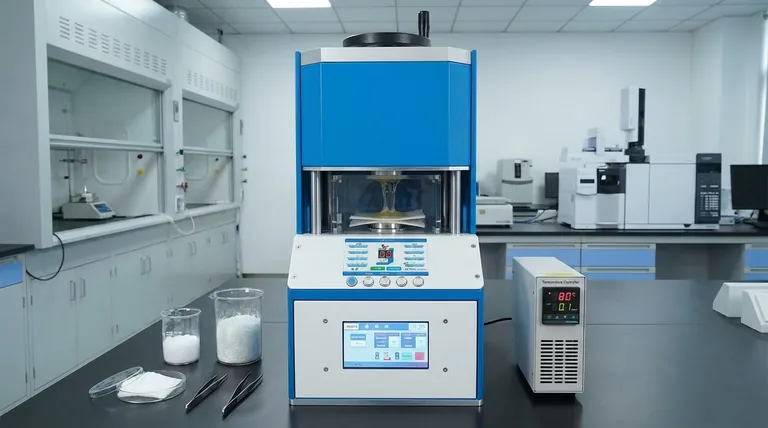
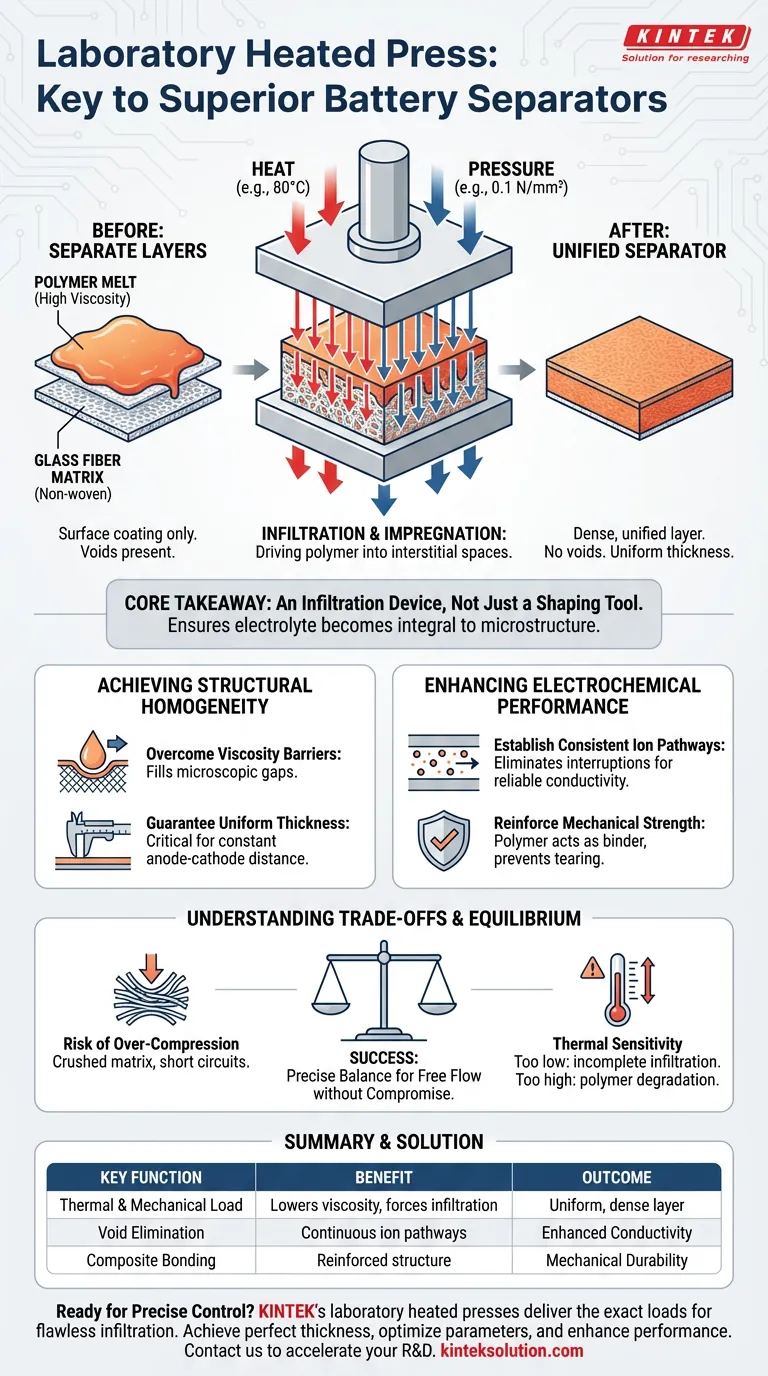
The primary function of a laboratory heated press in fabricating plastic crystal polymer infiltrated separators is to drive the thorough impregnation of a viscous electrolyte melt into a non-woven glass fiber matrix.
By applying precise thermal and mechanical loads—such as 0.1 N/mm² at 80°C—the press lowers the viscosity of the polymer and physically forces it into the separator's interstitial spaces. This transforms a surface-coated material into a dense, unified layer with uniform thickness, which is a prerequisite for reliable battery function.
Core Takeaway The heated press is not merely a shaping tool; it is an infiltration device that overcomes the natural resistance of viscous polymers. It ensures the electrolyte becomes an integral part of the separator's microstructure, eliminating voids that would otherwise compromise mechanical strength and ionic conductivity.
Achieving Structural Homogeneity
Overcoming Viscosity Barriers
Plastic crystal polymer electrolytes are often highly viscous in their melted state. Without external force, they coat the surface of a glass fiber separator without fully penetrating it.
The heated press applies heat to maintain the melt's fluidity while simultaneously applying pressure to drive the material deep into the fiber network. This ensures the polymer fills the microscopic gaps between fibers rather than sitting on top.
Guaranteeing Uniform Thickness
In battery assembly, variations in separator thickness can lead to uneven current distribution. The heated press creates a dense layer of uniform thickness across the entire surface area.
This geometric precision is critical for ensuring that the distance between the anode and cathode remains constant, preventing localized hotspots during operation.
Enhancing Electrochemical Performance
Establishing Consistent Ion Pathways
A separator must facilitate the movement of ions between electrodes. The pressing process creates a continuous phase of electrolyte within the separator.
By eliminating air pockets and voids through compression, the press ensures there are no interruptions in the ion transport pathways. This directly results in consistent and reliable ionic conductivity.
Reinforcing Mechanical Strength
A non-woven glass fiber separator is fragile on its own. When the polymer is successfully infiltrated and densified by the press, it acts as a binder.
This process significantly enhances the mechanical integrity of the composite. The result is a robust separator that can withstand the physical stresses of battery assembly and operation without tearing or delaminating.
Understanding the Trade-offs
The Risk of Over-Compression
While pressure is necessary for infiltration, excessive force can be detrimental. Applying pressure beyond the optimal range (e.g., significantly higher than 0.1 N/mm² for this specific application) may crush the glass fiber network.
Damaging the host matrix reduces the separator's ability to prevent physical contact between electrodes, potentially leading to short circuits.
Thermal Sensitivity
Temperature control must be exact. The heat must be sufficient to lower the polymer's viscosity for flow, but it must not exceed the degradation threshold of the components.
If the temperature is too low, infiltration will be incomplete, leaving voids. If it is too high, the polymer structure may alter, negatively affecting its electrochemical properties.
Making the Right Choice for Your Goal
To optimize the fabrication of your separators, align your pressing parameters with your specific performance targets:
- If your primary focus is mechanical durability: Prioritize pressure duration to ensure the polymer fully encapsulates the fiber network, creating a reinforced composite structure.
- If your primary focus is maximizing ionic conductivity: Focus on precise temperature control to ensure the melt reaches optimal fluidity for pore-filling without degrading the polymer's transport properties.
Success relies on finding the precise equilibrium where the polymer flows freely into the matrix without compromising the structural integrity of the separator.
Summary Table:
| Key Function | Benefit | Typical Parameter Example |
|---|---|---|
| Thermal Management | Lowers polymer viscosity for deep infiltration | 80°C |
| Mechanical Compression | Forces polymer into interstitial spaces, ensures uniform thickness | 0.1 N/mm² |
| Structural Homogeneity | Eliminates voids, creates continuous ion pathways | N/A |
| Performance Outcome | Enhanced ionic conductivity and mechanical durability | N/A |
Ready to fabricate superior battery separators with precise control?
KINTEK's laboratory heated presses are engineered to deliver the exact thermal and mechanical loads required for flawless polymer infiltration. Whether you are developing next-generation batteries or optimizing your current process, our automatic lab presses, isostatic presses, and heated lab presses provide the reliability and precision your laboratory needs.
We help you:
- Achieve perfect infiltration and uniform separator thickness.
- Optimize pressing parameters (temperature, pressure, duration) for your specific performance goals.
- Enhance the mechanical strength and ionic conductivity of your separators.
Don't let inconsistent results hold back your R&D. Contact KINTEK today to discuss how our lab press solutions can accelerate your development of high-performance battery materials.
Visual Guide
Related Products
- 24T 30T 60T Heated Hydraulic Lab Press Machine with Hot Plates for Laboratory
- Laboratory Split Manual Heated Hydraulic Press Machine with Hot Plates
- Heated Hydraulic Press Machine with Heated Plates for Vacuum Box Laboratory Hot Press
- Automatic Heated Hydraulic Press Machine with Hot Plates for Laboratory
- Laboratory Manual Heated Hydraulic Press Machine with Hot Plates
People Also Ask
- Function of a Laboratory Hydraulic Press with Heated Platens in SSE? Enhance Battery Density & Conductivity
- Why is a laboratory hydraulic press with heating plates required for PLA/TEC films? Achieve Precise Sample Integrity
- What role does a laboratory heated hydraulic press play in LTCC? Essential for High-Density Ceramic Lamination
- Why reduce load when applying composite strengthening tabs? Protect Specimen Integrity and Data Accuracy
- Why is a laboratory heated hydraulic press utilized during the lamination stage of NASICON green tapes?



















