
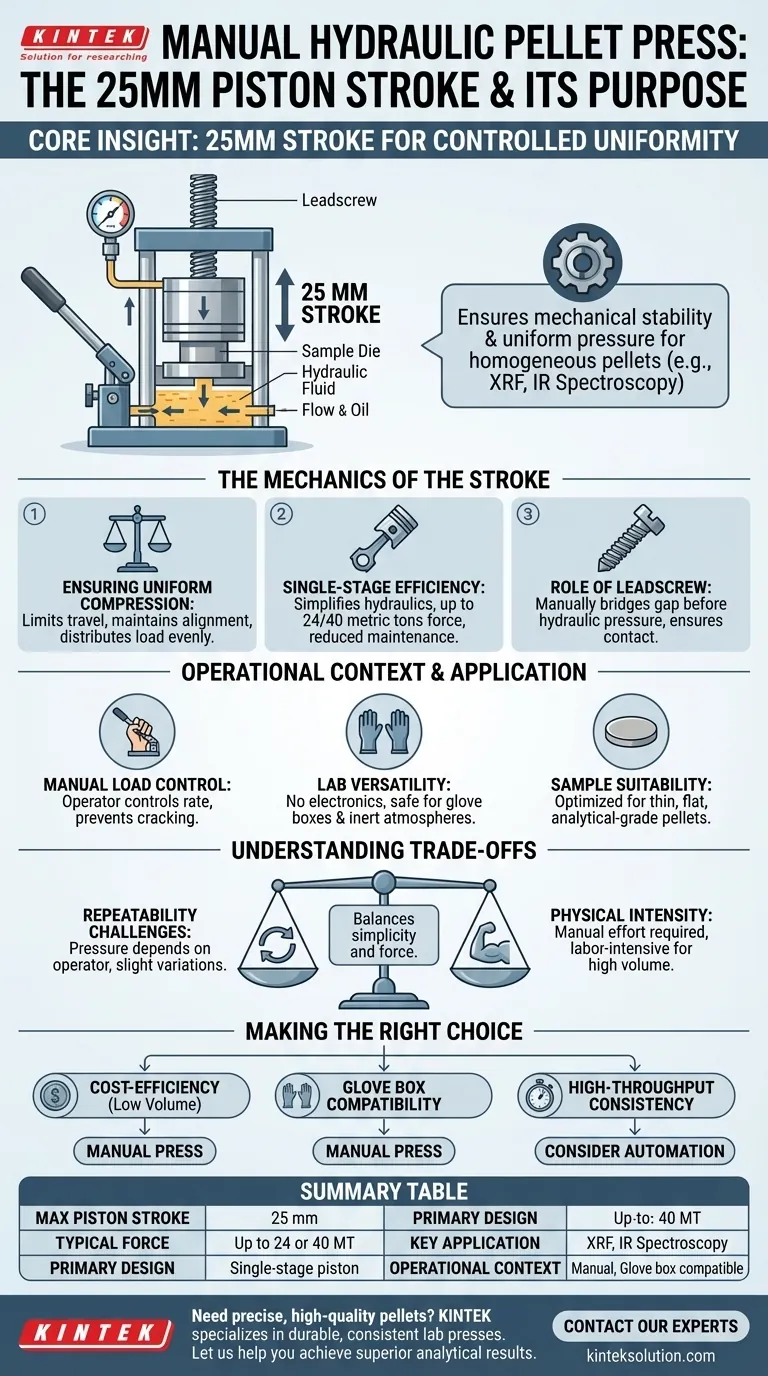
The maximum piston stroke of a standard manual hydraulic pellet press is typically 25 mm. This specific length is a feature of its single-stage design, intended to provide a concise, controlled range of motion that ensures the uniform application of pressure across a sample.
Core Insight: While the 25 mm stroke defines the physical limit of hydraulic travel, its primary function is to guarantee mechanical stability. This limited range forces a controlled compression cycle, which is essential for creating the homogeneous pellets required for sensitive analytical methods like X-ray fluorescence (XRF).
The Mechanics of the Piston Stroke
Ensuring Uniform Compression
The 25 mm stroke is calibrated to maximize pressure uniformity. By limiting the travel distance, the press maintains strict vertical alignment, ensuring the load is distributed evenly across the entire surface of the sample die.
Single-Stage Efficiency
These presses typically utilize a single-stage piston. This design choice simplifies the internal hydraulics, reducing maintenance requirements while providing sufficient force—often up to 24 or 40 metric tons—to compact powder samples effectively.
The Role of the Leadscrew
Because the hydraulic stroke is limited to 25 mm, the press includes a manual leadscrew at the top. Before applying hydraulic pressure, the operator must lower this screw to physically contact the workpiece, bridging the gap that the hydraulic stroke does not cover.
Operational Context and Application
Manual Load Control
The stroke is actuated by a hand-operated lever that pumps hydraulic oil into the piston. This gives the operator direct control over the rate of compression, allowing for a slower application of force which can prevent sample cracking.
Laboratory Versatility
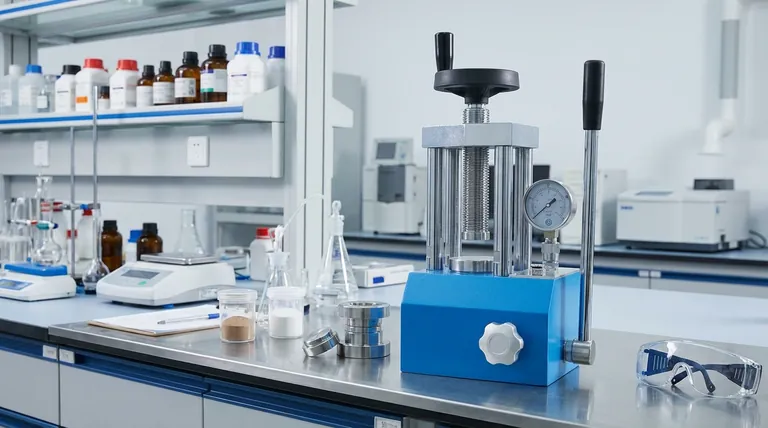
This mechanical design is favored in materials and chemistry research. Because the press functions without electronic components, it is safe and effective for use inside glove boxes under inert or oxidizing gas atmospheres.
Sample Suitability
The controlled stroke is specifically optimized for preparing thin, flat discs. These high-quality, homogeneous pellets are the industry standard for obtaining accurate results in elemental analysis and infrared spectroscopy.
Understanding the Trade-offs
Repeatability Challenges
While the stroke length is fixed, the final pressure depends on the operator. Unlike automated systems, achieving the exact same load on every cycle can be difficult, potentially leading to slight variations in pellet density between different users.
Physical Intensity
Utilizing the full potential of the hydraulic stroke requires physical effort. For high-volume laboratories, the repetitive manual pumping required to achieve high tonnage can become labor-intensive and inefficient compared to automated alternatives.
Making the Right Choice for Your Goal
To determine if the 25 mm stroke capacity fits your needs, evaluate your specific workflow requirements.
- If your primary focus is cost-efficiency for infrequent use: The manual press offers a robust, economical solution for low-volume sample preparation.
- If your primary focus is glove box compatibility: The absence of electronic components makes this press the safest option for controlled environments with inert or oxidizing atmospheres.
- If your primary focus is high-throughput consistency: Be aware that the manual nature of the stroke may introduce operator fatigue and slight inconsistencies compared to automated presses.
The 25 mm stroke represents a balance between mechanical simplicity and the force required to produce laboratory-grade analytical samples.
Summary Table:
| Feature | Specification | Purpose |
|---|---|---|
| Maximum Piston Stroke | 25 mm | Limits travel for mechanical stability and uniform pressure application |
| Typical Force Range | Up to 24 or 40 metric tons | Sufficient for effective powder compaction |
| Primary Design | Single-stage piston | Simplifies hydraulics and reduces maintenance |
| Key Application | XRF, IR Spectroscopy | Produces homogeneous pellets for accurate analytical results |
| Operational Context | Manual lever control, Glove box compatible | Allows controlled compression rate and safe use in inert atmospheres |
Need precise, high-quality pellets for your analytical work?
The 25mm stroke manual hydraulic press is a cornerstone of reliable sample preparation. At KINTEK, we specialize in lab press machines, including manual hydraulic pellet presses, designed for durability and consistent performance in demanding laboratory environments.
Our presses are trusted for their ability to deliver uniform compression, making them ideal for XRF and spectroscopy. Whether you're working in a glove box or a standard lab setting, KINTEK equipment ensures your sample integrity.
Let us help you achieve superior analytical results. Contact our experts today to find the perfect press for your laboratory's specific needs!
Visual Guide
Related Products
- Manual Laboratory Hydraulic Pellet Press Lab Hydraulic Press
- Manual Laboratory Hydraulic Press Lab Pellet Press
- Automatic Laboratory Hydraulic Press Lab Pellet Press Machine
- Automatic Laboratory Hydraulic Press for XRF and KBR Pellet Pressing
- Laboratory Hydraulic Pellet Press for XRF KBR FTIR Lab Press
People Also Ask
- What is the primary purpose of a manual lab hydraulic pellet press? Ensure Accurate Sample Prep for XRF and FTIR
- What is the primary purpose of manual lab hydraulic pellet presses? Achieve High-Precision Sample Preparation for Spectroscopy
- What is the primary function of a laboratory hydraulic press in evaluating the ionic conductivity of Li6PS5X (LMSX)?
- What is the purpose of initial axial molding using a lab hydraulic press? Optimizing Electrolyte Green Bodies
- What role does a lab hydraulic press play in researching squishy granular matter? Expert Insights into Material Physics



















