
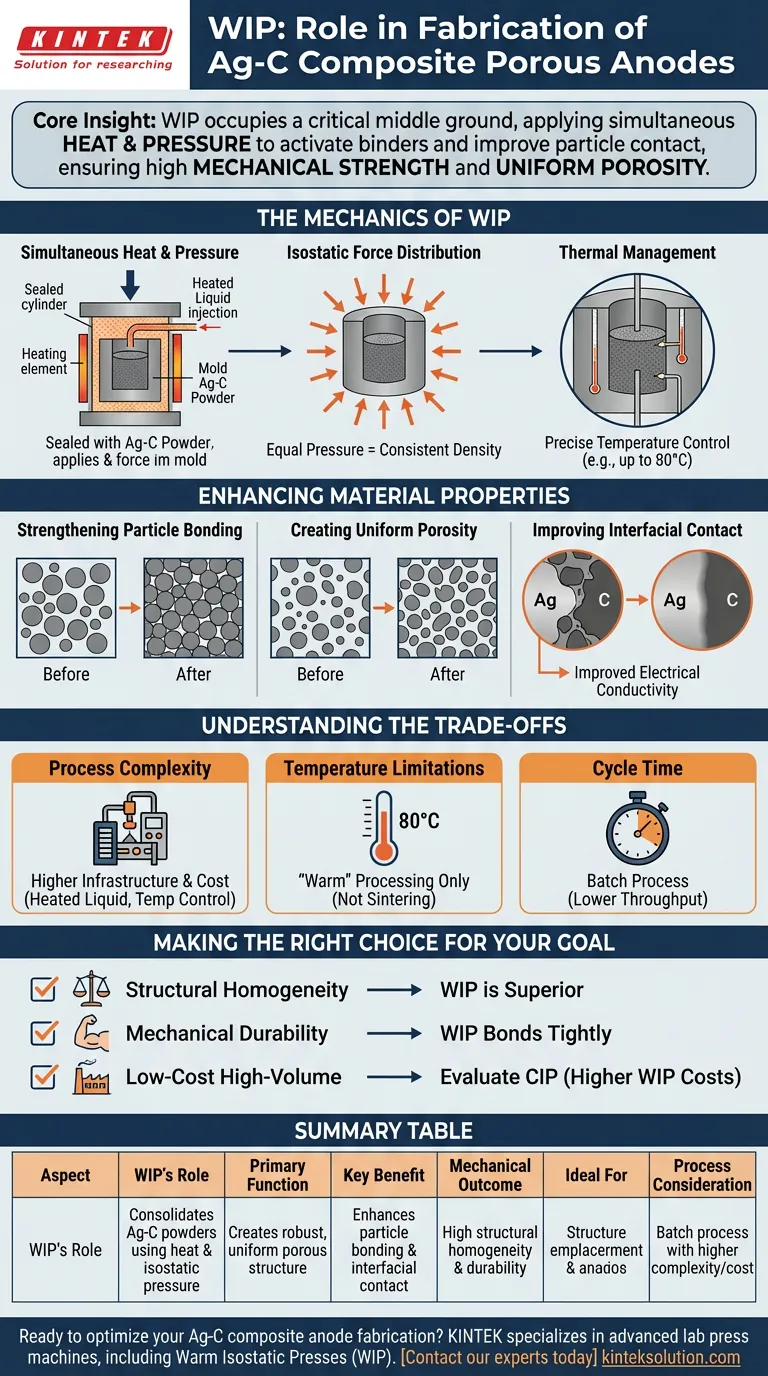
Warm Isostatic Pressing (WIP) serves as a specialized consolidation technique in the fabrication of Ag-C composite porous anodes, primarily utilized to enhance mechanical stability and structural uniformity. By applying isostatic pressure via a heated liquid medium, WIP facilitates the tight bonding of silver (Ag) and carbon (C) particles, creating a robust, uniform porous structure that might be difficult to achieve through cold pressing alone.
Core Insight: WIP occupies a critical middle ground between cold pressing and high-temperature sintering. It applies heat and pressure simultaneously to activate binders and improve particle contact, ensuring the anode achieves high mechanical strength without sacrificing the uniform porosity required for optimal performance.
The Mechanics of WIP in Anode Fabrication
Simultaneous Heat and Pressure
Unlike standard pressing methods, a WIP system injects a heated liquid medium into a sealed cylinder to apply pressure.
This combination allows for the processing of powders and binders that have specific temperature requirements or cannot be successfully molded at room temperature.
Isostatic Force Distribution
The pressure in a WIP is isostatic, meaning it is applied equally from all directions.
This eliminates the density gradients common in uniaxial pressing, ensuring that the Ag-C composite has a consistent density profile throughout the entire geometry of the anode.
Thermal Management
To maintain precision, the pressing cylinder is often equipped with its own heating element alongside the heated fluid injection.
This ensures the material remains at the exact temperature required to facilitate particle rearrangement and bonding without causing unwanted thermal degradation.
Enhancing Material Properties
Strengthening Particle Bonding
The primary role of WIP in this context is to bond the constituent particles—silver and carbon—more tightly.
By eliminating microscopic gaps between these dissimilar materials, the process significantly enhances the overall mechanical strength of the anode structure.
Creating Uniform Porosity
For a porous anode, the distribution of voids is just as important as the solid material.
WIP facilitates the formation of a uniform porous structure, preventing localized dense spots that could block flow or weak spots that could lead to structural failure.
Improving Interfacial Contact
Drawing parallels from its use in solid-state battery lamination, WIP is effective at eliminating microscopic voids at solid-solid interfaces.
In an Ag-C anode, this improved contact serves to minimize interfacial impedance, likely improving the electrical conductivity and efficiency of the composite.
Understanding the Trade-offs
Process Complexity
Compared to Cold Isostatic Pressing (CIP), WIP requires more complex infrastructure to manage liquid heating and temperature control.
This increases the operational cost and maintenance requirements of the fabrication process.
Temperature Limitations
WIP is designed for "warm" processing (e.g., up to moderate temperatures like 80°C or slightly higher), not the extreme heat of Hot Isostatic Pressing (HIP).
It is not suitable for materials requiring full metallic sintering or diffusion bonding that occurs at temperatures approaching the melting point of silver.
Cycle Time
Because it involves heating a liquid medium and pressurizing a vessel, WIP is generally a batch process.
This can result in lower throughput compared to continuous pressing methods, making it a choice for high-value or performance-critical components rather than mass commodity production.
Making the Right Choice for Your Goal
To determine if WIP is the correct solution for your Ag-C anode fabrication, consider your specific performance requirements.
- If your primary focus is Structural Homogeneity: WIP is the superior choice, as the isostatic pressure guarantees a uniform density and pore distribution that uniaxial pressing cannot match.
- If your primary focus is Mechanical Durability: WIP provides the necessary heat and pressure to bond Ag and C particles tightly, preventing the anode from crumbling during operation.
- If your primary focus is Low-Cost High-Volume Production: You may wish to evaluate if Cold Isostatic Pressing (CIP) offers "good enough" results, as WIP introduces higher cycle times and operational costs.
WIP acts as a precision tool for maximizing the structural integrity and uniformity of composite anodes where standard cold molding fails to provide adequate particle adhesion.
Summary Table:
| Aspect | WIP's Role in Ag-C Anode Fabrication |
|---|---|
| Primary Function | Consolidates Ag and C powders using simultaneous heat and isostatic pressure. |
| Key Benefit | Creates a robust, uniform porous structure with consistent density. |
| Mechanical Outcome | Enhances particle bonding and interfacial contact for greater strength. |
| Ideal For | Applications requiring high structural homogeneity and durability. |
| Process Consideration | Batch process with higher complexity and cost than cold pressing methods. |
Ready to optimize your Ag-C composite anode fabrication? KINTEK specializes in advanced lab press machines, including Warm Isostatic Presses (WIP) designed for precise temperature and pressure control. Our solutions help you achieve the uniform porosity and superior mechanical strength critical for high-performance anodes. Contact our experts today to discuss how a KINTEK WIP can enhance your laboratory's capabilities and material outcomes.
Visual Guide
Related Products
- Warm Isostatic Press for Solid State Battery Research Warm Isostatic Press
- Electric Lab Cold Isostatic Press CIP Machine
- Automatic Lab Cold Isostatic Pressing CIP Machine
- Electric Split Lab Cold Isostatic Pressing CIP Machine
- Manual Cold Isostatic Pressing CIP Machine Pellet Press
People Also Ask
- Why must composite cathodes be sealed in vacuum lamination bags for WIP? Ensure Battery Stability and Density
- What is the function of elastic molds in warm isostatic pressing? Achieve Uniform Density in Composite Particles
- How do sacrificial volume materials (SVM) maintain microchannels in isostatic pressing? Ensure Structural Integrity
- What is the process involved in warm isostatic pressing? Mastering Uniform Density with WIP Technology
- How does Warm Isostatic Pressing differ from traditional pressing methods? Unlock Uniform Density for Complex Parts



















