
The primary advantage of using a laboratory hydraulic press is the creation of intimate, void-free physical contact between the cathode and electrolyte layers.
In all-solid-state batteries (ASSBs), the electrolyte is a solid rigid material rather than a liquid that naturally wets the electrode surface. A hydraulic press solves this "contact problem" by applying high pressure (typically 40 to 250 MPa) to mechanically force the cathode and electrolyte particles together. This process significantly densifies the material, eliminates microscopic voids, and drastically reduces interfacial impedance, which is the main barrier to efficient lithium-ion transport.
Core Insight: In solid-state systems, ionic conductivity is strictly a function of physical connectivity. A laboratory hydraulic press is not just a shaping tool; it is a critical instrument for minimizing interfacial resistance, enabling the ions to move across the solid-solid boundary without the aid of high-temperature co-sintering.
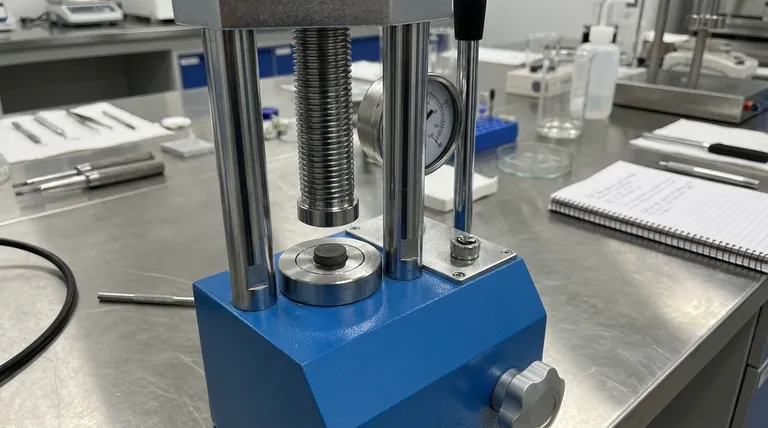
The Challenge of the Solid-Solid Interface
To understand why the hydraulic press is indispensable, you must first understand the fundamental limitation of solid-state chemistry.
The Inability to Wet
Unlike liquid electrolytes, solid electrolytes cannot flow into the porous structures of a cathode.
The Consequence of Voids
Without mechanical intervention, the interface between the cathode and electrolyte remains rough and porous. These microscopic gaps act as insulators, blocking the path of lithium ions and rendering the battery inefficient or non-functional.
Mechanisms of Performance Enhancement
The hydraulic press turns a loose collection of powders into a functional electrochemical system through three specific mechanisms.
Densification of Materials
Applying high pressure compresses the mixed cathode powders (often sulfur and solid electrolyte) into dense pellets. This reduction in internal porosity is vital for creating a continuous path for ion movement.
Increasing Contact Area
By forcing particles closer together, the press maximizes the active surface area where the cathode and electrolyte touch. This directly lowers the contact resistance at the solid-solid interface.
Cold-Pressing Capability
A distinct advantage of using a hydraulic press is the ability to form these interfaces at ambient temperatures ("cold-pressing"). This allows researchers to achieve high-quality contact without exposing sensitive materials to the thermal stress of high-temperature co-sintering.
The Role of Precision in R&D
Beyond brute force, the laboratory press provides the control necessary for scientific rigor.
Ensuring Repeatability
Consistency is the bedrock of reliable research. A hydraulic press maintains consistent forming pressure from cell to cell, minimizing variations in interfacial resistance.
Reliable Data Generation
By eliminating assembly variables, researchers can ensure that changes in performance are due to material properties, not manufacturing inconsistencies. This allows for accurate evaluation of impedance spectra and cycling performance.
Complex Structure Fabrication
For advanced designs, such as bilayer structures, the press allows for "pre-compaction." This creates a flat, mechanically stable substrate for the first layer, preventing intermixing or delamination when subsequent layers are added.
Understanding the Trade-offs
While the hydraulic press is essential, it introduces specific variables that must be managed to avoid compromising your data.
Pressure Intensity vs. Material Integrity
While high pressure (e.g., 250 MPa) maximizes density, it must be balanced against the material's limits. The goal is to maximize contact without causing brittle fracture or unwanted deformation of the active materials.
The Necessity of Uniformity
If the applied pressure is not uniform across the stack, it leads to gradients in current density. This can cause localized "hotspots" of resistance, leading to inconsistent electrochemical measurements that do not accurately reflect the material's potential.
Making the Right Choice for Your Goal
The way you utilize a hydraulic press should depend on the specific bottleneck you are trying to solve in your battery assembly.
- If your primary focus is minimizing impedance: Prioritize high-pressure capabilities (240+ MPa) to maximize pellet density and eliminate voids between particles.
- If your primary focus is reproducible data: Prioritize automation and pressure control to ensure every cell has identical interfacial contact, removing assembly variables from your results.
- If your primary focus is preventing delamination: Use a press capable of precise pre-compaction steps to create flat, stable substrates before adding secondary layers.
Ultimately, the laboratory hydraulic press is the bridge that transforms theoretical material properties into realized electrochemical performance by enforcing the physical connection that solid-state chemistry requires.
Summary Table:
| Key Advantage | Mechanism | Impact on ASSB Performance |
|---|---|---|
| Intimate, Void-Free Contact | Applies high pressure (40-250 MPa) to force particles together | Drastically reduces interfacial impedance, enabling efficient ion transport |
| Cold-Pressing Capability | Forms interfaces at ambient temperatures | Avoids thermal stress from high-temperature co-sintering on sensitive materials |
| Enhanced Repeatability & Data Reliability | Provides consistent, controlled pressure for each cell | Eliminates assembly variables, ensuring performance changes reflect material properties |
Ready to Bridge the Gap in Your Solid-State Battery Research?
Achieving intimate, void-free contact between cathode and electrolyte layers is critical for minimizing interfacial resistance and unlocking the full potential of your all-solid-state battery materials. KINTEK specializes in precision laboratory press machines, including automatic lab presses and isostatic presses, designed to provide the high-pressure, uniform compaction essential for reproducible and reliable R&D.
Let our expertise in lab press technology help you transform theoretical material properties into realized electrochemical performance. Contact our team today to discuss your specific application needs and find the perfect press for your laboratory.
Visual Guide

Related Products
- Laboratory Hydraulic Press Lab Pellet Press Machine for Glove Box
- Laboratory Hydraulic Press 2T Lab Pellet Press for KBR FTIR
- 24T 30T 60T Heated Hydraulic Lab Press Machine with Hot Plates for Laboratory
- Laboratory Hydraulic Press Lab Pellet Press Button Battery Press
- Laboratory Hydraulic Pellet Press for XRF KBR FTIR Lab Press
People Also Ask
- How does a laboratory hydraulic press contribute to the preparation of Li3-3xScxSb samples? Optimize Ionic Conductivity
- What is the function of a laboratory hydraulic press in FT-IR of curcumin-coated MWCNTs? Achieve Optical Clarity.
- Why is a laboratory hydraulic press required for compression molding boron-siloxane? Solve High-Loading Density Challenges
- What role does a laboratory hydraulic press play in reaction pellets? Optimizing Lunar Soil and Metal Fuel Density
- What role does a laboratory hydraulic press play in the preparation of piezoelectric ceramic discs for DC-PG? | KINTEK



















