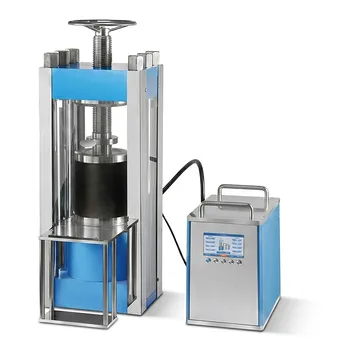
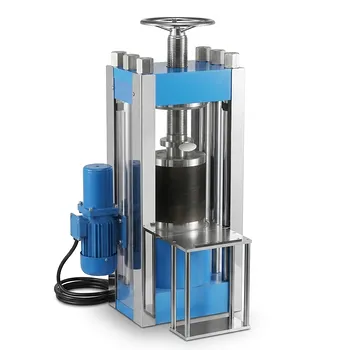
The primary function of a heated lab press is to apply precise, simultaneous control of heat and pressure to shape materials, cure composites, and prepare samples for analysis. These instruments serve as the bridge between raw material and testable product, allowing researchers to manipulate substances under specific conditions that simulate full-scale industrial manufacturing environments.
By integrating thermal energy with mechanical force, heated lab presses enable the creation of samples with highly reproducible characteristics, a requirement that is fundamental for valid scientific research and rigorous quality control.
The Core Mechanics of Operation
Simultaneous Application of Forces
The defining feature of a heated lab press is its ability to apply controlled heat and pressure at the exact same moment.
Unlike standard presses, these units utilize platens with integrated heating elements.
This dual capability allows for the physical transformation of heat-sensitive materials, such as polymers and composites, into specific shapes or densities.
Achieving Reproducibility
In scientific settings, a result is only valuable if it can be repeated.
Heated lab presses provide the uniform pressure distribution and temperature stability required to ensure every sample is identical.
This consistency eliminates variables during material testing, ensuring that data reflects the material's properties rather than inconsistent sample preparation.
Critical Applications Across Industries
Material Characterization and Spectroscopy
One of the most common uses for these presses is preparing solid samples for analysis.
Technicians use them to compact powders into pellets for Infrared (IR) spectroscopy and X-Ray Fluorescence (XRF) spectroscopy.
This compaction ensures a flat, uniform surface, which is critical for accurate spectral readings.
Polymer and Composite Development
In the polymer industry, these presses are essential for film production and laminating.
They allow engineers to fuse multiple layers of materials to create strong composite structures.
They are also used to mold rubber and plastics into specific shapes, facilitating the creation of prototypes for automotive parts or household items.
Pharmaceutical Manufacturing
Heated presses play a vital role in pill manufacturing and drug delivery research.
They allow for the precise compaction of pharmaceutical powders.
This ensures that pills have consistent density and dissolution rates, which are critical for patient safety and regulatory compliance.
Simulation and R&D
Research and Development (R&D) labs use these presses to simulate industrial conditions on a smaller scale.
They allow for short production runs and rapid prototyping of specialized components.
This capability enables researchers to optimize processes and investigate material properties before committing to expensive mass production.
Understanding the Trade-offs
Temperature Limits and Compatibility
While robust, these units have physical thermal limits.
Some advanced models can reach temperatures up to 500 °C, making them suitable for ceramics and high-performance polymers.
However, selecting a press with insufficient heating capacity for your specific material will result in incomplete curing or poor bonding.
The Necessity of Uniformity
The quality of the output is entirely dependent on the uniformity of the platen.
If a press delivers uneven pressure or has "cold spots" on the heating element, the resulting sample will have structural flaws.
This can lead to false negatives in quality control or skewed data in research applications.
Making the Right Choice for Your Goal
To select the correct equipment, you must match the machine's capabilities to your specific end-goal.
- If your primary focus is analytical precision: Prioritize a press designed for spectroscopy that guarantees ultra-flat, uniform pellet formation to ensure accurate sensor readings.
- If your primary focus is material engineering: Select a unit capable of reaching high temperatures (up to 500 °C) to accurately simulate industrial curing and molding processes.
Success in the lab depends not just on applying force, but on the precise control of the environment in which that force is applied.
Summary Table:
| Feature | Function & Impact |
|---|---|
| Dual-Force Application | Simultaneous heat and pressure for material transformation and curing. |
| Reproducibility | Ensures uniform temperature and pressure for consistent, valid research data. |
| Material Processing | Enables film production, laminating, and molding of polymers and composites. |
| Analytical Prep | Compresses powders into pellets for accurate IR and XRF spectroscopy analysis. |
| Industrial R&D | Simulates full-scale manufacturing conditions for prototyping and process optimization. |
Elevate Your Lab’s Precision with KINTEK Pressing Solutions
At KINTEK, we understand that scientific breakthroughs depend on the reliability of your samples. Whether you are conducting cutting-edge battery research, developing advanced polymers, or performing sensitive spectroscopy, our comprehensive range of laboratory presses is designed to meet your exact specifications.
Why choose KINTEK?
- Diverse Solutions: We offer manual, automatic, heated, and multifunctional models.
- Specialized Equipment: Explore our glovebox-compatible designs and high-performance cold/warm isostatic presses.
- Unmatched Uniformity: Eliminate structural flaws with our high-precision platen technology.
Ready to simulate industrial conditions with benchtop efficiency? Contact our technical experts today to find your perfect press solution.
Related Products
- 24T 30T 60T Heated Hydraulic Lab Press Machine with Hot Plates for Laboratory
- Automatic Heated Hydraulic Lab Press 120x120mm Plate Fully Automated Material Research Press
- Automatic Heated Hydraulic Lab Press with Programmable Touch Screen Controls and Precision Temperature Regulation
- Automatic Heated Hydraulic Lab Press Machine 200x200 Plate Size for Battery Research and Materials Science
- Manual Heated Hydraulic Lab Press with Integrated Hot Plates Hydraulic Press Machine
People Also Ask
- Function of a Laboratory Hydraulic Press with Heated Platens in SSE? Enhance Battery Density & Conductivity
- Why is a laboratory hydraulic press with heating plates required for PLA/TEC films? Achieve Precise Sample Integrity
- What role does a laboratory heated hydraulic press play in LTCC? Essential for High-Density Ceramic Lamination
- Why is a laboratory heated hydraulic press required? Ensure Precise Vulcanization for NBR/EPDM Nanocomposites
- Why is a laboratory heated hydraulic press utilized during the lamination stage of NASICON green tapes?