
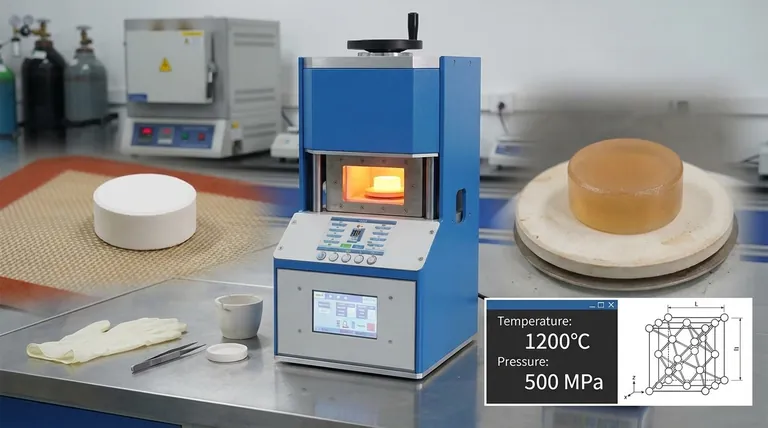
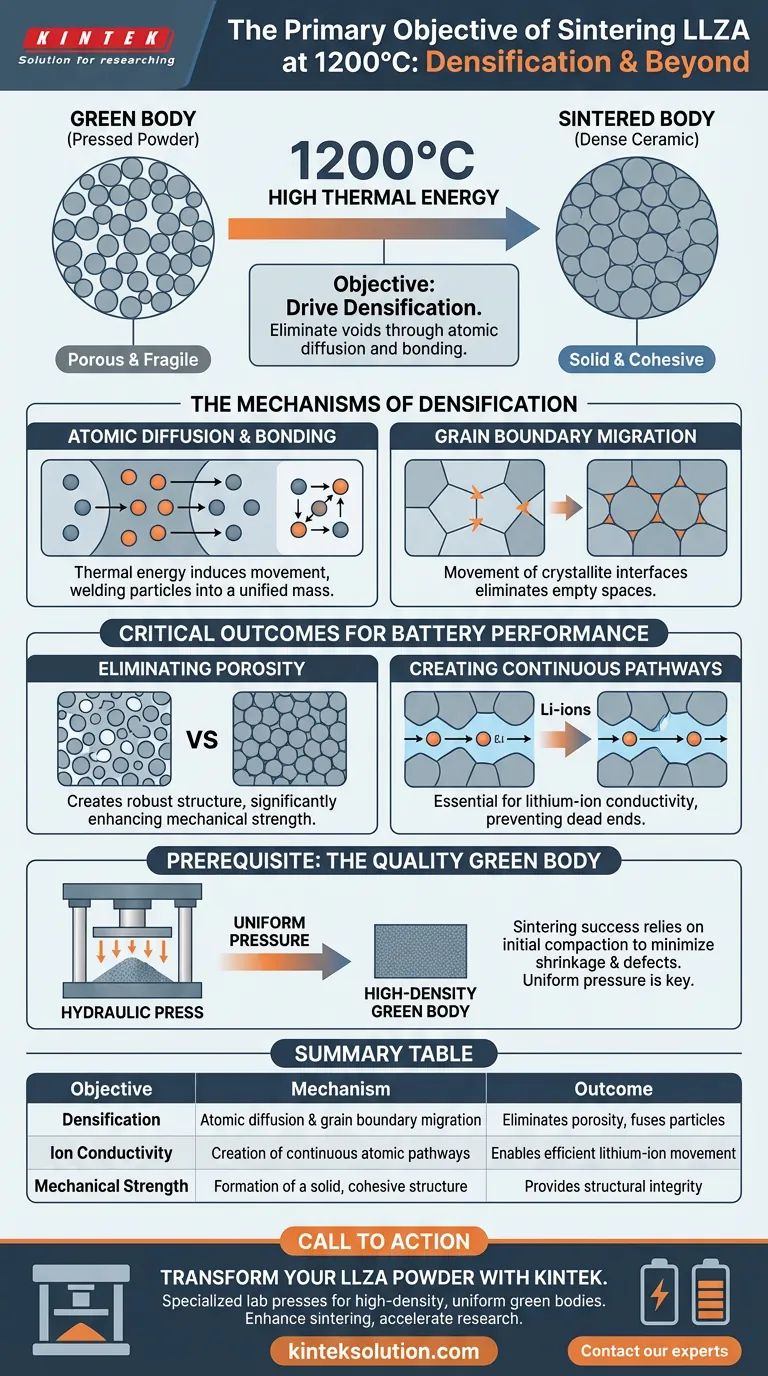
The primary objective of sintering pressed Li₆.₁₆Al₀.₂₈Zr₂La₃O₁₂ (LLZA) at 1200°C is to drive the densification of the ceramic body. Through the application of high thermal energy, the process induces atomic diffusion and bonding between powder particles. This eliminates the voids found in the initial "green body," transforming it into a solid, cohesive structure capable of conducting ions.
Core Takeaway While the initial pressing gives the material its shape, sintering at 1200°C provides its function. By eliminating porosity and fusing particles, the process creates the continuous atomic pathways required for both high mechanical strength and maximum lithium-ion conductivity.
The Mechanisms of Densification
Atomic Diffusion and Bonding
At 1200°C, the thermal energy acts as a catalyst for movement on the atomic level.
This energy induces atomic diffusion, causing atoms to move across the boundaries of the pressed powder particles.
As these atoms migrate, they facilitate bonding between adjacent particles, effectively welding them together into a unified mass.
Grain Boundary Migration
Beyond simple bonding, the high temperature promotes grain boundary migration.
This is the movement of the interfaces between crystallites (grains) within the material.
As these boundaries move, they help eliminate the empty spaces, or pores, that naturally exist between the loosely packed particles of the green body.
Critical Outcomes for Battery Performance
Eliminating Porosity
The most immediate physical result of sintering is the removal of pores.
In a pressed green body, voids between particles act as barriers to both physical stress and ionic movement.
Sintering creates a robust structure by closing these voids, significantly enhancing the material's mechanical strength.
Creating Continuous Pathways
For an electrolyte like LLZA, structure dictates performance.
The elimination of pores results in continuous pathways throughout the ceramic material.
These uninterrupted channels are essential for lithium-ion conductivity, allowing ions to move freely through the material without hitting dead ends created by air pockets.
Understanding the Trade-offs and Prerequisites
The Dependency on the Green Body
Sintering at 1200°C is a powerful consolidation step, but it cannot correct fundamental flaws in the pre-sintering preparation.
The process relies heavily on the quality of the green body formed by the hydraulic press.
If the initial pressure applied was not uniform or stable, the particles will not be in a tightly packed arrangement.
Shrinkage and Defect Management
Sintering inevitably causes the material to shrink as pores are eliminated.
The initial compaction by the hydraulic press is crucial to minimize shrinkage and control it.
Without high-quality initial compaction to reduce voids beforehand, high-temperature sintering can lead to unpredictable deformation or structural defects rather than a dense, uniform ceramic.
Making the Right Choice for Your Goal
To achieve a high-performance LLZA electrolyte, you must view pressing and sintering as connected phases of a single process.
- If your primary focus is Ion Conductivity: Prioritize holding the temperature at 1200°C long enough to ensure maximum pore elimination and the formation of continuous conduction pathways.
- If your primary focus is Mechanical Integrity: Ensure your hydraulic pressing stage applies uniform pressure to create a high-density green body, preventing defects during the thermal stress of sintering.
Sintering transforms a fragile powder compact into a functional electrolyte by closing the gaps that inhibit performance.
Summary Table:
| Objective | Mechanism | Outcome |
|---|---|---|
| Densification | Atomic diffusion & grain boundary migration | Eliminates porosity, fuses particles |
| Ion Conductivity | Creation of continuous atomic pathways | Enables efficient lithium-ion movement |
| Mechanical Strength | Formation of a solid, cohesive structure | Provides structural integrity for the electrolyte |
Ready to transform your LLZA powder into a high-performance solid electrolyte?
The precise application of pressure and heat is critical for successful sintering. KINTEK specializes in lab press machines, including automatic and heated lab presses, designed to create the high-density, uniform green bodies required for optimal sintering outcomes.
Our equipment helps researchers like you achieve consistent results by ensuring uniform compaction, which minimizes shrinkage and prevents defects during the critical 1200°C sintering phase. This leads to robust electrolytes with superior ion conductivity for your solid-state battery development.
Contact our experts today to discuss how our pressing solutions can enhance your sintering process and accelerate your battery research.
Visual Guide
Related Products
People Also Ask
- Function of a Laboratory Hydraulic Press with Heated Platens in SSE? Enhance Battery Density & Conductivity
- How does a laboratory heated hydraulic press facilitate PBN sample prep for WAXS? Achieve Precise X-Ray Scattering
- What are the requirements for electrode pressing with high-viscosity ionic liquids like EMIM TFSI? Optimize Performance
- What are the industrial applications of heated hydraulic presses? Master Heat & Force for Precision Manufacturing
- Why is a laboratory hydraulic press with heating plates required for PLA/TEC films? Achieve Precise Sample Integrity
