
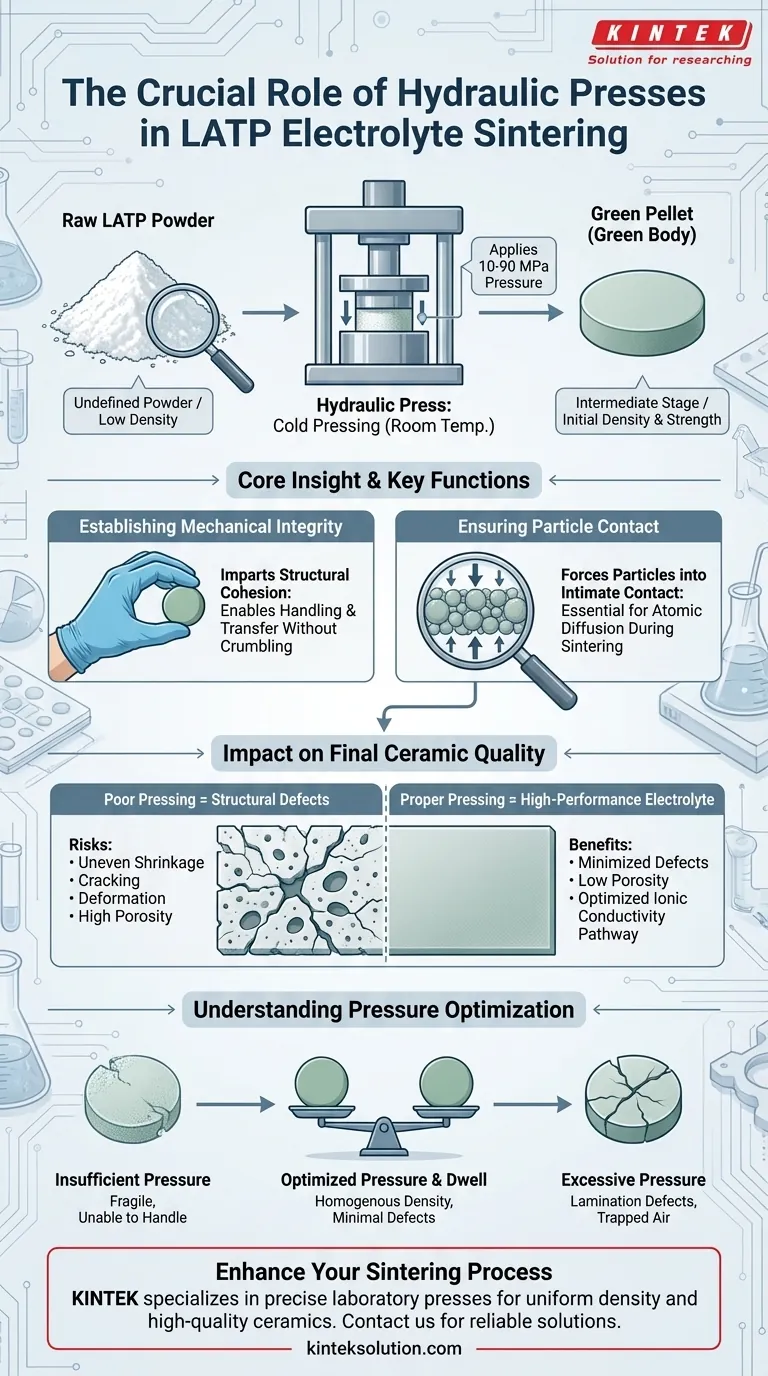
The primary purpose of a hydraulic press in the traditional sintering process of LATP electrolytes is to perform "cold pressing," which compacts loose powder into a solid, cohesive "green pellet." By applying uniaxial pressure (typically ranging from 10 MPa to 90 MPa) at room temperature, the press establishes the initial density and mechanical strength required for the material to be handled and transferred into a furnace for the subsequent high-temperature firing at over 950 °C.
Core Insight: In traditional sintering, the hydraulic press does not perform the chemical bonding; it establishes the physical architecture. It transforms undefined powder into a uniform geometric shape, creating the critical particle-to-particle contact necessary for successful densification during the later heating stage.
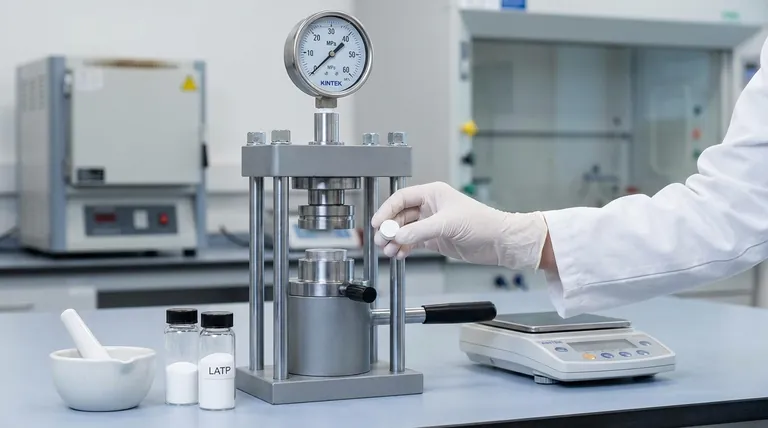
The Role of the Green Pellet
The output of the hydraulic press is technically referred to as a green body or green pellet. This intermediate stage acts as the bridge between raw synthesis and the final ceramic product.
Establishing Mechanical Integrity
Raw LATP powder lacks the structural cohesion to be moved or processed.
The hydraulic press imparts enough mechanical strength to the powder compact so it can be ejected from the die and handled without crumbling. This allows for transfer to sintering crucibles without the need for a confining mold during the heating phase.
Ensuring Particle Contact
Sintering relies on atomic diffusion across particle boundaries.
By compressing the material, the hydraulic press forces powder particles into intimate contact. This proximity is essential; without it, the high temperatures applied later would fail to fuse the particles effectively, leaving the material porous and weak.
Impact on Final Ceramic Quality
The quality of the pressing step directly dictates the quality of the final sintered electrolyte.
Preventing Structural Defects
A uniform and dense green pellet minimizes common high-temperature failures.
Proper pressing reduces the risk of uneven shrinkage, cracking, or deformation when the material is subjected to temperatures exceeding 950 °C. If the initial compaction is inconsistent, the ceramic will likely warp or fracture during densification.
Maximizing Ionic Conductivity
For an electrolyte like LATP, performance depends on how easily lithium ions can move through the material.
The press drives out air and reduces void space, aiming for high initial density. This leads to a final ceramic sheet with low porosity, providing an optimal, uninterrupted pathway for efficient lithium-ion conduction.
Understanding the Trade-offs
While the hydraulic press is standard equipment, the application of pressure involves variables that must be managed to avoid failure.
The Density Gradient Challenge
Uniaxial pressure (pressure from one direction) can sometimes result in density gradients within the pellet.
If the pressure is not distributed uniformly, the green body will have hard and soft spots. During sintering, these variances lead to differential shrinkage, resulting in a distorted or cracked final product.
Pressure Optimization
There is a delicate balance regarding the magnitude of pressure applied (e.g., 10 MPa vs. 90 MPa) and the duration of the hold time.
Insufficient pressure results in a fragile pellet that cannot be handled. Conversely, excessive pressure can induce lamination defects or trap air pockets that expand and rupture the pellet during heating.
Making the Right Choice for Your Goal
To ensure the highest quality LATP electrolyte, you must align your pressing parameters with your specific outcome requirements.
- If your primary focus is Handling Strength: Prioritize higher pressures (up to 90 MPa) to ensure the green pellet is robust enough to be moved without breaking.
- If your primary focus is Final Conductivity: Focus on pressure uniformity and dwell time to ensure a homogenous density, which is critical for minimizing porosity and maximizing ion flow.
The hydraulic press is not merely a shaping tool; it is the gatekeeper of density that determines whether your final LATP ceramic will be a high-performance electrolyte or a fractured failure.
Summary Table:
| Key Aspect | Role of the Hydraulic Press |
|---|---|
| Primary Purpose | Cold pressing to compact LATP powder into a solid green pellet |
| Pressure Range | 10 MPa to 90 MPa at room temperature |
| Critical Outcome | Establishes particle-to-particle contact for successful sintering |
| Impact on Final Product | Determines final density, structural integrity, and ionic conductivity |
Need a reliable hydraulic press for your LATP electrolyte research? KINTEK specializes in laboratory press machines, including automatic lab presses and heated lab presses designed for precise powder compaction. Our equipment ensures uniform density and mechanical integrity in your green pellets, leading to higher-quality sintered ceramics with superior ionic conductivity. Contact us today to discuss how our lab presses can enhance your sintering process and deliver consistent, high-performance results for your laboratory needs.
Visual Guide
References
- Khushnuda Nur, Olivier Guillon. Cold Co-Sintering Studies of Composite Cathode for All Solid-State Li Batteries. DOI: 10.1149/1945-7111/ada82b
This article is also based on technical information from Kintek Solution Knowledge Base .
Related Products
- Automatic High Temperature Heated Hydraulic Press Machine with Heated Plates for Lab
- Manual Heated Hydraulic Lab Press with Integrated Hot Plates Hydraulic Press Machine
- Heated Hydraulic Press Machine with Heated Plates for Vacuum Box Laboratory Hot Press
- Laboratory Hydraulic Press 2T Lab Pellet Press for KBR FTIR
- Laboratory Hydraulic Press Lab Pellet Press Machine for Glove Box
People Also Ask
- Function of a Laboratory Hydraulic Press with Heated Platens in SSE? Enhance Battery Density & Conductivity
- How does a laboratory heated hydraulic press facilitate PBN sample prep for WAXS? Achieve Precise X-Ray Scattering
- What are the requirements for electrode pressing with high-viscosity ionic liquids like EMIM TFSI? Optimize Performance
- What are the industrial applications of heated hydraulic presses? Master Heat & Force for Precision Manufacturing
- Why is a laboratory hydraulic press with heating plates required for PLA/TEC films? Achieve Precise Sample Integrity



















