
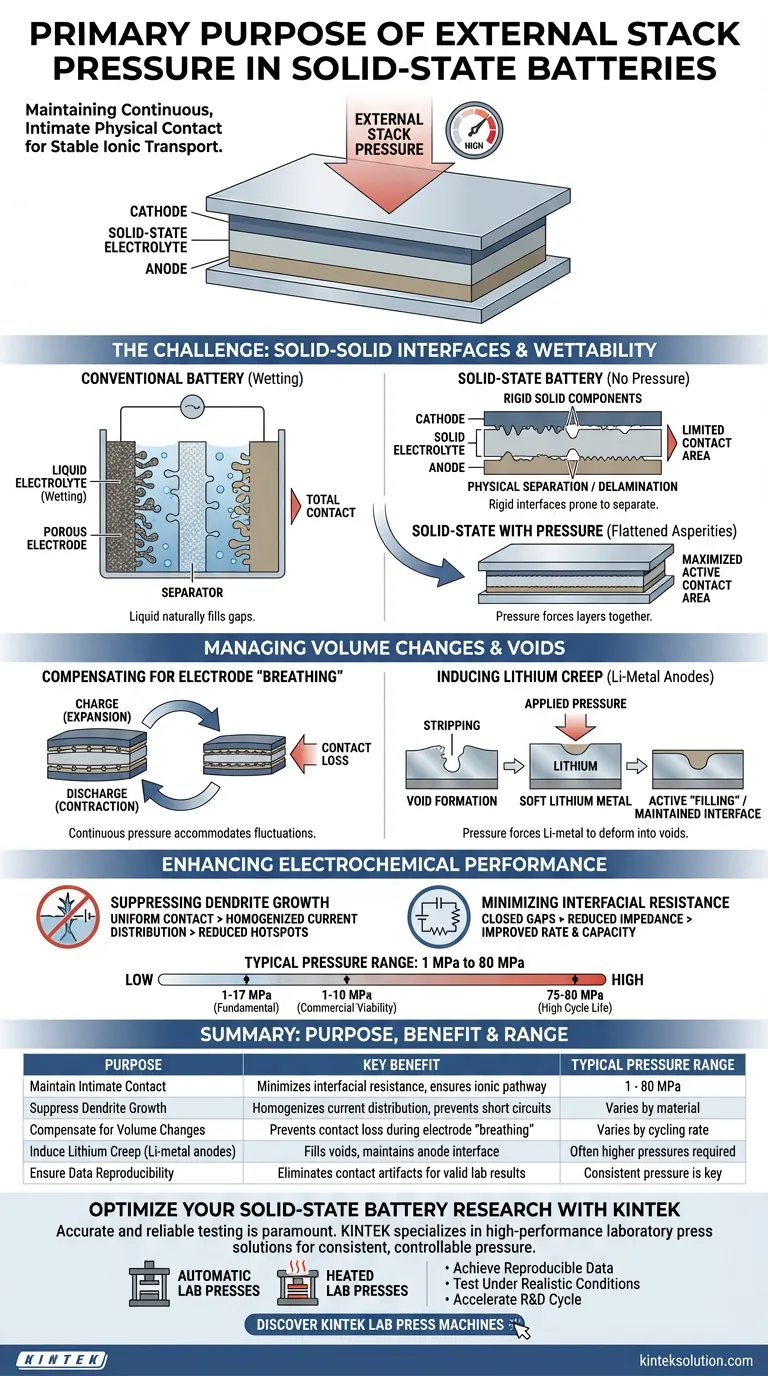
The primary purpose of applying external stack pressure in solid-state batteries is to maintain continuous, intimate physical contact between the rigid solid components—specifically the electrodes and the solid-state electrolyte. Unlike liquid electrolytes that naturally wet surfaces to fill gaps, solid interfaces are prone to physical separation; external mechanical pressure forces these layers together to minimize interfacial resistance and ensure a stable pathway for lithium ion transport.
Solid-state batteries face a fundamental physical challenge: rigid interfaces tend to delaminate during the volumetric "breathing" of charge cycles. External pressure acts as a mechanical stabilizer, ensuring ionic connectivity and suppressing dendrite growth to enable reliable long-term operation.
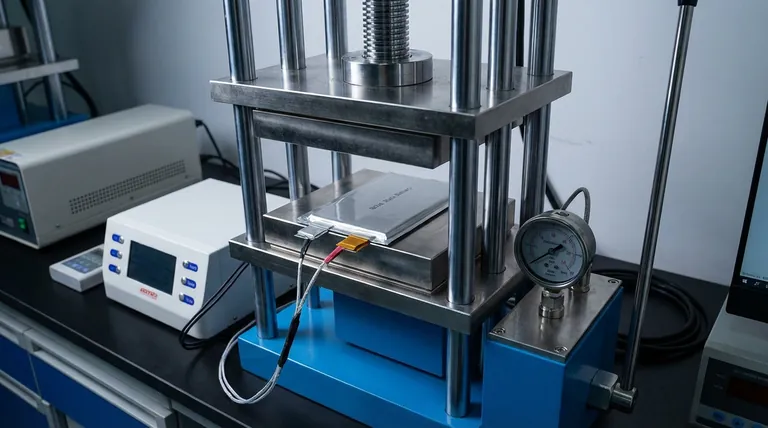
The Challenge of Solid-Solid Interfaces
Overcoming Lack of Wettability
In conventional batteries, liquid electrolytes easily flow into porous electrodes, ensuring total contact. Solid-state batteries lack this "wetting" capability.
Without external force, the microscopic roughness of solid components creates gaps at the interface. External pressure is required to flatten these asperities and maximize the active contact area between the cathode, electrolyte, and anode.
Ensuring Data Reproducibility
For researchers, the application of pressure is not just about performance, but about validity. Loose interfaces lead to erratic impedance readings.
Using a specialized cell holder or hydraulic press to apply constant pressure (often uniaxial) ensures that performance data is authentic and reproducible. This eliminates contact artifacts, allowing researchers to study the true electrochemical properties of the materials.
Managing Volume Changes and Voids
Compensating for Electrode "Breathing"
During cycling, electrode materials expand and contract as they absorb and release lithium. In a rigid system, this volume change can cause layers to physically separate.
Continuous stack pressure accommodates these volumetric fluctuations. It effectively pushes the layers back together after contraction, preventing permanent contact loss that would otherwise terminate the battery's life.
Inducing Lithium Creep
A critical function of pressure specifically related to lithium metal anodes is the induction of creep. Lithium is a soft metal that flows plastically under stress.
When voids form during lithium stripping (discharging), applied pressure forces the lithium metal to deform and flow into these gaps. This active "filling" mechanism maintains the interface and prevents the accumulation of dead space.
Enhancing Electrochemical Performance
Suppressing Dendrite Growth
Voids and uneven contact points create "hotspots" of high current density. These hotspots often serve as nucleation sites for lithium dendrites—metallic filaments that cause short circuits.
By enforcing uniform contact and filling voids, stack pressure homogenizes the current distribution. This suppression of dendrites is essential for improving the battery's critical current density (CCD).
Minimizing Interfacial Resistance
The most direct measurable impact of stack pressure is on impedance. Gaps act as insulators, drastically increasing the resistance to ion flow.
High stack pressure (ranging significantly in testing from 1 MPa to 80 MPa) minimizes this interfacial resistance. This directly improves the battery's rate performance and its ability to utilize its full capacity.
Understanding the Trade-offs
The Variance in Pressure Requirements
While pressure is beneficial, the magnitude required varies significantly depending on the materials and testing goals. References indicate a wide testing range, from as low as 1-17 MPa to as high as 75-80 MPa.
Simulation vs. Reality
In a laboratory setting, hydraulic presses provide massive, controlled force to simulate ideal conditions. However, achieving these high pressures (e.g., 75 MPa) in a commercial battery pack presents significant engineering challenges regarding weight and containment.
Making the Right Choice for Your Goal
Whether you are designing a testing protocol or analyzing failure mechanisms, the application of pressure must be tailored to your specific objective.
- If your primary focus is Fundamental Material Analysis: Apply sufficient pressure (typically lower range) to ensure reproducible impedance data without masking the intrinsic properties of the material.
- If your primary focus is Anode-Free or Lithium Metal Cycle Life: utilize higher pressures to maximize lithium creep, ensuring voids are actively filled and dendrites are suppressed during aggressive cycling.
- If your primary focus is Commercial Viability: Test within lower, practical pressure ranges (1-10 MPa) to determine if the chemistry can remain stable without the aid of heavy industrial presses.
Ultimately, external stack pressure is not merely a testing parameter; it is an active, functional component of the solid-state battery system essential for bridging the gap between a rigid structure and fluid ionic motion.
Summary Table:
| Purpose of Stack Pressure | Key Benefit | Typical Pressure Range |
|---|---|---|
| Maintain Intimate Contact | Minimizes interfacial resistance, ensures ionic pathway | 1 - 80 MPa |
| Suppress Dendrite Growth | Homogenizes current distribution, prevents short circuits | Varies by material |
| Compensate for Volume Changes | Prevents contact loss during electrode 'breathing' | Varies by cycling rate |
| Induce Lithium Creep (Li-metal anodes) | Fills voids, maintains anode interface | Often higher pressures required |
| Ensure Data Reproducibility | Eliminates contact artifacts for valid lab results | Consistent pressure is key |
Optimize Your Solid-State Battery Research with KINTEK
Accurate and reliable testing is paramount for developing next-generation solid-state batteries. The precise application of external stack pressure is a critical variable that directly impacts your results, from fundamental material analysis to long-term cycle life studies.
KINTEK specializes in high-performance laboratory equipment, including robust press solutions designed for battery research. Our automatic lab presses and heated lab presses provide the consistent, controllable pressure required to:
- Achieve reproducible electrochemical data.
- Test materials under realistic and extreme conditions.
- Accelerate your R&D cycle with reliable, high-quality equipment.
Don't let inconsistent pressure compromise your research. Ensure your findings are valid and scalable.
Contact KINTEK today to discuss your specific solid-state battery testing needs and discover how our lab press machines can enhance your research outcomes.
Visual Guide
Related Products
- Warm Isostatic Press for Solid State Battery Research Warm Isostatic Press
- Laboratory Hydraulic Press Lab Pellet Press Button Battery Press
- Button Battery Sealing Press Machine for Lab
People Also Ask
- Why must composite cathodes be sealed in vacuum lamination bags for WIP? Ensure Battery Stability and Density
- How do sacrificial volume materials (SVM) maintain microchannels in isostatic pressing? Ensure Structural Integrity
- What is the function of elastic molds in warm isostatic pressing? Achieve Uniform Density in Composite Particles
- What is the function of hydraulic pressure in warm isostatic pressing? Achieve Uniform Material Density
- What is the mechanism of a Warm Isostatic Press (WIP) on cheese? Master Cold Pasteurization for Superior Safety


