
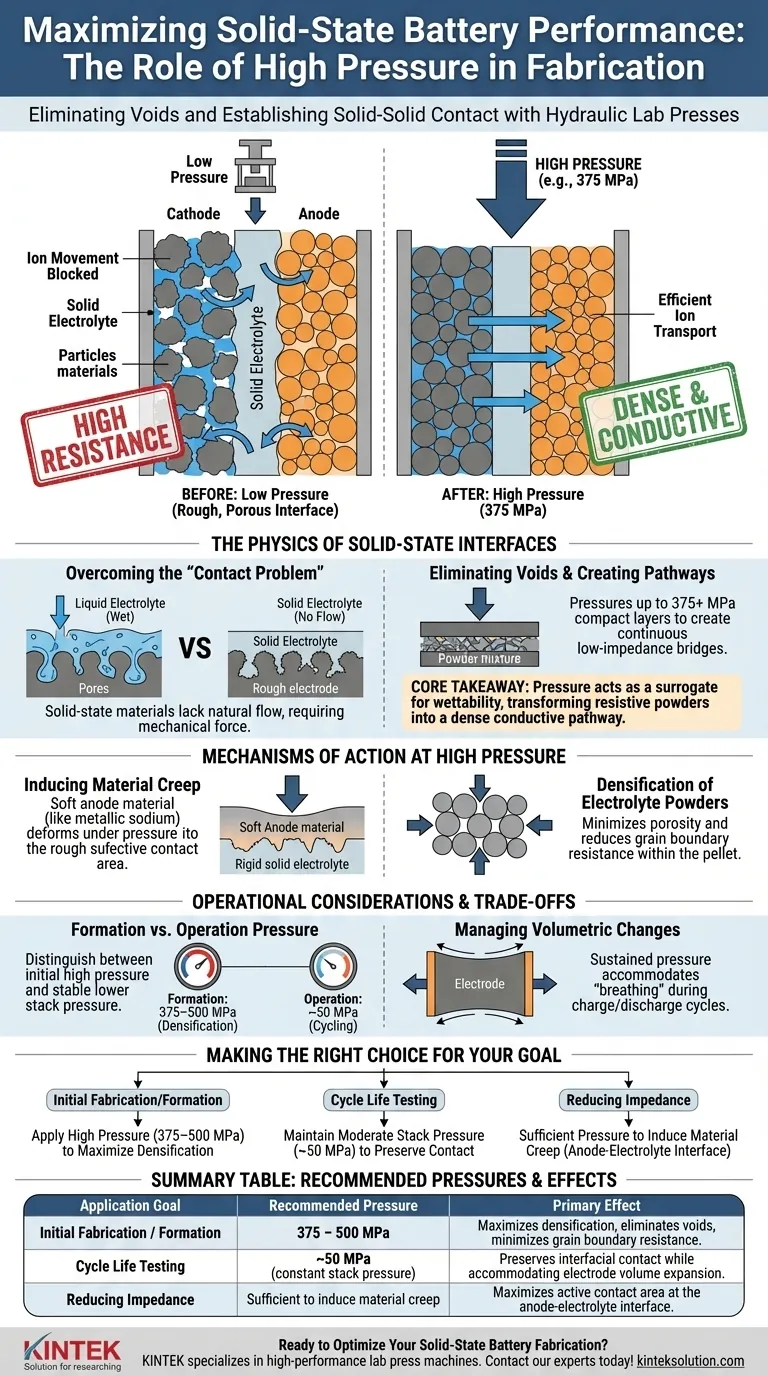
The primary purpose of applying high pressure (such as 375 MPa) with a hydraulic lab press is to eliminate microscopic voids and establish intimate, extensive solid-solid contact between the battery components. Unlike liquid electrolytes that naturally flow into pores, solid-state materials require significant mechanical force to densify powders and minimize the interfacial resistance that otherwise blocks ion movement.
Core Takeaway In solid-state battery fabrication, pressure acts as a surrogate for wettability. By crushing voids and forcing particles to merge, high pressure transforms loose, resistive powders into a dense, conductive pathway essential for efficient ion transport and high-rate performance.
The Physics of Solid-State Interfaces
Overcoming the "Contact Problem"
In conventional batteries, liquid electrolytes easily wet the electrode surfaces, filling every gap. Solid-state batteries lack this mechanism. Without intervention, the interface between the solid electrolyte and the electrode remains rough and porous.
Eliminating Voids
Applying high pressure effectively removes the air pockets and voids that naturally exist between solid particles. References indicate that pressures up to 375 MPa—and even 500 MPa for materials like Li-argyrodite—are necessary to compact these layers effectively.
Creating Continuous Pathways
The ultimate goal of this densification is to create a continuous, low-impedance bridge for ions. If the particles are not physically touching, lithium ions cannot transport across the interface, rendering the battery non-functional.
Mechanisms of Action at High Pressure
Inducing Material Creep
High pressure does more than just push parts together; it deforms them. Pressures in the range of tens to hundreds of megapascals induce creep in softer materials, such as metallic sodium.
This deformation forces the malleable metal to flow into and fill the microscopic irregularities of the rigid solid electrolyte. This maximizes the effective contact area, which is strictly required to lower resistance.
Densification of Electrolyte Powders
For powder-based solid electrolytes, high pressure is required to minimize porosity within the pellet itself. This creates "intimate contact" between individual powder particles, reducing grain boundary resistance. This internal densification is fundamental for achieving high ionic conductivity through the bulk of the material.
Operational Considerations and Trade-offs
Formation vs. Operation Pressure
It is critical to distinguish between the pressure used for formation (densification) and the pressure used during cycling. While 375+ MPa creates the initial structure, maintaining a stable, lower "stack pressure" (e.g., 50 MPa) is often required during operation.
Managing Volumetric Changes
Solid-state electrodes undergo significant volumetric changes (expansion and contraction) during charge and discharge cycles.
A rigid, densified structure creates excellent conductivity but can lose contact if these volume changes are not managed. Sustained external pressure is necessary to accommodate this "breathing" and ensure the durable physical contact required for a long cycle life.
Making the Right Choice for Your Goal
To achieve optimal results with your hydraulic lab press, align your pressure strategy with your specific fabrication stage:
- If your primary focus is Initial Fabrication/Formation: Apply high pressure (375–500 MPa) to maximize densification, eliminate voids, and minimize initial grain boundary resistance.
- If your primary focus is Cycle Life Testing: Maintain a moderate, constant stack pressure (approx. 50 MPa) to preserve interfacial contact while accommodating electrode volume expansion.
- If your primary focus is Reducing Impedance: Ensure your pressure is sufficient to induce creep in your specific anode material, maximizing the active contact area at the interface.
Success in solid-state battery development relies entirely on treating the solid-solid interface as a dynamic boundary that must be mechanically forced into continuity.
Summary Table:
| Application Goal | Recommended Pressure | Primary Effect |
|---|---|---|
| Initial Fabrication / Formation | 375 – 500 MPa | Maximizes densification, eliminates voids, minimizes grain boundary resistance. |
| Cycle Life Testing | ~50 MPa (constant stack pressure) | Preserves interfacial contact while accommodating electrode volume expansion. |
| Reducing Impedance | Sufficient to induce material creep | Maximizes active contact area at the anode-electrolyte interface. |
Ready to Optimize Your Solid-State Battery Fabrication? Achieving the precise pressure required for densification and long-term performance is critical. KINTEK specializes in high-performance lab press machines, including automatic and heated lab presses, designed to meet the exacting demands of solid-state battery research and development.
Our presses deliver the controlled, high-pressure force you need to eliminate voids, create intimate solid-solid contact, and ensure efficient ion transport in your components. Let us help you build a better battery.
Contact our experts today to discuss your specific application requirements!
Visual Guide
References
- Yuju Jeon, Zheng Chen. Lithium diffusion-controlled Li-Al alloy negative electrode for all-solid-state battery. DOI: 10.1038/s41467-025-64386-y
This article is also based on technical information from Kintek Solution Knowledge Base .
Related Products
- 24T 30T 60T Heated Hydraulic Lab Press Machine with Hot Plates for Laboratory
- Laboratory Hydraulic Press 2T Lab Pellet Press for KBR FTIR
- Manual Heated Hydraulic Lab Press with Integrated Hot Plates Hydraulic Press Machine
- Laboratory Hydraulic Press Lab Pellet Press Machine for Glove Box
- Automatic High Temperature Heated Hydraulic Press Machine with Heated Plates for Lab
People Also Ask
- Function of a Laboratory Hydraulic Press with Heated Platens in SSE? Enhance Battery Density & Conductivity
- Why is a laboratory hydraulic press with heating plates required for PLA/TEC films? Achieve Precise Sample Integrity
- What role does a laboratory heated hydraulic press play in LTCC? Essential for High-Density Ceramic Lamination
- Why reduce load when applying composite strengthening tabs? Protect Specimen Integrity and Data Accuracy
- Why is a laboratory heated hydraulic press required? Ensure Precise Vulcanization for NBR/EPDM Nanocomposites



















