
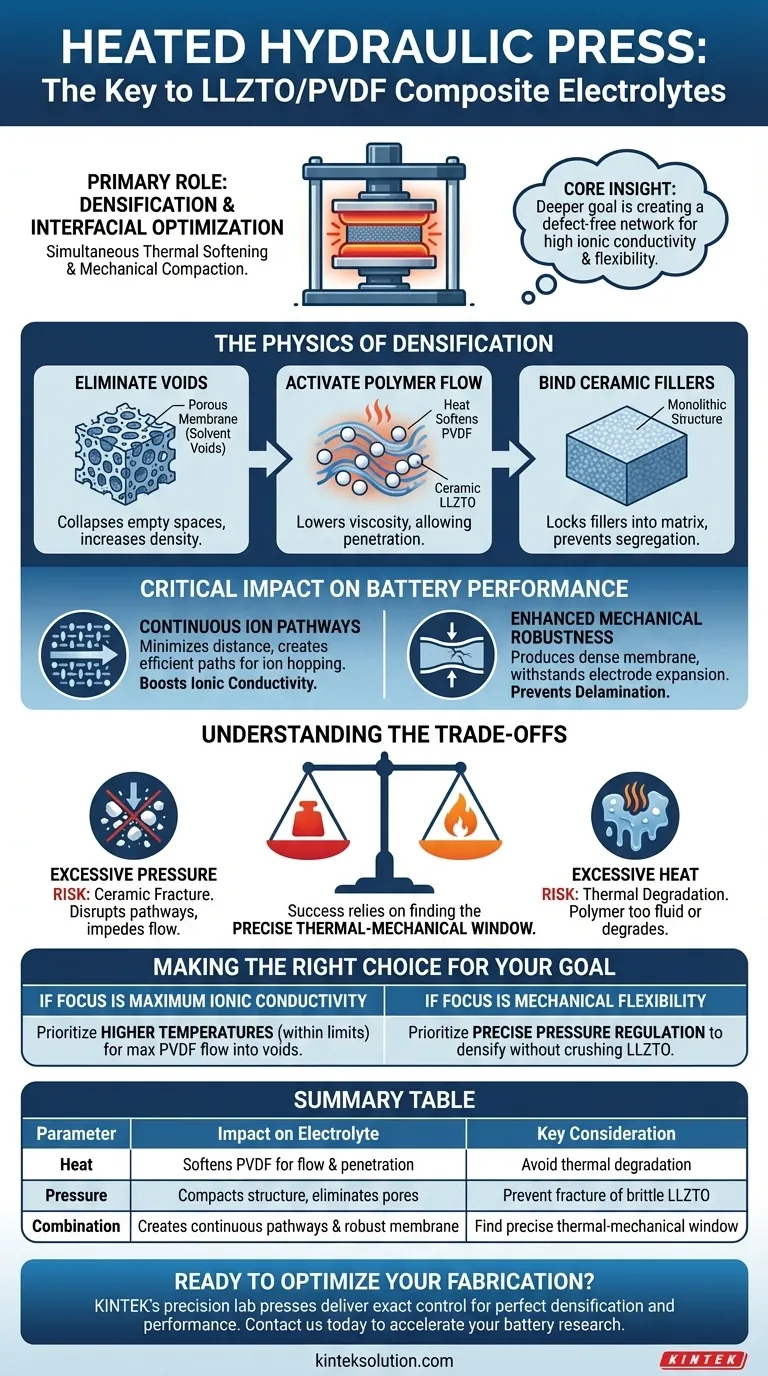
The primary role of a heated hydraulic press in fabricating LLZTO/PVDF composite electrolytes is to achieve densification through simultaneous thermal softening and mechanical compaction. By applying precise heat and pressure, the press eliminates the large structural pores left behind by solvent evaporation. This induces the PVDF polymer to flow and tightly bind the LLZTO ceramic fillers, transforming a loose, porous membrane into a solid, monolithic structure.
The Core Insight While the surface-level function is simple compaction, the deeper engineering goal is interfacial optimization. The heated press forces the polymer matrix to flow into microscopic voids, creating a continuous, defect-free network that is essential for both high ionic conductivity and mechanical flexibility.
The Physics of Densification
Eliminating Solvent-Induced Voids
In the initial stages of fabrication, the evaporation of solvents inevitably leaves behind large pores within the membrane.
If left untreated, these voids act as insulators that block ion transport.
The heated press mechanically collapses these empty spaces, significantly increasing the volume density of the electrolyte.
Activating Polymer Flow
Pressure alone is often insufficient to create a unified composite.
The heat applied by the press softens the PVDF matrix, lowering its viscosity.
This allows the polymer to "flow" rather than just compress, enabling it to penetrate the interstitial spaces between LLZTO particles.
Binding the Ceramic Fillers
The combination of flow and pressure ensures the LLZTO fillers are physically locked into the polymer matrix.
This tight binding prevents the segregation of ceramic particles.
It creates a uniform structure where the ceramic contributes to conductivity and the polymer provides mechanical support.
Critical Impact on Battery Performance
Establishing Continuous Ion Pathways
For a solid-state battery to function, lithium ions must move freely from anode to cathode.
The heated press minimizes the distance between LLZTO particles and the conductive polymer matrix.
This reduction in porosity creates efficient, continuous pathways for ion hopping, directly boosting ionic conductivity.
Enhancing Mechanical Robustness
A porous electrolyte is brittle and prone to cracking under the physical stress of battery cycling.
Hot pressing produces a dense, mechanically robust membrane.
This density provides the flexibility required to withstand electrode expansion and contraction without delaminating.
Understanding the Trade-offs
While hot pressing is essential, improper application leads to critical failures in the electrolyte structure.
The Risk of Ceramic Fracture
Applying excessive pressure can crush the brittle LLZTO ceramic particles.
Fractured particles disrupt the conductive pathways and create new, disconnected interfaces that impede ion flow.
Thermal Degradation
If the temperature is set too high, the PVDF polymer may degrade or become too fluid.
Excessive fluidity can cause the polymer to squeeze out of the mold entirely, altering the ratio of ceramic to polymer and ruining the composite's stoichiometry.
Anisotropy Issues
Uniaxial pressure (pressure from one direction) can sometimes lead to anisotropic properties.
This means the electrolyte might conduct ions well in one direction but poorly in another if the particles align strictly perpendicular to the force.
Making the Right Choice for Your Goal
To maximize the effectiveness of your heated hydraulic press, align your parameters with your specific performance targets.
- If your primary focus is Maximum Ionic Conductivity: Prioritize higher temperatures (within the polymer's safety limit) to ensure maximum flow of the PVDF into every microscopic void, reducing resistance at the particle boundaries.
- If your primary focus is Mechanical Flexibility: Prioritize precise pressure regulation to densify the membrane without crushing the LLZTO particles, preserving the structural integrity of the ceramic filler.
Success in solid-state electrolyte fabrication relies not just on applying force, but on finding the precise thermal-mechanical window where the polymer flows without degrading and the ceramic compacts without fracturing.
Summary Table:
| Parameter | Impact on Electrolyte | Key Consideration |
|---|---|---|
| Heat | Softens PVDF for flow and void penetration | Avoid thermal degradation of polymer |
| Pressure | Compacts structure and eliminates pores | Prevent fracture of brittle LLZTO particles |
| Combination | Creates continuous ion pathways and robust membrane | Find the precise thermal-mechanical window |
Ready to optimize your solid-state electrolyte fabrication?
KINTEK's precision lab presses, including our automatic and heated hydraulic models, are engineered to deliver the exact thermal and mechanical control required to fabricate high-performance LLZTO/PVDF composites. Achieve perfect densification, maximize ionic conductivity, and ensure mechanical flexibility without risking ceramic fracture or polymer degradation.
Contact us today using the form below to discuss how our expertise and equipment can accelerate your battery research and development. Let's find the perfect press for your lab's needs.
Visual Guide
Related Products
- Heated Hydraulic Press Machine with Heated Plates for Vacuum Box Laboratory Hot Press
- Automatic High Temperature Heated Hydraulic Press Machine with Heated Plates for Lab
- Heated Hydraulic Press Machine With Heated Plates For Vacuum Box Laboratory Hot Press
- 24T 30T 60T Heated Hydraulic Lab Press Machine with Hot Plates for Laboratory
- Automatic Heated Hydraulic Press Machine with Hot Plates for Laboratory
People Also Ask
- What are the requirements for electrode pressing with high-viscosity ionic liquids like EMIM TFSI? Optimize Performance
- How does a laboratory heated hydraulic press facilitate PBN sample prep for WAXS? Achieve Precise X-Ray Scattering
- What are the industrial applications of heated hydraulic presses? Master Heat & Force for Precision Manufacturing
- Function of a Laboratory Hydraulic Press with Heated Platens in SSE? Enhance Battery Density & Conductivity
- How are heated hydraulic presses utilized in the preparation of thin films? Key Mechanisms and Applications



















