
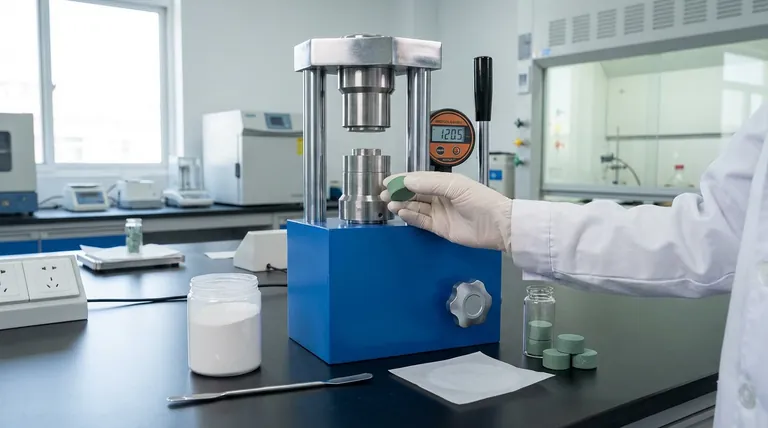
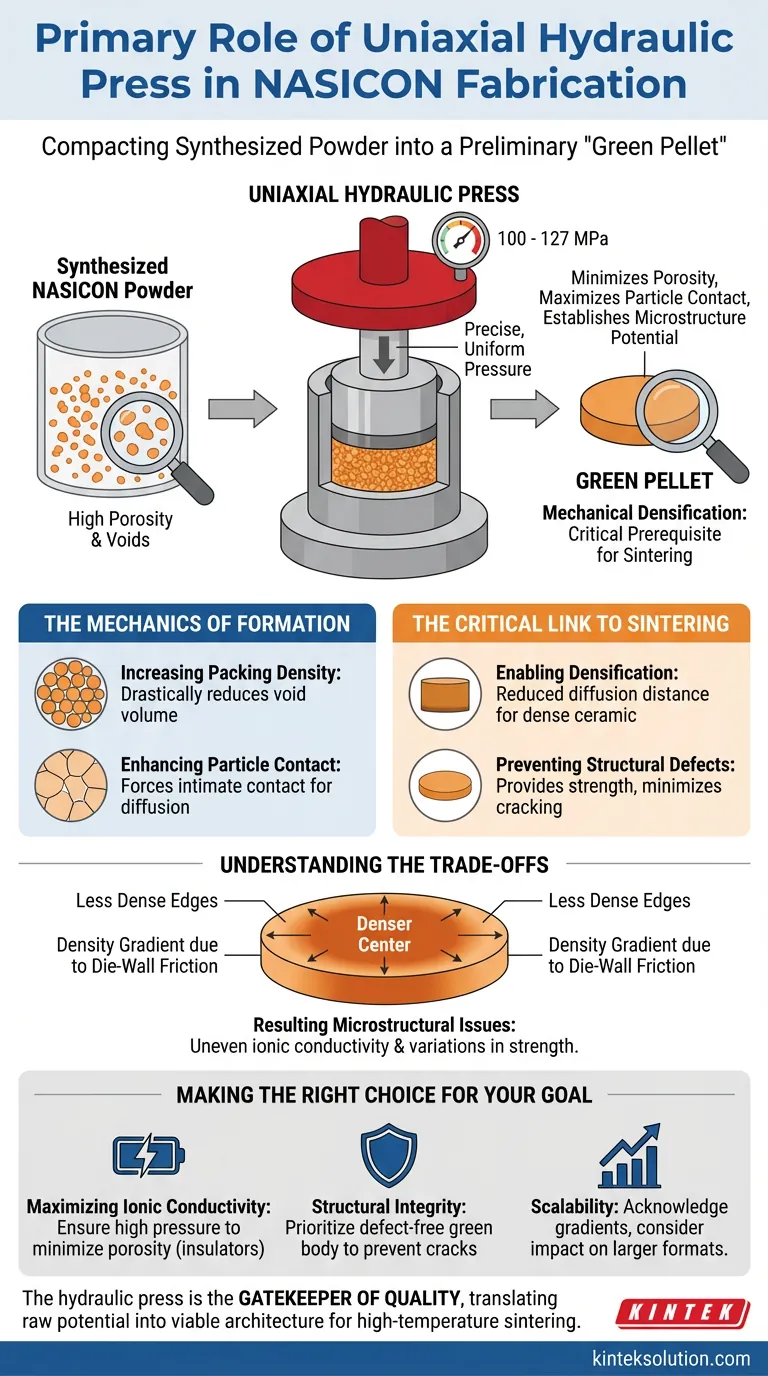
The primary role of a uniaxial hydraulic press in NASICON fabrication is to compact loose, synthesized powder into a preliminary solid form known as a "green pellet."
By applying precise, uniform pressure (often ranging from 100 to 127 MPa), the press forces raw particles into intimate contact and significantly reduces void space. This mechanical densification is the critical prerequisite for the subsequent sintering stage, ensuring the final ceramic electrolyte achieves high ionic conductivity and structural integrity.
Core Takeaway The hydraulic press does not merely shape the material; it establishes the microstructure's potential. By maximizing particle contact in the "green" state, the press minimizes porosity and creates the physical conditions necessary for successful solid-state reactions and densification during high-temperature sintering.
The Mechanics of Green Pellet Formation
The transformation from loose powder to a solid electrolyte relies on the physical rearrangement of particles. The uniaxial press acts as the primary tool to bridge the gap between synthesis and final densification.
Increasing Packing Density
The immediate function of the press is to apply significant force to the powder within a die. This pressure collapses the loose arrangement of the powder, drastically reducing the volume of voids between particles.
Enhancing Particle Contact
For solid-state reactions to occur effectively, reagents must physically touch. The press forces particles into close proximity, increasing the contact area between grain boundaries. This "intimate contact" is a fundamental requirement for the diffusion processes that drive densification.
The Critical Link to Sintering Success
The quality of the final NASICON ceramic is largely predetermined by the quality of the green pellet produced by the hydraulic press.
Enabling Densification
High-temperature sintering cannot easily close large pores left by poor compaction. A high-density green body reduces the distance atoms must diffuse, facilitating the formation of a dense, low-porosity ceramic. This directly correlates to higher ionic conductivity in the final product.
Preventing Structural Defects
A well-formed green pellet possesses the necessary mechanical strength to withstand handling and thermal stress. Proper compaction minimizes the risk of macroscopic defects, such as cracking or deformation, which can occur as the material shrinks during sintering.
Understanding the Trade-offs
While uniaxial pressing is a standard technique, it introduces specific physical limitations that can affect the uniformity of the electrolyte.
The Density Gradient Challenge
Friction inevitably occurs between the powder and the inner walls of the mold during pressing. This friction resists the transmission of pressure, preventing it from distributing perfectly evenly throughout the powder bed.
Resulting Microstructural Issues
Consequently, uniaxial pressed pellets often exhibit a density gradient, where the center of the pellet is denser than the edges. This uneven microstructure can lead to variations in ionic conductivity across the pellet and compromise its overall mechanical strength, representing a potential bottleneck for large-scale consistency.
Making the Right Choice for Your Goal
The hydraulic press is a precision instrument that dictates the baseline quality of your solid-state electrolyte.
- If your primary focus is maximizing Ionic Conductivity: Ensure your pressing pressure is high enough (e.g., >100 MPa) to minimize internal porosity, as voids act as insulators against ion flow.
- If your primary focus is Structural Integrity: Prioritize the creation of a defect-free green body to prevent the propagation of cracks during the high-stress sintering phase.
- If your primary focus is Scalability: Acknowledge the density gradients inherent in uniaxial pressing and consider how edge-to-center variations might impact larger cell formats.
Ultimately, the uniaxial press serves as the gatekeeper of quality, translating raw chemical potential into a physically viable architecture ready for sintering.
Summary Table:
| Role | Key Function | Impact on Final Pellet |
|---|---|---|
| Particle Densification | Applies high pressure (100-127 MPa) to reduce void space. | Minimizes porosity, enabling effective sintering. |
| Enhancing Particle Contact | Forces particles into intimate contact. | Facilitates solid-state reactions and diffusion. |
| Preventing Defects | Creates a mechanically stable green body. | Reduces risk of cracking during sintering. |
| Inherent Limitation | Can create density gradients due to die-wall friction. | May cause variations in ionic conductivity. |
Ready to achieve superior densification for your solid-state electrolyte research? KINTEK specializes in precision lab press machines, including automatic and heated lab presses, designed to deliver the uniform, high-pressure compaction essential for fabricating high-performance NASICON pellets. Our expertise ensures your lab can produce defect-free green bodies with minimal porosity, setting the stage for successful sintering and optimal ionic conductivity. Contact our experts today to find the perfect press for your laboratory's needs!
Visual Guide
Related Products
- Automatic Laboratory Hydraulic Press for XRF and KBR Pellet Pressing
- Automatic Laboratory Hydraulic Press Lab Pellet Press Machine
- Manual Laboratory Hydraulic Pellet Press Lab Hydraulic Press
- Manual Laboratory Hydraulic Press Lab Pellet Press
- Laboratory Hydraulic Press Lab Pellet Press Machine for Glove Box
People Also Ask
- Why is pressing powder into a pellet critical before sintering? Ensure Dense, Conductive Solid-State Electrolytes
- What is the role of a laboratory pressure machine and KBr in FTIR? Master Sample Preparation for Flame Retardants
- What are the advantages of using a laboratory automatic hydraulic press for HEA green compact forming?
- What are the advantages of using a lab automatic hydraulic press for HEA green body molding? Ensure Material Integrity
- How does an automatic laboratory hydraulic press improve KBr pellet preparation? Achieve Precision IR Spectroscopy



















