
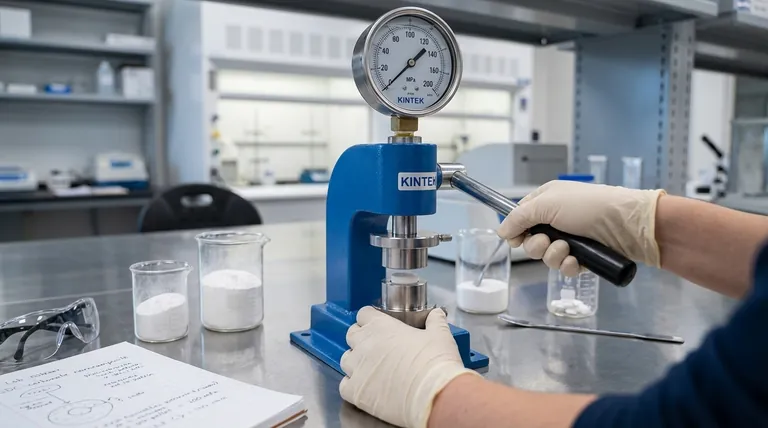
The primary purpose of applying 200 MPa of pressure is to transform loose SDC-carbonate nanocomposite powder into a cohesive "green pellet" with sufficient mechanical integrity. This cold-pressing step forces the rearrangement of particles to increase their contact area, creating the necessary physical foundation for the subsequent high-temperature sintering and densification phases.
The Core Insight Compacting SDC-carbonate powder at 200 MPa is a critical "shaping" step that creates a handleable structure and establishes particle-to-particle contact. However, this pressure alone is a preparatory measure; it establishes the geometry and initial density but relies entirely on subsequent thermal processing to achieve the final ceramic properties.
The Role of Mechanical Compaction
The application of 200 MPa via a uniaxial hydraulic press serves three distinct physical functions required to transition from a raw powder to a functional electrolyte.
Establishing Green Strength
The most immediate goal is the creation of a "green body." Loose nanocomposite powders have no structural integrity and cannot be handled or moved into a furnace.
Applying 200 MPa interlocks the powder granules mechanically. This results in a pellet that holds its shape and is strong enough to withstand transfer to sintering equipment without crumbling.
Reducing Interstitial Voids
Before pressure is applied, the "air gap" or void space between individual powder particles is significant. These gaps act as barriers to both densification and ionic transport.
The hydraulic press minimizes these interstitial voids. By forcing particles closer together, you significantly increase the "tightness" of the packing, ensuring that the volume of the pellet is dominated by material rather than air.
Enabling Diffusion Pathways
For an electrolyte to function, ions must be able to move through the material. This requires continuous pathways.
High-pressure compaction increases the number of physical contact points between particles. These contact points are the bridges across which material migration occurs during sintering. Without this intimate contact, the material would not densify correctly when heated.
Understanding the Trade-offs
While applying 200 MPa is the conventional standard for preparing these electrolytes, it is vital to understand the inherent limitations of this specific method as highlighted in your references.
The Density Ceiling
Cold-pressing at 200 MPa is effective for shaping, but it is rarely sufficient to fully densify SDC-carbonate materials on its own.
References indicate that this method typically results in a relative density of less than 75% after sintering. This means that despite the high pressure, significant microscopic porosity often remains in the final product.
The Limits of Pore Elimination
While the press reduces voids, it does not eliminate them entirely. The "green pellet" still contains trapped air and spacing defects.
If the subsequent sintering process is not perfectly optimized, these remaining pores will persist. In an electrolyte, residual porosity interrupts ion transport pathways and lowers the overall conductivity of the ceramic.
Making the Right Choice for Your Goal
The application of 200 MPa is a balancing act between mechanical stability and material performance. Here is how to view this step based on your specific objectives:
- If your primary focus is Structural Integrity: The 200 MPa standard is essential for creating a robust green pellet that can be handled easily without inducing micro-cracks before sintering.
- If your primary focus is High Ionic Conductivity: Recognize that 200 MPa is only the starting point; you must rely heavily on optimized sintering temperatures to overcome the <75% density limitation inherent in this cold-pressing method.
Ultimately, the 200 MPa press is the architectural step that defines the pellet's shape, but the heat treatment is what defines its performance.
Summary Table:
| Purpose of 200 MPa Pressure | Key Outcome |
|---|---|
| Establish Green Strength | Creates a cohesive, handleable pellet for transfer to sintering furnace. |
| Reduce Interstitial Voids | Increases particle packing density, minimizing air gaps. |
| Enable Diffusion Pathways | Creates particle contact points essential for material migration during sintering. |
| Limitation | Typically results in <75% relative density after sintering, requiring optimized thermal processing. |
Achieve superior pellet density and performance with KINTEK's precision lab presses.
The initial compaction step is critical for the success of your ceramic electrolyte research. KINTEK specializes in hydraulic lab presses, including automatic and heated models, designed to deliver the precise, repeatable pressure your SDC-carbonate powder requires to form optimal green bodies.
Let our expertise in laboratory pressing solutions help you establish the perfect foundation for your sintering process. Contact our experts today to discuss how our presses can enhance your lab's capabilities and material outcomes.
Visual Guide

Related Products
- Automatic Laboratory Hydraulic Press for XRF and KBR Pellet Pressing
- Laboratory Hydraulic Press 2T Lab Pellet Press for KBR FTIR
- Split Automatic Heated Hydraulic Press Machine with Heated Plates
- Automatic Laboratory Hydraulic Press Lab Pellet Press Machine
- Automatic Heated Hydraulic Press Machine with Heated Plates for Laboratory
People Also Ask
- Why is pressing powder into a pellet critical before sintering? Ensure Dense, Conductive Solid-State Electrolytes
- What is the role of a laboratory pressure machine and KBr in FTIR? Master Sample Preparation for Flame Retardants
- What are the advantages of using a laboratory automatic hydraulic press for HEA green compact forming?
- What are the advantages of using a lab automatic hydraulic press for HEA green body molding? Ensure Material Integrity
- How does an automatic laboratory hydraulic press improve KBr pellet preparation? Achieve Precision IR Spectroscopy



















