
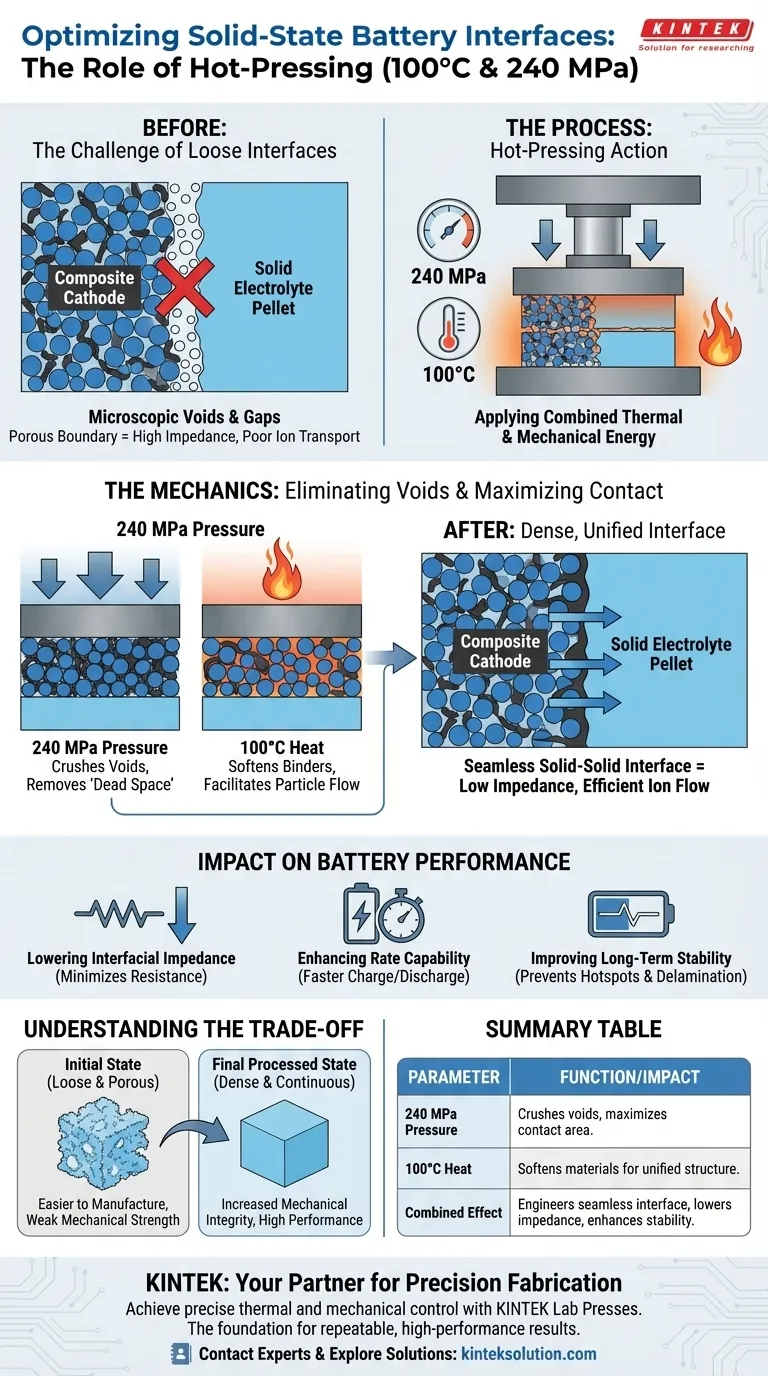
The primary purpose of applying an additional hot-pressing step at 100°C and 240 MPa is to engineer an intimate, seamless solid-solid interface between the composite cathode and the solid electrolyte pellet. This specific combination of thermal and mechanical energy is required to eliminate microscopic voids and gaps that naturally occur when stacking rigid solid components.
Core Takeaway In all-solid-state batteries, mere physical contact between layers is insufficient for efficient ion transport. Hot-pressing transforms the interface from a loose, porous boundary into a dense, unified structure, drastically reducing interfacial impedance and enabling high battery performance.
The Mechanics of Interface Engineering
Eliminating Voids and Gaps
When a composite cathode is placed against a solid electrolyte pellet, the surface roughness of both materials creates microscopic air pockets.
At a pressure of 240 MPa, the process forces the materials together with sufficient energy to crush these voids. This ensures that the solid particles physically touch, removing the "dead space" that blocks ionic movement.
Maximizing Effective Contact Area
The elimination of gaps directly translates to a maximized effective contact area.
In liquid batteries, the electrolyte wets the surface, filling gaps automatically. In solid-state systems, you must mechanically force this contact to create continuous pathways for ion transport.
The Role of Thermal Activation
Applying 100°C heat during this compression is not arbitrary; it serves a crucial rheological function.
Heat softens the polymer binders or the electrolyte matrix within the composite structure. This softening facilitates particle rearrangement and flow, allowing the materials to deform and fill the interstitial spaces that pressure alone might not resolve.
Impact on Battery Performance
Lowering Interfacial Impedance
The most critical outcome of this process is a significant reduction in interfacial impedance.
High impedance acts as a bottleneck for energy flow. by creating a seamless interface, you minimize the resistance ions face when crossing from the cathode to the electrolyte.
Enhancing Stability and Rate Capability
A high-quality interface directly improves the battery's operational metrics.
Lower resistance allows the battery to charge and discharge faster (rate capability). Furthermore, the elimination of voids prevents the formation of hotspots or uneven current distribution, leading to better long-term cycling stability.
Understanding the Trade-offs
Porosity vs. Density
There is a distinct trade-off between the initial state of the material and its final processed state.
Without this hot-pressing step, the coated structure remains loose and porous. While easier to manufacture, a porous structure lacks the mechanical strength and ionic pathways required for a functional battery.
Mechanical Integrity
The process transforms the components into a dense, continuous whole.
This increases the mechanical strength of the assembly, ensuring the battery can withstand the physical stresses of operation without delaminating. However, achieving this requires precise control of the equipment to ensure the pressure is applied uniformly.
Making the Right Choice for Your Goal
When designing your fabrication protocol, the parameters of the hot-pressing step largely dictate your cell's final characteristics.
- If your primary focus is Rate Capability: Prioritize high pressure (240 MPa) to maximize the effective contact area and minimize the distance ions must travel.
- If your primary focus is Mechanical Stability: Ensure precise thermal control (100°C) to soften the binder sufficiently, creating a unified, non-porous pellet that resists separation.
Ultimately, the hot-pressing step is the bridge that turns separate components into a single, cohesive electrochemical device.
Summary Table:
| Parameter | Function | Impact on Battery |
|---|---|---|
| 240 MPa Pressure | Crushes microscopic voids and gaps between materials. | Maximizes contact area for efficient ion transport. |
| 100°C Heat | Softens binders/electrolyte to facilitate particle flow. | Creates a dense, unified structure for mechanical stability. |
| Combined Effect | Engineers an intimate, seamless solid-solid interface. | Drastically lowers interfacial impedance, enhancing rate capability and cycling stability. |
Ready to Engineer Superior Battery Interfaces?
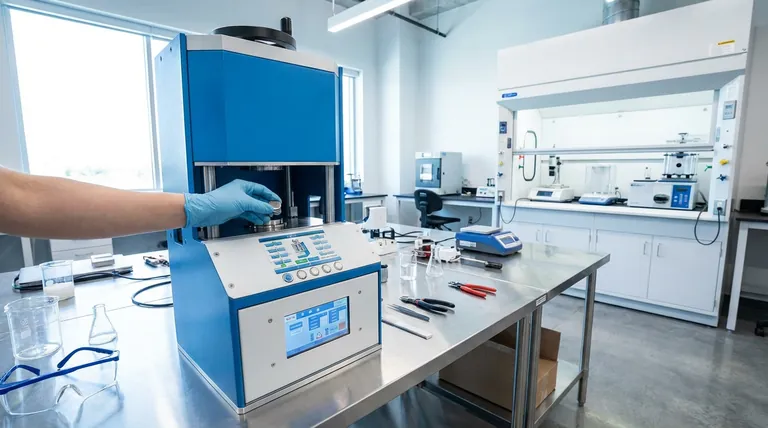
Achieving the precise thermal and mechanical control required for advanced all-solid-state battery research is critical. The right lab press equipment is not just a tool—it's the foundation for repeatable, high-performance results.
KINTEK specializes in lab press machines (including automatic, isostatic, and heated lab presses) designed to meet the exacting demands of laboratory-scale battery fabrication. Our equipment delivers the uniform pressure and precise temperature control you need to replicate the 100°C and 240 MPa conditions essential for creating seamless, high-performance solid-state interfaces.
Let us help you bridge the gap between your materials and your goals.
Contact our experts today to discuss how our lab press solutions can enhance your battery development process.
Visual Guide
Related Products
- Automatic High Temperature Heated Hydraulic Press Machine with Heated Plates for Lab
- Heated Hydraulic Press Machine with Heated Plates for Vacuum Box Laboratory Hot Press
- Automatic Heated Hydraulic Press Machine with Hot Plates for Laboratory
- Heated Hydraulic Press Machine With Heated Plates For Vacuum Box Laboratory Hot Press
- Laboratory Manual Heated Hydraulic Press Machine with Hot Plates
People Also Ask
- Function of a Laboratory Hydraulic Press with Heated Platens in SSE? Enhance Battery Density & Conductivity
- What are the requirements for electrode pressing with high-viscosity ionic liquids like EMIM TFSI? Optimize Performance
- How does a laboratory heated hydraulic press facilitate PBN sample prep for WAXS? Achieve Precise X-Ray Scattering
- What are the industrial applications of heated hydraulic presses? Master Heat & Force for Precision Manufacturing
- Why is a laboratory hydraulic press with heating plates required for PLA/TEC films? Achieve Precise Sample Integrity



















