
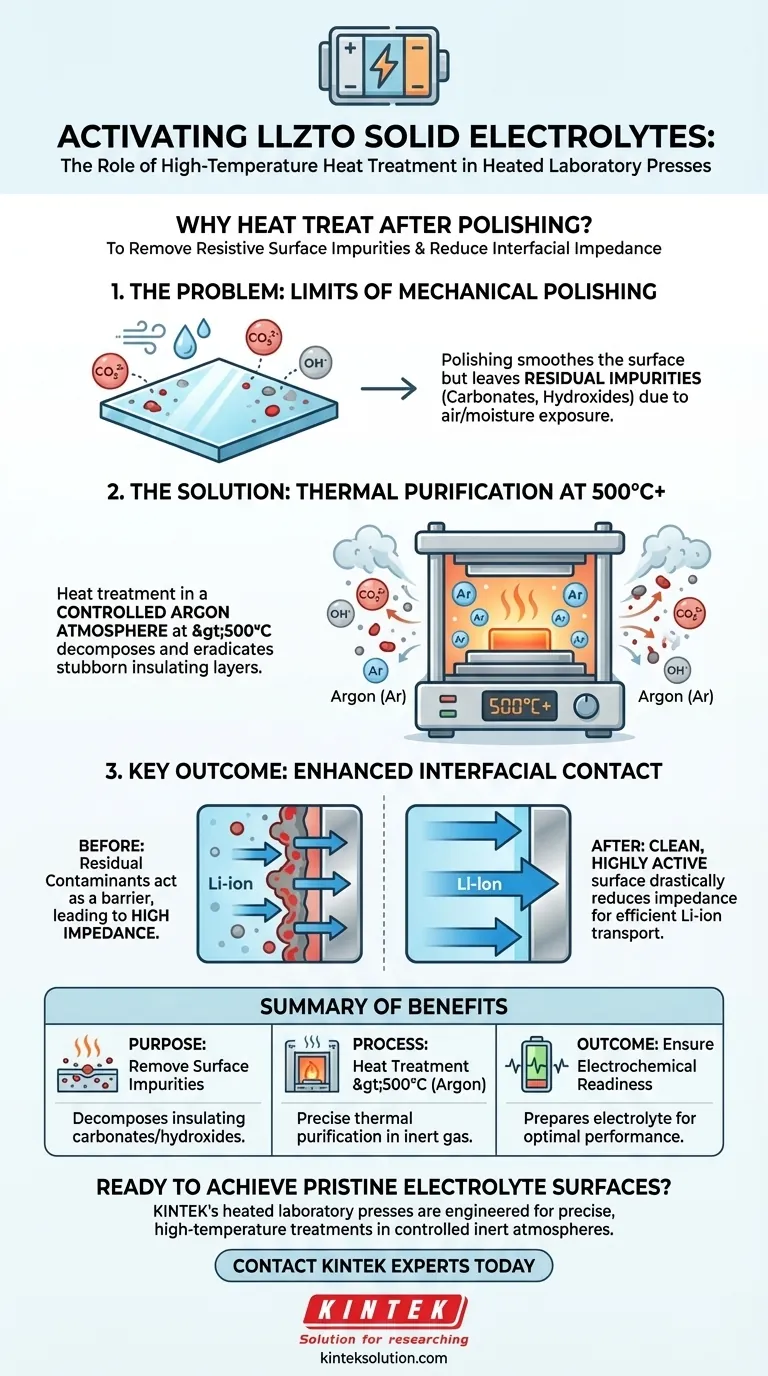
The primary purpose of performing high-temperature heat treatment on LLZTO-type solid electrolytes after polishing is to ensure the complete removal of resistive surface impurities. By subjecting the polished electrolyte to temperatures above 500°C within a controlled environment (such as a heated laboratory press filled with argon), you eliminate residual contaminants that mechanical polishing alone cannot remove.
Core Takeaway Mechanical polishing is necessary for flatness but insufficient for chemical purity; it often leaves behind or exposes the surface to carbonates and hydroxides. High-temperature treatment is the definitive "activation" step that eradicates these insulating layers to drastically reduce interfacial impedance.
Eliminating Surface Contaminants
The Limits of Mechanical Polishing
While mechanical polishing effectively smoothes the electrolyte surface, it does not ensure chemical cleanliness.
In fact, the process often leaves behind residual impurities, specifically carbonates and hydroxides. These compounds can form rapidly when the reactive LLZTO surface is exposed to air or moisture during the polishing process.
Thermal Purification at 500°C+
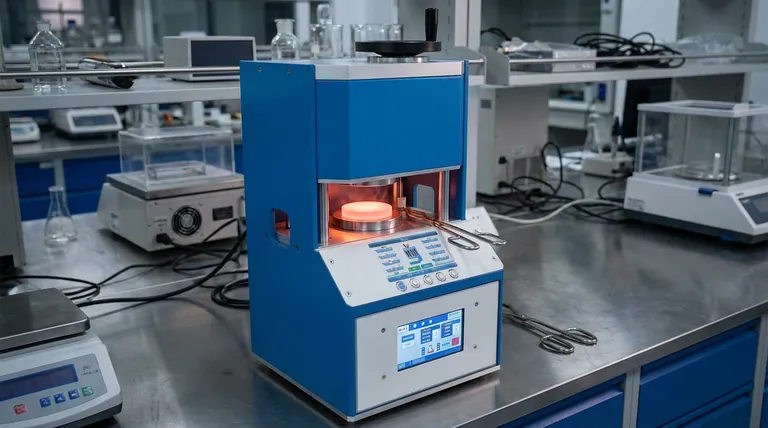
To counteract this, the electrolyte undergoes heat treatment in a heated laboratory press.
This process must occur at temperatures above 500°C. At this thermal threshold, the stubborn carbonate and hydroxide layers decompose and are driven off the surface.
The Role of Controlled Atmosphere
This treatment is rarely performed in ambient air.
The heated press allows for a controlled atmosphere, typically using an inert gas like argon. This prevents new contaminants from forming during the heating process, ensuring the surface remains chemically pure.
Enhancing Interfacial Contact
Creating a Highly Active Surface
The removal of insulating impurities results in a "clean" and highly active electrolyte surface.
This chemical activation is essential for the next stage of battery assembly. A pristine surface interacts much more favorably with the anode material than a contaminated one.
Reducing Interfacial Impedance
The most critical metric improved by this process is interfacial impedance.
When the electrolyte comes into contact with lithium metal, any residual contaminants act as a barrier to ion flow. By removing them, the resistance at the interface drops significantly, enabling efficient lithium ion transport.
Understanding the Trade-offs
Equipment Capability vs. Process Complexity
Using a heated laboratory press for this step offers precision, but it introduces complexity compared to a standard furnace.
You are utilizing a device capable of applying pressure to perform a heat-treatment task. This allows for seamless transitions between processing steps (like subsequent bonding) but requires strict management of the inert gas environment to prevent re-contamination.
Material Stability
While heat removes impurities, one must ensure the temperature does not exceed the stability limit of the specific LLZTO doping formulation.
The goal is surface cleaning, not bulk phase transformation. Therefore, adhering to the 500°C range is a calculated balance between cleaning power and maintaining the material's structural integrity.
Making the Right Choice for Your Goal
To maximize the performance of your solid-state battery cells, apply this treatment based on your specific assembly requirements:
- If your primary focus is lowering resistance: Prioritize this heat treatment immediately before bringing the electrolyte into contact with Lithium metal to ensure minimum impedance.
- If your primary focus is process efficiency: Ensure your heated press is equipped with an integrated argon atmosphere to combine cleaning and subsequent bonding steps without exposing the sample to air.
Ultimately, a polished surface is only physically flat; heat treatment makes it electrochemically ready.
Summary Table:
| Purpose | Key Process | Outcome |
|---|---|---|
| Remove Surface Impurities | Heat treatment >500°C in inert gas (e.g., Argon) | Decomposes and eliminates insulating carbonates/hydroxides left by polishing |
| Enhance Interfacial Contact | Creates a chemically clean, highly active surface | Significantly reduces impedance for efficient lithium-ion transport |
| Ensure Electrochemical Readiness | Final 'activation' step post-polishing | Prepares the electrolyte for optimal performance in solid-state battery assembly |
Ready to Achieve Pristine Electrolyte Surfaces and Lower Impedance?
KINTEK's heated laboratory presses are engineered for precise, high-temperature treatments in a controlled inert atmosphere—exactly the process described for activating LLZTO electrolytes. Our automatic lab presses and isostatic presses provide the reliability and environmental control your laboratory needs to ensure your solid electrolytes are electrochemically ready for peak battery performance.
Let KINTEK be your partner in advanced materials processing. Contact our experts today to discuss how our lab press solutions can enhance your solid-state battery research and development.
Visual Guide
Related Products
- 24T 30T 60T Heated Hydraulic Lab Press Machine with Hot Plates for Laboratory
- Heated Hydraulic Press Machine with Heated Plates for Vacuum Box Laboratory Hot Press
- Laboratory Split Manual Heated Hydraulic Press Machine with Hot Plates
- Automatic Heated Hydraulic Press Machine with Hot Plates for Laboratory
- Automatic Heated Hydraulic Press Machine with Heated Plates for Laboratory
People Also Ask
- Function of a Laboratory Hydraulic Press with Heated Platens in SSE? Enhance Battery Density & Conductivity
- Why is a laboratory hydraulic press with heating plates required for PLA/TEC films? Achieve Precise Sample Integrity
- What role does a laboratory heated hydraulic press play in LTCC? Essential for High-Density Ceramic Lamination
- Why reduce load when applying composite strengthening tabs? Protect Specimen Integrity and Data Accuracy
- Why is a laboratory heated hydraulic press utilized during the lamination stage of NASICON green tapes?



















